
Euroleague Playoff Preview: The Biggest Surprise vs. The Most Expensive Team
100 analysts would have picked Panathinaikos first or second and Valencia - best case - as a late Playoff scratch before the season. The regular season disagreed. The playoffs start over. Valencia must win Game 1 in Athens — or this series ends before it begins.
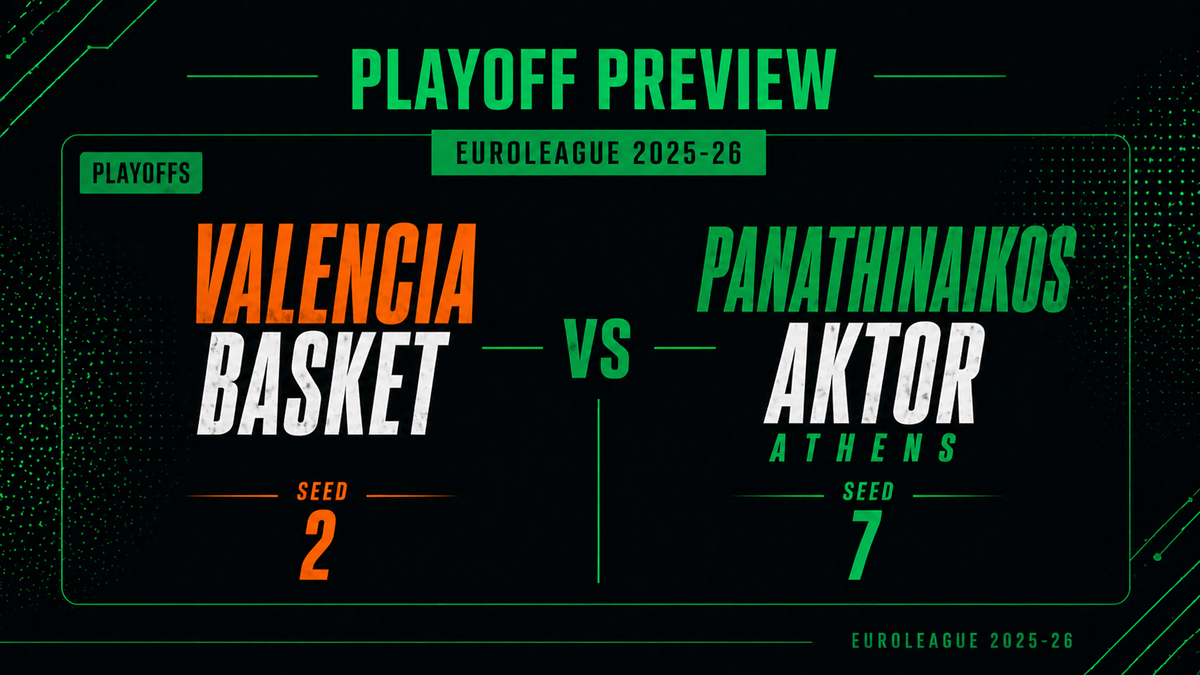
efore the season began, ask any of the 100 EuroLeague analysts which of these two teams would finish second and which would finish seventh — and every single one of them would have given you the same answer. Panathinaikos second. Valencia seventh. And even that would have been considered a remarkable achievement for the Spanish club.
The regular season had other ideas.
Valencia Basket finished 26-12, second in the EuroLeague, the competition's highest-scoring team at 90.9 points per game, and the single greatest positive surprise of the 2025-26 campaign. Panathinaikos — the 2024 EuroLeague champions, the competition's most expensive roster, the club with the deepest historical pedigree in modern European basketball — finished seventh, limped through the Play-In, survived Monaco at home, and arrives in this quarterfinal carrying the weight of an underperforming season and the knowledge that their city, their fans, and their budget expected considerably more.
The regular season, however, is over. The seeding advantage belongs to Valencia — home court in a potential Game 5, should this series reach that point. Everything else belongs to Panathinaikos.
Valencia — More Than the Sum of Its Parts
There is a basketball cliché that gets applied to teams that overperform relative to their individual talent: "they are more than the sum of their parts." Most of the time, it is lazy analysis. For Valencia Basket 2025-26, it is the most accurate single sentence in European basketball.
Jean Montero leads the team at 13.7 points and 4.6 assists per game — a guard with the creation ability to break down half-court defenses and the composure to manage close games. Darius Thompson provides the second ball-handler and perimeter shooting at 9.6 points and 40.8% from three. Nathan Reuvers — 10.8 points on 73.6% from two, 43.9% from three — is the most efficient big man in the competition and the structural foundation of Valencia's offense. Kameron Taylor, Jaime Pradilla, Omari Moore — the rotation goes 10 deep without a meaningful drop in competitive intensity.
What makes Valencia genuinely dangerous is not any single player. It is the system. Completely collective, completely interchangeable, completely resistant to the kind of individual-coverage adjustments that a team like Panathinaikos can apply to a traditional star player. There is no obvious off switch. You cannot put your best defender on the number one option and neutralize the offense because the number one option changes from possession to possession.
The statistics confirm the identity: first in points scored (90.9), second in rebounds (37.7), second in assists (21.0), second in blocks (3.2). Valencia are statistically better than Panathinaikos in almost every offensive category. They have been throughout the entire season.
The defensive vulnerability is real. Valencia allowed 86.3 points per game — 11th in the competition. Against a Panathinaikos offense with Kendrick Nunn, Cedi Osman, and Kostas Sloukas capable of scoring from multiple positions and levels, that defensive rating will be tested. Valencia's defense relies on intensity, communication, and collective effort — the same qualities that have made their offense so effective. Whether those qualities hold against a more individually gifted Panathinaikos roster is the series' central tactical question.
Panathinaikos — Waking Up at the Right Moment
The 2024 EuroLeague champions. The competition's most expensive payroll. The team that has been building toward something all season that never quite arrived — until the Play-In.
Beating Monaco at home in Athens was the inflection point. Not just for the result, but for what it represented: a team that had been inconsistent, fractured at times, unable to find the collective expression of its obvious individual talent — finally clicking. The OAKA arena, frantic with green, was both the catalyst and the evidence. Panathinaikos, when they play at that level of intensity in front of that crowd, is a different team from the one that lost games it should not have lost throughout the regular season.
Kendrick Nunn is the offensive engine — 18.6 points per game, 57.6% from two, 37.9% from three, 16.7 PIR. He is the kind of guard who makes everything around him easier: he draws defensive attention on drives, his pull-up from mid-range is reliable, and his willingness to take the late-game shot removes the decision from everyone else. Against Valencia's collective defense, Nunn's individual creation becomes the series' most important individual factor.
Cedi Osman provides the secondary scoring and the veteran experience — 12.9 points, 3.2 assists, 12.4 PIR. His range as a scorer — capable from three, capable in the mid-range, capable as a cutter — makes him genuinely difficult to guard cleanly in the context of Panathinaikos's offense. Juancho Hernangomez brings size and shooting at 8.2 points on 35% from three, a pick-and-pop option that Valencia's defensive system will need to account for. Kostas Sloukas — despite a season of inconsistency — remains one of European basketball's most experienced point guards, capable of managing tempo and making the right read in pressure moments.
The defensive numbers are actually encouraging for Panathinaikos: 84.8 points allowed per game, eighth in the competition, with the best steals differential in the league at minus-1.3 turnovers generated per game. Panathinaikos's athleticism — TJ Shorts, Jerian Grant, and Osman all capable of applying full-court pressure — creates turnovers that Valencia's ball-movement-dependent offense may not fully anticipate.
The Tactical Battle
Valencia needs to win Game 1. This is not a preference — it is a structural imperative.
If Panathinaikos takes Game 1 in Athens, the series momentum shifts immediately and dramatically. An already-fragile Valencia road record (their away form has been noticeably weaker than their home dominance) combined with facing Panathinaikos with the crowd behind them and the series lead in hand creates a scenario where the quarterfinal ends in three or four games rather than five. The psychological advantage of winning Game 1, for a team built on collective belief rather than individual superstar confidence, is enormous.
Valencia must establish their offensive system from the opening tip — the ball movement, the screening, the pace that makes their offense so difficult to defend — before Panathinaikos can calibrate their defensive adjustments. Games 1 and 2 are in Athens. Valencia cannot afford to lose both.
The Athens crowd is Panathinaikos's greatest asset. The OAKA arena at full intensity — 15,000 people, green smoke, the kind of noise that physically affects visiting teams — transforms Panathinaikos from a talented but inconsistent team into something genuinely formidable. Valencia, for all their collective quality, has never played in that environment. The systemic courage required to execute the ball movement, to keep shooting from range, to maintain composure when every Valencia turnover becomes a fast break met with an eruption of noise — that is not something training camp prepares you for.
For Panathinaikos, the key is Nunn. If Nunn is engaged and efficient in Games 1 and 2, Panathinaikos wins both and the series is effectively over. If Valencia can disrupt his rhythm — with trapping, with physicality, with changing defensive coverages — and force Panathinaikos into half-court possessions that rely on shot creation from Sloukas and Shorts, the series becomes considerably more competitive.
The Prediction
Panathinaikos 3-1.
This is my upset pick of the quarterfinals, and I am standing by it.
The regular season told one story. The playoffs tell another. Valencia's achievement in finishing second is genuine, documented, and impressive. But Panathinaikos — with Nunn as their first option, with the Athens crowd as their sixth player, with the championship experience of 2024 still present in the locker room — is the better team for a best-of-five postseason series.
Valencia will steal one game. Probably at home in Spain, in a building where their system operates at its most efficient. That game will be spectacular — the kind of Valencia performance that reminds the EuroLeague why this club has been the season's most compelling story.
But Game 1 and Game 2 in Athens, with Panathinaikos finally playing to their level, close this series before it fully opens.
Valencia must win Game 1. If they don't, darkness falls quickly. And Panathinaikos, waking up at exactly the right moment, will not give them the second chance they need.