
Euroleague Playoff Preview: The Defending Champions Against One Of The League's Best Overachievers.
Zalgiris: top-6 PIR in the EuroLeague, one of the smallest budgets in the competition. Fenerbahce: defending champions, fourth place, Jasikevicius dissatisfied. On paper the closest series. In reality: the most honest story of the playoffs - with Turkish and Lithuanian Basketball Fire
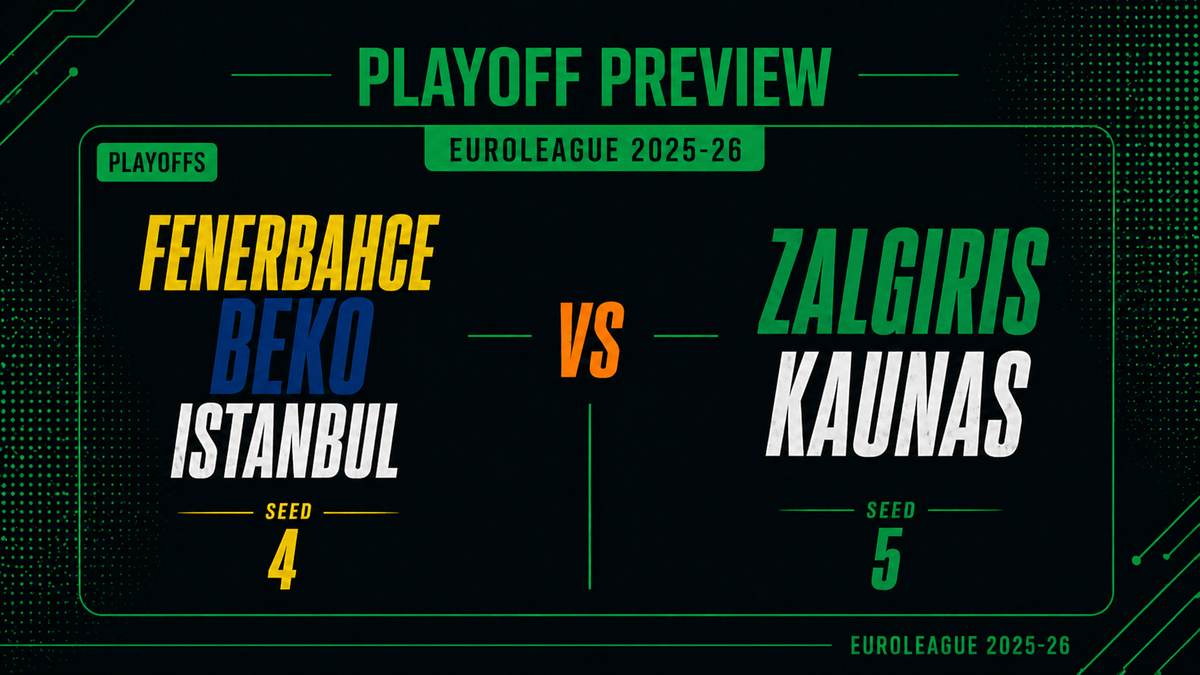
Zalgiris Kaunas finished the EuroLeague regular season with a 99.2 PIR — sixth in the competition — on one of the smallest budgets in the league. Fenerbahce Beko Istanbul finished fourth with an 86.4 PIR and the most expensive roster they have assembled in years. Those two numbers, side by side, tell you everything about why this series is more complicated than the seeding suggests — and why Saras Jasikevicius spent the final weeks of the regular season visibly dissatisfied with his own team.
The fourth-versus-fifth matchup is supposed to be the quarterfinal coin flip, the series where talent differentials are smallest and anything can happen. Dismiss that framing immediately. Fenerbahce are the defending EuroLeague champions. Zalgiris are a mid-budget Lithuanian club that has no business being this dangerous in April. The gap between these rosters is real. The gap between their trajectories into this series tells a different story.
Fener underperformed their own standards down the final stretch. Zalgiris overperformed everyone's expectations across the entire season. One team arrives with something to prove. The other arrives with nothing to lose.
Zalgiris — The Most Honest Team in Europe
The statistics Zalgiris produced this season should not exist for a club with their financial constraints. 87.6 points per game — tenth in the EuroLeague. 39.8% from three — first in the competition. 19.4 assists per game — sixth. A team PIR of 99.2, sixth in Europe, produced by a roster assembled on a fraction of what Istanbul's clubs spend. This is not overachievement through luck or schedule. This is an identity, executed with remarkable consistency.
Sylvain Francisco is the reason. The 28-year-old guard leads Zalgiris in PIR at 19.5 and assists at 6.4 per game, and represents the clearest example in this EuroLeague season of a player arriving — fully, irreversibly — at the elite level of European basketball. Francisco does not merely run the offense. He sets its tempo, its ambition, and its ceiling. In transition, he is as dangerous as any guard in the competition. In the half-court, he creates advantages that a team with Zalgiris's offensive firepower then converts at a 39.8% clip from three.
Moses Wright anchors the front line at 6.6 rebounds per game, while Laurynas Birutis shoots 69.1% from two — the kind of interior efficiency that punishes any defense that collapses too aggressively on perimeter shooters. Arnas Butkevicius, at 54.3% from three, is one of the most dangerous spot-up threats in the competition. Deividas Sirvydis, Edgaras Ulanovas, and Kajus Mikalauskas extend the rotation with the kind of collective depth that makes Zalgiris genuinely difficult to scout for any single game.
The defensive numbers are equally coherent: 82.8 points allowed per game — second in the EuroLeague. Only Fenerbahce, at 80.6, is better. Zalgiris limit turnovers better than almost anyone in the competition, commit 11.4 per game — fourth-fewest — while their opponents commit 17.5. That turnover differential is not a coincidence. It is a direct product of Tomas Masiulis's system: disciplined, positionally sound, collectively committed.
This team has earned everything it has.
Fenerbahce — A Champion Playing Below Themselves, and a Coach Who Knows It
The defending EuroLeague champion finished fourth. On 81.9 points per game — fifteenth in the competition. With a team PIR of 86.4 — seventeenth.
Those numbers require explanation, because Fenerbahce's roster does not produce them by accident. Wade Baldwin IV leads the team at 16.4 PIR and 5.5 assists per game. Talen Horton-Tucker scores 15.9 points — the team's leading scorer on a roster constructed to contend for the title. Nicolo Melli leads in rebounds at 5.7. The individual quality is not the problem. The collective expression of it, down the stretch, has been.
Saras Jasikevicius runs one of the most tactically demanding systems in European basketball. His playbook is not merely large — it is genuinely exhausting to master. Every player is expected to know every set play, every exit option, every coverage rotation, and to execute the correct read in real time under playoff pressure. The standard he demands is that of a former elite point guard who saw the game at a speed most players cannot match — and he has never fully lowered that expectation for anyone on his roster. When Fenerbahce are executing at their peak, the system is beautiful and nearly impossible to defend. When they are not, the complexity becomes friction.
The final stretch of the regular season was friction. No significant injuries. No obvious structural excuse. The team was sluggish, the offense predictably patterned, the defensive intensity — which had placed them first in points allowed at 80.6 per game — holding, but not dominating. Jasikevicius does not accept this quietly. His teams are slow starters as a matter of institutional identity — the system takes time, the reads take repetition, the collective understanding builds across a season rather than in its opening months. But finishing fourth while defending the title, with this roster, is not the trajectory he planned.
The talent is here. Horton-Tucker and Baldwin have the individual creation to win possessions against any defense in Europe. The front line — Khem Birch at 60.8% from two, Armando Bacot Jr., Chris Silva — provides the interior presence to punish small lineups. Tarik Biberovic, at 95.1% from the free-throw line, is the most reliable pressure performer on the roster.
Fenerbahce will be better in April than they were in March. They always are.
The Tactical Question — Can Zalgiris Make This Five Games?
The series turns on one structural tension: Fenerbahce's defensive discipline against Zalgiris's three-point volume.
Zalgiris led the EuroLeague in three-point percentage at 39.8%. Fenerbahce held opponents to 32.1% from three — first in the competition by a significant margin. Something has to give. If Fener's perimeter defense translates from the regular season into this series — contesting Francisco's creation, switching aggressively on Butkevicius and Sirvydis, preventing the open corner threes that Zalgiris's ball movement generates — then Zalgiris's offensive identity is suppressed, and the series ends in three or four games.
If Francisco can disrupt that coverage — through his transition creation, through dribble penetration that forces rotations — and Zalgiris finds the open threes that their system is built to generate, the series becomes genuinely competitive. Zalgiris's own defense allowed only 82.8 points per game, second in the EuroLeague. They can keep games in the seventies and low eighties. In that range, with Francisco playing at his current level, anything is possible.
Kaunas — a city where basketball is a civic religion — will provide the kind of atmosphere in Games 3 and 4 that physically changes what Fenerbahce's role players are willing to attempt under pressure. Istanbul's Ulker Sports Arena does the same for Fener. This is a series that will be played in two genuine basketball cathedrals, and that matters.
The Prediction
Fenerbahce 3-2.
This will be the best series of the quarterfinals. Not the most star-studded, not the most analytically complex, but the most competitive — the one where the result remains genuinely in doubt until a decisive possession in Game 4 or Game 5.
Zalgiris will win at least one game in Istanbul. Francisco will have a performance that confirms what this season has already demonstrated: he is no longer a pleasant surprise. He is a legitimate EuroLeague star. Zalgiris will push the defending champions harder than anyone outside Kaunas expected, and harder than Fenerbahce's end-of-season form suggested they could be pushed.
But Fenerbahce have Jasikevicius, and Jasikevicius in the playoffs is a different coach from Jasikevicius in February. The system sharpens when the calendar demands it. The standard he holds his players to — every exit option, every coverage read, the near-inhuman expectation that professionals perform at the level of a former elite point guard's tactical memory — becomes an asset rather than a burden when the opponent has had two weeks to prepare for exactly that complexity.
Zalgiris have earned this stage. Fenerbahce will remind them of the distance that still separates a well-run mid-budget program from a defending champion with something to prove.
Four games, minimum. Possibly five. Two basketball cities fully alive.
That, by itself, is worth the price of admission.