
Euroleague Playoffs (4-5): The Defending Champions Who Need to Prove It — Against the A Team That Plays WIth House Money
Fener wins Series 3-1
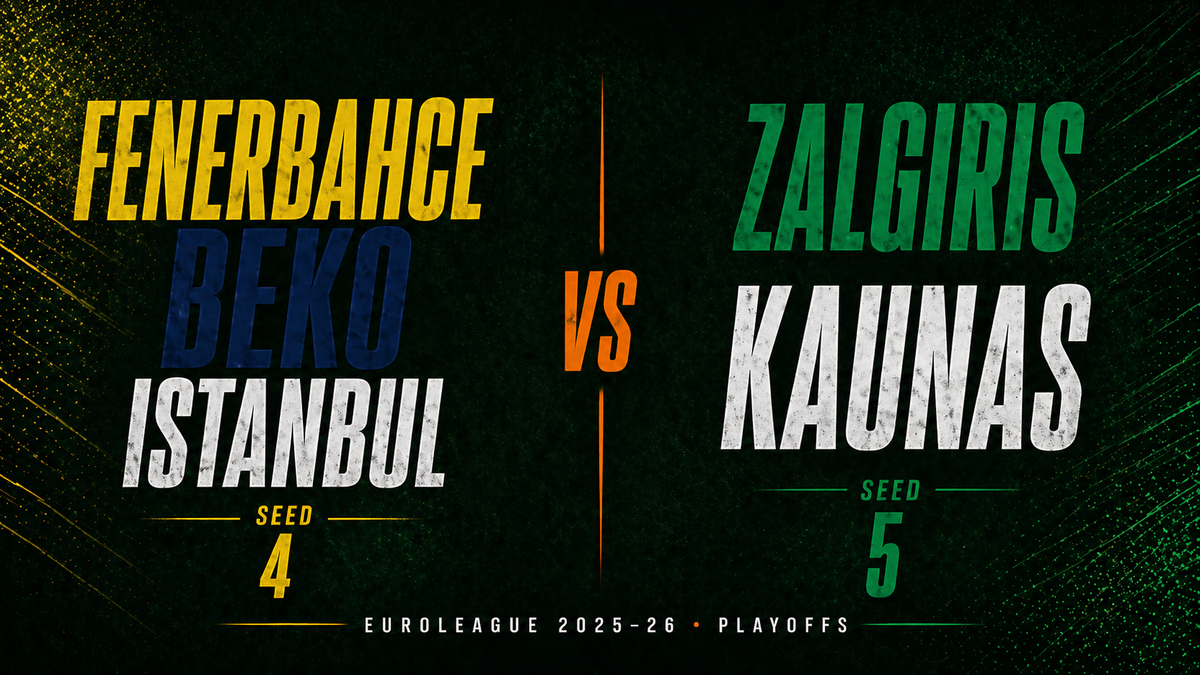
My prediction: Fener 3-1 · Fener wins Series 3-1
Game 4 - Fenerbahçe Close the Series — Jasikevicius's System Wins Again
Zalgiris Kaunas 90 – Fenerbahçe Beko Istanbul 94
Zalgiris had the Žalgirio Arena. They had momentum from Game 3. They had Tubelis in form and Francisco finally delivering. They led after the second quarter.
None of it was enough. Fenerbahçe won 94-90 in Kaunas and advance to the Final Four in Athens. Series: 3-1. The prediction holds. The system wins.
This is what Saras Jasikevicius's teams do: they absorb hostile environments, survive opponent momentum, and find a way to execute in the moments that decide series. Zalgiris won Game 3 by outscoring Fenerbahçe 24-16 in the fourth quarter. In Game 4, the same arena produced the opposite: Fenerbahçe outscored Zalgiris in the decisive stretch and closed the series before it could go back to Istanbul.
The Numbers That Define the Series
Across four games, Fenerbahçe shot 41.7%, 48.1%, 36.8% and 36.8% from three. Zalgiris shot 22.7%, 21.7%, 31% and 31%. The gap in Games 1 and 2 was the series — a 19 and 26-percentage-point differential that produced back-to-back double-digit wins for Fenerbahçe at Ülker. Games 3 and 4 were decided by three points each.
When the three-point gap closes, Zalgiris can compete. When Fenerbahçe's perimeter shooting operates at its peak, nobody in this bracket could have beaten them. The series was decided in Istanbul, not Kaunas.
Game 4 specifically came down to individual matchups in the fourth quarter. Zalgiris outscored Fenerbahçe 24-16 in Q4 of Game 3 and won. In Game 4, Fenerbahçe's rotation — Baldwin, Horton Tucker, Biberovic — produced enough in the critical moments to hold Zalgiris's late surge. Baldwin finished with 16 points and a 16 PIR; not dominant, but sufficient. Horton Tucker's 15 points on 75% two-point shooting provided interior stability that Zalgiris could not match.
Tubelis scored 26 again — his second consecutive 26-point game with PIR above 30. Williams-Goss contributed 18 points. Francisco finished with 12 points and 8 assists. This was the best version of Zalgiris — and it lost by four in Kaunas. That four-point margin, against Fenerbahçe's B-performance in the fourth quarter, tells the story of the talent differential more honestly than the 12-point margins in Istanbul.
What This Series Revealed
The blueprint for beating Fenerbahçe exists. It requires three-point shooting above 30%, a complete Francisco game, a dominant Tubelis performance, and a hostile home environment. Zalgiris achieved all four conditions in Games 3 and 4 — and went 1-1.
The reason Fenerbahçe advance 3-1 rather than 2-2 or 2-3 is the first two games. When Jasikevicius's system operates at full capacity — rotating closers, Baldwin controlling tempo, Biberovic providing the unexpected 26-point performance — Zalgiris has no answer. The budget gap between these clubs is real. The tactical gap, when both teams are at their best, is smaller than the series score suggests.
Maodo Lo finished this series as a question mark. Four games. Limited minutes. Minimal offensive impact. The Zalgiris bench player identified as the critical X-factor before Game 1 never materialized as a factor. Whether that changes his status at the club this summer is a more interesting question than what happened in Athens.
Fenerbahçe in Athens
Jasikevicius takes a defending champion to the Final Four. They arrive as one of the competition's most tactically complete teams — a system built on rotational depth rather than individual hierarchy, capable of producing a different leading scorer in every game of a series.
Olympiacos await as the #1 seed in Athens. The Peace and Friendship Stadium crowd will be what it always is against visiting teams. Fenerbahçe have been here before.
The Žalgirio Arena gave Zalgiris everything it had. It wasn't enough.
It rarely is.
Series History:
Preview
Zalgiris Kaunas finished the EuroLeague regular season with a 99.2 PIR — 6th in the competition — on one of the smallest budgets in the league. Fenerbahce Beko Istanbul finished fourth with an 86.4 PIR and the most expensive roster they have assembled in years. Those two numbers, side by side, tell you everything about why this series is more complicated than the seeding suggests — and why Saras Jasikevicius spent the final weeks of the regular season visibly dissatisfied with his own team.
The fourth-versus-fifth matchup is supposed to be the quarterfinal coin flip, the series where talent differentials are smallest and anything can happen. Dismiss that framing immediately. Fenerbahce are the defending EuroLeague champions. Zalgiris are a mid-budget Lithuanian club that has no business being this dangerous in April. The gap between these rosters is real. The gap between their trajectories into this series tells a different story.
Fener underperformed their own standards down the final stretch. Zalgiris overperformed everyone's expectations across the entire season. One team arrives with something to prove. The other arrives with nothing to lose.
Zalgiris — The Most Honest Team in Europe
The statistics Zalgiris produced this season should not exist for a club with their financial constraints. 87.6 points per game — tenth in the EuroLeague. 39.8% from three — first in the competition. 19.4 assists per game — sixth. A team PIR of 99.2, sixth in Europe, produced by a roster assembled on a fraction of what Istanbul's clubs spend. This is not overachievement through luck or schedule. This is an identity, executed with remarkable consistency.
Sylvain Francisco is the reason. The 28-year-old guard leads Zalgiris in PIR at 19.5 and assists at 6.4 per game, and represents the clearest example in this EuroLeague season of a player arriving — fully, irreversibly — at the elite level of European basketball. Francisco does not merely run the offense. He sets its tempo, its ambition, and its ceiling. In transition, he is as dangerous as any guard in the competition. In the half-court, he creates advantages that a team with Zalgiris's offensive firepower then converts at a 39.8% clip from three.
Moses Wright anchors the front line at 6.6 rebounds per game, while Laurynas Birutis shoots 69.1% from two — the kind of interior efficiency that punishes any defense that collapses too aggressively on perimeter shooters. Arnas Butkevicius, at 54.3% from three, is one of the most dangerous spot-up threats in the competition. Deividas Sirvydis, Edgaras Ulanovas, and Kajus Mikalauskas extend the rotation with the kind of collective depth that makes Zalgiris genuinely difficult to scout for any single game.
The defensive numbers are equally coherent: 82.8 points allowed per game — second in the EuroLeague. Only Fenerbahce, at 80.6, is better. Zalgiris limit turnovers better than almost anyone in the competition, commit 11.4 per game — fourth-fewest — while their opponents commit 17.5. That turnover differential is not a coincidence. It is a direct product of Tomas Masiulis's system: disciplined, positionally sound, collectively committed.
This team has earned everything it has.
Fenerbahce — A Champion Playing Below Themselves, and a Coach Who Knows It
The defending EuroLeague champion finished fourth. On 81.9 points per game — fifteenth in the competition. With a team PIR of 86.4 — seventeenth.
Those numbers require explanation, because Fenerbahce's roster does not produce them by accident. Wade Baldwin IV leads the team at 16.4 PIR and 5.5 assists per game. Talen Horton-Tucker scores 15.9 points — the team's leading scorer on a roster constructed to contend for the title. Nicolo Melli leads in rebounds at 5.7. The individual quality is not the problem. The collective expression of it, down the stretch, has been.
Saras Jasikevicius runs one of the most tactically demanding systems in European basketball. His playbook is not merely large — it is genuinely exhausting to master. Every player is expected to know every set play, every exit option, every coverage rotation, and to execute the correct read in real time under playoff pressure. The standard he demands is that of a former elite point guard who saw the game at a speed most players cannot match — and he has never fully lowered that expectation for anyone on his roster. When Fenerbahce are executing at their peak, the system is beautiful and nearly impossible to defend. When they are not, the complexity becomes friction.
The final stretch of the regular season was friction. No significant injuries. No obvious structural excuse. The team was sluggish, the offense predictably patterned, the defensive intensity — which had placed them first in points allowed at 80.6 per game — holding, but not dominating. Jasikevicius does not accept this quietly. His teams are slow starters as a matter of institutional identity — the system takes time, the reads take repetition, the collective understanding builds across a season rather than in its opening months. But finishing fourth while defending the title, with this roster, is not the trajectory he planned.
The talent is here. Horton-Tucker and Baldwin have the individual creation to win possessions against any defense in Europe. The front line — Khem Birch at 60.8% from two, Armando Bacot Jr., Chris Silva — provides the interior presence to punish small lineups. Tarik Biberovic, at 95.1% from the free-throw line, is the most reliable pressure performer on the roster.
Fenerbahce will be better in April than they were in March. They always are.
The Tactical Question — Can Zalgiris Make This Five Games?
The series turns on one structural tension: Fenerbahce's defensive discipline against Zalgiris's three-point volume.
Zalgiris led the EuroLeague in three-point percentage at 39.8%. Fenerbahce held opponents to 32.1% from three — first in the competition by a significant margin. Something has to give. If Fener's perimeter defense translates from the regular season into this series — contesting Francisco's creation, switching aggressively on Butkevicius and Sirvydis, preventing the open corner threes that Zalgiris's ball movement generates — then Zalgiris's offensive identity is suppressed, and the series ends in three or four games.
If Francisco can disrupt that coverage — through his transition creation, through dribble penetration that forces rotations — and Zalgiris finds the open threes that their system is built to generate, the series becomes genuinely competitive. Zalgiris's own defense allowed only 82.8 points per game, second in the EuroLeague. They can keep games in the seventies and low eighties. In that range, with Francisco playing at his current level, anything is possible.
Kaunas — a city where basketball is a civic religion — will provide the kind of atmosphere in Games 3 and 4 that physically changes what Fenerbahce's role players are willing to attempt under pressure. Istanbul's Ulker Sports Arena does the same for Fener. This is a series that will be played in two genuine basketball cathedrals, and that matters.
The Prediction
Fenerbahce 3-1.
Zalgiris will win one game. Probably Game 3 or Game 4 in Kaunas, where the atmosphere is unlike anything else in European basketball and Francisco will produce a performance that confirms everything this season has shown. That game will be a reminder of what Zalgiris have built and what Francisco has become.
Then Fenerbahce close it.
Because Jasikevicius in the playoffs is a different coach from Jasikevicius in February. Because Baldwin and Horton-Tucker have the individual creation to win possessions in ways that Zalgiris's system cannot fully account for. And because Fenerbahce's defensive discipline — first in the EuroLeague at 80.6 points allowed per game — will ultimately contain the three-point volume that has defined Zalgiris's season. You can run the best three-point offense in Europe at 39.8%. Against the best perimeter defense in Europe, across four or five games with no margin for error, the percentage comes down.
Zalgiris have earned this stage. They will leave it with their reputation intact and Francisco's name in lights.
Fenerbahce will leave it as what they are: defending champions, reminded of their own standard, ready for the Final Four.
Game 1 - The Defending Champion Doesn't Apologize
Fenerbahçe Beko Istanbul 89 – Zalgiris Kaunas 78
Tarik Biberovic scored 26 points on 4-of-5 from two and 6-of-8 from three. He played 27 minutes. He committed zero assists. He didn't need to.
That's the version of Fenerbahçe that wins championships: Jasikevicius's system producing a different executioner every night, with Wade Baldwin IV orchestrating everything from a 22 PIR performance that doesn't show up in the scoring column. In a best-of-5, Game 1 at Ülker Sports Hall was never in doubt after halftime. Fenerbahçe led by two after the first quarter, by ten at the break, and by eleven at the final buzzer. This was a controlled demolition. And it came against a Zalgiris side that, statistically, had no business being outclassed this cleanly.
The Biberovic Variable Changes Everything
Sylvain Francisco entered this series as Zalgiris's primary weapon — 19.5 PIR in the regular season, best assist rate in the competition, the engine of the competition's biggest budget overachievement. He finished Game 1 with 13 PIR and 15 points. Technically fine. Structurally not enough.
Because Fenerbahçe had Biberovic.
The Bosnian forward was the kind of X-factor performance that closes series before they begin. 80% two-point shooting, 75% from three, a +11 plus/minus in 27 minutes. Zalgiris had no answer because there is no standard defensive scheme designed for a forward who shoots 75% from distance in a playoff game. When Biberovic plays like this, Jasikevicius doesn't need Baldwin to score. He needs him to control — and a 22 PIR game with 4 assists and 5 rebounds in under 26 minutes is precisely that.
The team PIR tells the complete story: Fenerbahçe 96, Zalgiris 78. An 18-point gap in a competition where margins are everything.
Zalgiris Won the Two-Point Battle and Still Lost by Eleven
Here is the statistical paradox of this game: Zalgiris shot 66.7% from two. Fenerbahçe shot 63.4%. The smaller team, on the road, converted at a higher rate in the paint. And still lost by eleven points.
The answer is the three-point line. Fenerbahçe shot 41.7% from deep — 10-of-24. Zalgiris shot 22.7% — 5-of-22. That's a 19-percentage-point gap that produced roughly 15 additional points for the defending champions. In the EuroLeague, where half-court offense defines seasons, Fenerbahçe didn't just beat Zalgiris in Game 1. They beat them at their own game — and then beat them at Fenerbahçe's game too.
Tomas Masiulius's coaching dilemma is real. His team moved the ball — 16 assists to Fenerbahçe's 14 — but shot themselves out of the game from distance. Nigel Williams-Goss led all scorers with 24 points and a game-high 24 PIR, which tells you Zalgiris's best player showed up. It wasn't enough because he was the only one who did.
The Maodo Lo question deserves attention here. The German international had one point in 16 minutes. In a best-of-5, depth off the bench isn't a luxury — it's structural. If Lo and the second unit continue to be non-factors, Zalgiris won't win three games. They might not win one.
What Game 2 Actually Decides
TEP's pre-series prediction: Fenerbahçe 3-1. After Game 1, nothing has changed — except the margin for error for Kaunas has collapsed.
In a best-of-5, going down 0-2 requires winning three straight, two of them in Istanbul. The mathematical problem for Zalgiris is this: they need to be significantly better on the road in Game 2 than they were in Game 1. Better three-point shooting. Better bench contribution. More from Francisco as a scorer, not just a distributor.
Fenerbahçe, meanwhile, doesn't need Biberovic to score 26 again. They just need Jasikevicius's system to keep producing rotational threats that opponents can't plan for. Against a Zalgiris team that needs everything to go right, that's a comfortable position to be in.
If Fenerbahçe wins Game 2 at Ülker, this series is over in four. If Zalgiris steals it, Kaunas becomes the story of these playoffs.
Game 2 is the series.
Game 2 - Fener Closes the Door — Zalgiris Never Found the Key
Fenerbahçe Beko Istanbul 86 – Zalgiris Kaunas 74
Fenerbahçe led by 12 after the first quarter. By 18 at halftime. By 19 entering the fourth. The final margin was 12, meaning Zalgiris's only meaningful stretch of basketball came when the game was already decided.
That is the story of this series. Fenerbahçe are 2-0. Zalgiris travel back to Kaunas needing to win three straight games — two of them in Istanbul — to advance. In a best-of-5, that is not a deficit. It is a sentence.
TEP's pre-series prediction was Fenerbahçe 3-2. After Game 2, the only question is whether Zalgiris can force a fifth game at all.
The X-Factor Nobody Predicted
Tarik Biberovic scored 26 points in Game 1. The assumption was that Jasikevicius had found his closer. Game 2 produced a different answer.
Mikael Jantunen — a Finnish forward who averaged 5.6 points per game in the regular season — scored 13 points on 100% shooting from two, 100% from three and 100% from the free-throw line. His PIR of 23 was the highest of any player on either team. Jantunen grabbed 6 rebounds and committed one turnover in 24 minutes.
This is what makes Fenerbahçe structurally dangerous: Jasikevicius doesn't have one closer. He has a system that produces a different one every night. Biberovic was the story in Game 1. Jantunen was the story in Game 2. Nando De Colo came off the bench and shot 100% from two and 80% from three for 16 points and an 18 PIR. Baldwin contributed 7 assists and a +13 plus/minus while scoring only 11 points.
Zalgiris had no scouting answer for any of this because there is no scouting answer. You cannot prepare for a team where the game-deciding performance can come from three different positions on any given night.
The Three-Point Line Decided This Series
The statistical gap that defined both games of this series is not PIR, not rebounding, not turnovers. It is the three-point line.
Game 1: Fenerbahçe 41.7%, Zalgiris 22.7%. Game 2: Fenerbahçe 48.1%, Zalgiris 21.7%. Across two games, Fenerbahçe have shot 48-of-51 combined from the perimeter — not in makes, but in the efficiency gap. Zalgiris have shot 5-of-22 and 5-of-23 in Games 1 and 2 respectively. That is 10 three-pointers made across two playoff games for a team that ranked sixth in the EuroLeague in three-point attempts during the regular season.
Sylvain Francisco — 19.5 PIR in the regular season, the competition's assist leader, the engine of everything Zalgiris do offensively — shot 1-of-6 from three in Game 2 and finished with 12 PIR and 11 points. In Game 1 he had 13 PIR. In neither game has he been the player who makes Zalgiris function.
Maodo Lo played 19 minutes and scored 3 points. After two games, Lo has combined for 4 points in 35 minutes off the bench. TEP identified him as Zalgiris's critical X-factor before this series began. His absence as a scoring threat has been the difference between a series and a sweep.
What Zalgiris Can Do — And What They Can't
Zalgiris outscored Fenerbahçe in the fourth quarter 27-20. They had 9 steals to Fenerbahçe's 3. They shot 72.7% from two across the game — better than Fenerbahçe's 46.2%. Moses Wright finished with 16 points on 100% two-point shooting. Azuolas Tubelis contributed 16 points and a 19 PIR.
None of it mattered because Fenerbahçe built the lead in the first three quarters and absorbed the fourth. The shot chart tells the story more clearly than the scoreboard: Fenerbahçe's makes are clustered in the paint and spread across the arc. Zalgiris's makes are almost exclusively at the rim. Against a Fenerbahçe defense that controls the three-point line, interior scoring alone doesn't win EuroLeague playoff games.
Tomas Masiulius faces a coaching problem with no clean solution. His best perimeter shooters — Francisco, Lo, Williams-Goss — have collectively shot 6-of-51 from three across two games. If he adjusts to attack the rim more aggressively, Fenerbahçe's help defense and Khem Birch's shot-blocking come into play. If he keeps running the same perimeter sets, the percentages won't recover in one game.
Kaunas on Saturday. Then What?
Zalgiris go home for Game 3 needing a win to stay alive. The Žalgirio Arena in Kaunas is one of the genuine home-court environments in European basketball — 15,000 seats, a fan culture that has carried this team through decades of underdog seasons. The crowd will be there.
The three-point shooting almost certainly won't be.
Fenerbahçe are 2-0 in a best-of-5, playing the basketball of a team that has internalized Jasikevicius's system completely. Different scorer every game. Same result every game.
Zalgiris need three of those results to go differently.
Game 3 - Zalgiris Finds Their Voice — But the Series Logic Hasn't Changed
Zalgiris Kaunas 81 – Fenerbahçe Beko Istanbul 78
14,792 fans packed the Žalgirio Arena and got exactly what they came for: a Zalgiris win, a third game in the series, and proof that their team has more in them than the first two games suggested.
Azuolas Tubelis scored 26 points on 60% two-point shooting and 75% from three, grabbed 6 rebounds and posted a 31 PIR. Nigel Williams-Goss added 18 points on 60% from three. Sylvain Francisco contributed 12 points, 8 assists and 7 rebounds — finally the complete performance this series had been waiting for from Zalgiris's most important player.
Fenerbahçe led after every quarter until the fourth. Then Kaunas outscored them 24-16 in the final period and took the game. Series: 2-1. The sentence is no longer inevitable.
The Žalgirio Arena Did What Home Arenas Are Supposed To Do
In Games 1 and 2 at Ülker Sports Hall in Istanbul, Fenerbahçe's crowd was a factor. In Game 3, Kaunas answered. The Žalgirio Arena is one of the genuine home-court environments in European basketball — 15,000 seats of concentrated, educated fan culture built around decades of Lithuanian basketball identity. Zalgiris are not just a club here. They are an institution.
That environment produced a version of Zalgiris that the first two games had not. Tubelis's 31 PIR was the best individual performance of the series from either team. Francisco's 8 assists reflected a player finally operating with the confidence that made him the EuroLeague's assist leader during the regular season. Williams-Goss shot 60% from three after going 0-of-something in his previous outings.
The three-point shooting that had destroyed Zalgiris in Istanbul — 22.7% and 21.7% across Games 1 and 2 — recovered to 31% in Game 3. Not elite. But enough, because Fenerbahçe's own perimeter shooting collapsed to 36.8%, their lowest of the series.
Fenerbahçe's First Quarter Was the Warning They Ignored
Real Madrid led Hapoel 82-64 with four minutes remaining and nearly lost Game 1 of their series. Fenerbahçe led Zalgiris after three quarters in Game 3 — 62-57 — and lost the game.
The pattern is different but the lesson is the same: playoff leads in a best-of-5 require fourth-quarter execution that regular-season rhythms don't always produce. Fenerbahçe outscored Zalgiris 25-12 in the first quarter. By the fourth, their execution had deteriorated to 16 points in ten minutes against a team playing for its season.
Wade Baldwin IV finished with 16 PIR and 16 points — functional but not the conductor performance that carried Games 1 and 2. Tarik Biberovic, the X-factor with 26 points in Game 1, scored 10 on 42.9% shooting. Maodo Lo played under 11 minutes and scored 2 points. The bench that Jasikevicius needed in a hostile environment produced 13 points combined from non-starters.
Zalgiris outscored Fenerbahçe in turnovers too — 10 for Fenerbahçe, 12 for Zalgiris — a marginal difference that in a 3-point game reflects exactly how fine the margins were.
What Game 3 Actually Changed
TEP's pre-series prediction was Fenerbahçe 3-2. Game 3 keeps that prediction structurally alive — but the reasoning shifts. Zalgiris didn't just win. They won by finding their three-point shooting, getting a complete Francisco game, and producing their best individual performance of the series from Tubelis.
None of those things are guaranteed to repeat in Game 4. Fenerbahçe's system — different closer every night, Baldwin orchestrating regardless — remains intact. The Žalgirio Arena won't travel to Istanbul if a Game 5 is needed.
But Zalgiris have now demonstrated they can beat Fenerbahçe when everything clicks. In a best-of-5 trailing 1-2, that is the only knowledge they needed.
Game 4 is in Kaunas. For Zalgiris, it is a must-win. For Fenerbahçe, it is a chance to close a series that should have been closed already.
Game 4 - Fenerbahçe Close the Series — Jasikevicius's System Wins Again
Zalgiris Kaunas 90 – Fenerbahçe Beko Istanbul 94
Zalgiris had the Žalgirio Arena. They had momentum from Game 3. They had Tubelis in form and Francisco finally delivering. They led after the second quarter.
None of it was enough. Fenerbahçe won 94-90 in Kaunas and advance to the Final Four in Athens. Series: 3-1. The prediction holds. The system wins.
This is what Saras Jasikevicius's teams do: they absorb hostile environments, survive opponent momentum, and find a way to execute in the moments that decide series. Zalgiris won Game 3 by outscoring Fenerbahçe 24-16 in the fourth quarter. In Game 4, the same arena produced the opposite: Fenerbahçe outscored Zalgiris in the decisive stretch and closed the series before it could go back to Istanbul.
The Numbers That Define the Series
Across four games, Fenerbahçe shot 41.7%, 48.1%, 36.8% and 36.8% from three. Zalgiris shot 22.7%, 21.7%, 31% and 31%. The gap in Games 1 and 2 was the series — a 19 and 26-percentage-point differential that produced back-to-back double-digit wins for Fenerbahçe at Ülker. Games 3 and 4 were decided by three points each.
When the three-point gap closes, Zalgiris can compete. When Fenerbahçe's perimeter shooting operates at its peak, nobody in this bracket could have beaten them. The series was decided in Istanbul, not Kaunas.
Game 4 specifically came down to individual matchups in the fourth quarter. Zalgiris outscored Fenerbahçe 24-16 in Q4 of Game 3 and won. In Game 4, Fenerbahçe's rotation — Baldwin, Horton Tucker, Biberovic — produced enough in the critical moments to hold Zalgiris's late surge. Baldwin finished with 16 points and a 16 PIR; not dominant, but sufficient. Horton Tucker's 15 points on 75% two-point shooting provided interior stability that Zalgiris could not match.
Tubelis scored 26 again — his second consecutive 26-point game with PIR above 30. Williams-Goss contributed 18 points. Francisco finished with 12 points and 8 assists. This was the best version of Zalgiris — and it lost by four in Kaunas. That four-point margin, against Fenerbahçe's B-performance in the fourth quarter, tells the story of the talent differential more honestly than the 12-point margins in Istanbul.
What This Series Revealed
The blueprint for beating Fenerbahçe exists. It requires three-point shooting above 30%, a complete Francisco game, a dominant Tubelis performance, and a hostile home environment. Zalgiris achieved all four conditions in Games 3 and 4 — and went 1-1.
The reason Fenerbahçe advance 3-1 rather than 2-2 or 2-3 is the first two games. When Jasikevicius's system operates at full capacity — rotating closers, Baldwin controlling tempo, Biberovic providing the unexpected 26-point performance — Zalgiris has no answer. The budget gap between these clubs is real. The tactical gap, when both teams are at their best, is smaller than the series score suggests.
Maodo Lo finished this series as a question mark. Four games. Limited minutes. Minimal offensive impact. The Zalgiris bench player identified as the critical X-factor before Game 1 never materialized as a factor. Whether that changes his status at the club this summer is a more interesting question than what happened in Athens.
Fenerbahçe in Athens
Jasikevicius takes a defending champion to the Final Four. They arrive as one of the competition's most tactically complete teams — a system built on rotational depth rather than individual hierarchy, capable of producing a different leading scorer in every game of a series.
Olympiacos await as the #1 seed in Athens. The Peace and Friendship Stadium crowd will be what it always is against visiting teams. Fenerbahçe have been here before.
The Žalgirio Arena gave Zalgiris everything it had. It wasn't enough.
It rarely is.