FRANCHISE HISTORY: MINNESOTA VIKINGS
FRANCHISE HISTORY SERIES - #2 Four Super Bowls. Zero Wins. Sixty-Five Years of Almost.
Magic Numbers: 4 & 0
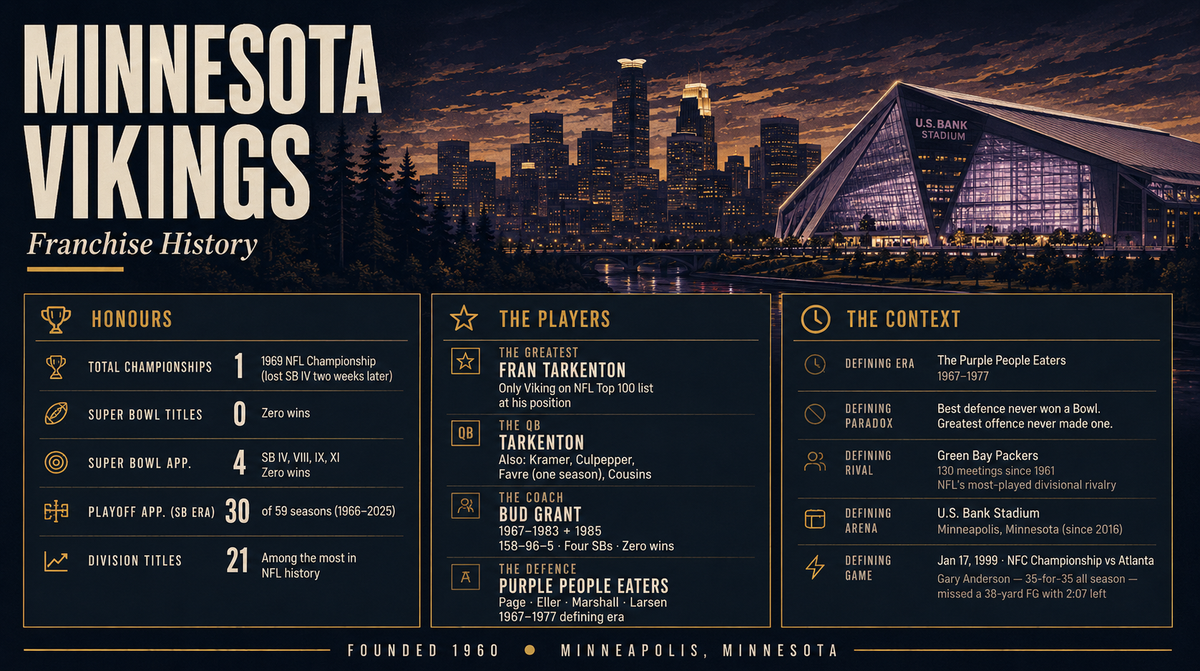
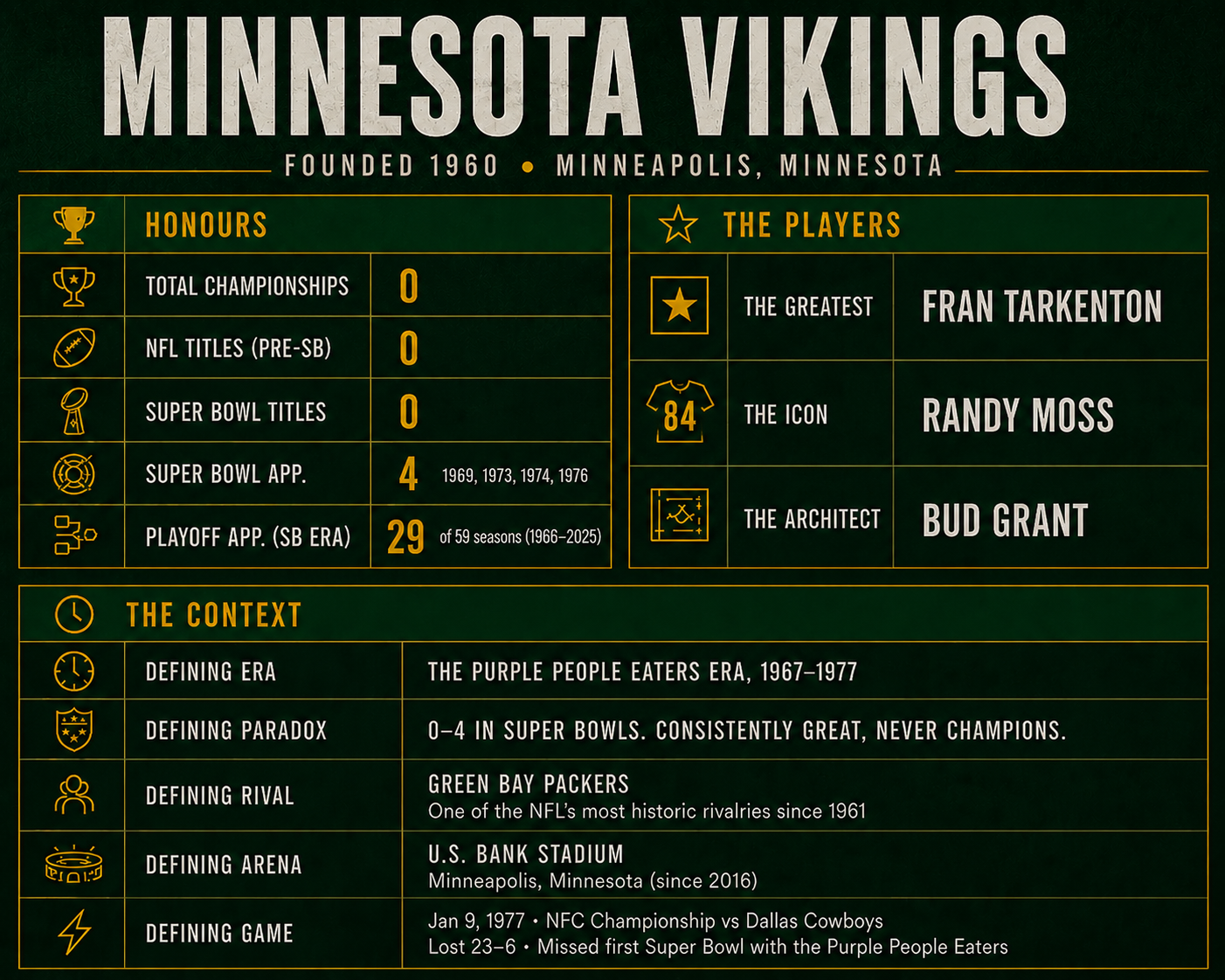
Four Super Bowl appearances. Zero Super Bowl wins. The Minnesota Vikings have been to the game four times — in 1969, 1973, 1974, and 1976 — and lost each one. No other franchise in NFL history has made four Super Bowl trips without winning once. The Vikings didn't just lose these games; they lost them convincingly, by a combined score of 95 to 34. The numbers constitute one of the most sustained, systematic failures in the history of a sport built on systematic failures.
And yet. The Vikings are one of the most successful franchises in NFL history by almost every other measure — 30 playoff appearances in 59 Super Bowl era seasons, 21 division titles, a defense that defined an era, and a parade of Hall of Fame players that most franchises would trade two decades of drafts to replicate. The paradox that defines Minnesota is not that they lost. It is that they were good enough to keep losing at the highest level, repeatedly, without ever crossing the line that separates the great from the championship.
This is a story about excellence without completion. About a franchise that has been, by turns, historically dominant and historically unfortunate — sometimes within the same season.
The NFL Stole This Franchise from the AFL
The Minnesota Vikings should not exist in the NFL. In 1959, a group of Minneapolis businessmen — led by Max Winter and Bill Boyer — were awarded an American Football League franchise. The AFL was the new rival league founded by Lamar Hunt and Bud Adams to challenge the NFL's monopoly. Minnesota was going to be part of it.
The NFL, facing the prospect of serious competition, moved decisively. It offered the Minnesota group an expansion slot in the established league. The businessmen accepted, forfeited their AFL membership, and joined the NFL as an expansion team for the 1961 season. The AFL spot they abandoned was awarded to Oakland — which became the Raiders. The Minnesota group got the NFL. Oakland got a dynasty in waiting. History would make this exchange look considerably more complicated than it appeared in 1960.
The franchise was built on betrayal. The Vikings left the AFL before it played a game. That decision has defined them ever since.
The name came from the region's Scandinavian heritage — Minnesota has the largest concentration of Scandinavian-Americans in the United States. The colors, purple and gold, were chosen by general manager Bert Rose, reportedly inspired by his alma mater, the University of Washington. The logo, a fierce horned Viking warrior, was designed by Los Angeles cartoonist Karl Hubenthal. In September 1960, the team was officially named the Minnesota Vikings. They would not play their first game for another nine months.
Their first head coach, Norm Van Brocklin, was a Hall of Fame quarterback who had led the Philadelphia Eagles to the 1960 NFL championship. He had never coached before. His relationship with his starting quarterback, Fran Tarkenton — a 21-year-old third-round pick out of Georgia — was contentious from the first week of training camp and never improved. These two men, a great quarterback and a great ex-quarterback, could not agree on what being a great quarterback required. Van Brocklin wanted control and conformity. Tarkenton wanted freedom. The franchise spent its first six years caught between them.
The Founding Five: Who Built the Franchise
Five men signed the original NFL franchise agreement on January 28, 1960. None of them are household names. All of them have streets, training facilities, or historical plaques in Minneapolis bearing some version of their surnames. The Vikings are not, like the Steelers or the Bears or the Packers, a single-family operation. They are an institutional product of a Minneapolis business class that was, in 1960, deciding which leagues, which markets, and which entertainment formats would shape the post-war American Midwest. The Vikings were one of those decisions, made simultaneously with similar bets on the Minneapolis Lakers (already departed for Los Angeles) and the Minnesota Twins (arriving from Washington in 1961). The men who made the decision were specific, and the histories they brought to it shaped the team more than the fact of their relative anonymity now suggests.
Max Winter was the most operationally important of the five. Born June 29, 1903, in Ostrava — then Austria-Hungary, now Czechia — he emigrated to Minneapolis as a child. He attended North High School and Hamline University on a basketball scholarship, and made his early money as co-owner of the 620 Club, a downtown Minneapolis restaurant specialising in turkey. By the late 1940s he was part-owner and general manager of the Minneapolis Lakers, the NBA team that won five championships before relocating to Los Angeles in 1960. The Vikings were his second professional sports project. He served as vice president from 1960, became president in 1965, and remained on the board until 1989. He died on July 26, 1996, age 92. Winter Park, the team's Eden Prairie practice facility from 1981 to 2018, was named for him. He is the closest thing this organization has to a founding father in the conventional sense, and his thirty-year stewardship spanned the four Super Bowl losses he never publicly resolved.
Bill Boyer was the franchise's first president (1960-1964) and one of its most active early operators. He handled stadium negotiations, league relations, and the institutional infrastructure that allowed Bert Rose and Norm Van Brocklin to focus on football. He died in February 1973 and his shares passed through his son-in-law John Steele to subsequent ownership iterations. H.P. Skoglund, the team's first treasurer, was a Minneapolis insurance executive whose contribution was financial steadying — the man who kept the books balanced through the early expansion losses. Bernie Ridder Jr. was the publisher of the Saint Paul Pioneer Press and the Saint Paul Dispatch. He brought both capital and the political cover that comes from controlling the local press during a period when that still mattered to professional sports.
Ole Haugsrud belongs in a separate category. He was added to the ownership group not because the other four wanted him but because the NFL required it. Haugsrud had owned the Duluth Eskimos, an NFL franchise that played intermittently in the 1920s before folding in 1929. When he sold the team back to the league, the contract specified that he would receive a 10 percent ownership stake in any future NFL team based in Minnesota. Thirty-two years later, that contract was honoured. Haugsrud's 10 percent of the Vikings made him one of the most accidentally fortunate sports investors of the twentieth century. He held the stake until his death in 1976. Ridder, Skoglund, and Haugsrud's heirs sold their interests across the 1980s. By 1989, the original five had been replaced by a new ownership group led by Irwin Jacobs and Carl Pohlad. By 2005, the Wilf family owned the franchise outright.
Five men signed the franchise into existence in 1960. By 1989, none of them or their direct heirs still held a controlling stake. The Vikings are not a family franchise. They are an institutional one, passed through Minneapolis business society like a piece of civic property whose specific custodians have always mattered less than the city's collective claim on the team.
Bert Rose, the team's first general manager, was hired in August 1960 from his job as Los Angeles Rams public relations director. He selected the team's name (after considering Chippewas, Miners, and Voyageurs) and recommended the Scandinavian framing that has anchored the identity ever since. Rose hired Norm Van Brocklin as the first head coach. He drafted Tommy Mason first overall in 1960 (the team's first-ever draft pick) and Fran Tarkenton in the third round of the same draft. He was fired three years later after disagreements with Van Brocklin over personnel decisions. He died in 1990. In the operational sense, he is the most important non-playing figure in the Vikings' first decade — the man who built the roster that produced the 1969 NFL Championship, by which point he had been gone for six years.
Tarkenton's Debut: Four Touchdowns and a Warning
On September 17, 1961, the Minnesota Vikings played their first regular-season game. Their opponent was the Chicago Bears, one of the NFL's founding franchises, at Metropolitan Stadium in Bloomington. The Vikings were a 3-to-1 underdog. Nobody gave them a chance.
Starter George Shaw was pulled in the first quarter. Fran Tarkenton came off the bench. He completed 17 of 23 passes for 250 yards, threw four touchdowns, and ran for a fifth. The Vikings won 37–13. The performance ranks among the most remarkable debuts in NFL history — a rookie quarterback, playing for an expansion team against a veteran opponent, producing a performance that suggested something extraordinary was in motion.
The season that followed told a different story. The Vikings won two more games and lost eleven. In 1962, they went 2–11–1. Expansion teams, built from veteran discards and unproven rookies, do not compete by their second season. What the Vikings had was a quarterback who was already, in his first year, establishing himself as unlike anything the league had seen — scrambling, improvising, treating the pocket as a suggestion rather than a rule. And a head coach who thought all of that was wrong.
Tarkenton was traded to the New York Giants in 1967 after a contract dispute. Van Brocklin had already resigned. The franchise that began with one of the greatest individual debuts in history had spent its first six years going nowhere in particular. What happened next changed everything.
Fran Tarkenton: The Quarterback Who Built the Position
Francis Asbury Tarkenton was born February 3, 1940, in Richmond, Virginia, the son of a Methodist minister. He attended the University of Georgia, won the SEC championship as a senior in 1959, and was drafted by the Vikings in the third round of the 1961 NFL Draft — the 29th overall selection. He was 21 years old, six feet tall, 190 pounds, and considered too small and too unconventional to start in the NFL. His debut on September 17, 1961 — five touchdowns, 250 yards, 37-13 win over the Chicago Bears — should have ended the conversation about his readiness. Norm Van Brocklin spent the next six years questioning him anyway. The friction was structural, not personal: Van Brocklin wanted a pocket passer and Tarkenton was the first NFL quarterback to demonstrate that the pocket was optional.
Tarkenton's eighteen-year NFL career — thirteen seasons in Minnesota (1961-1966, 1972-1978), five in New York (1967-1971) — produced numbers that held the all-time records for nearly two decades. When he retired after the 1978 season, he was the NFL's all-time leader in passing yards (47,003), passing touchdowns (342), pass completions (3,686), and rushing yards by a quarterback (3,674). Each record stood for at least a decade. Marino broke the passing yards record in 1995. Brett Favre broke the touchdown record in 2007 — fittingly, with TD pass number 421 thrown to Greg Jennings against the Vikings at the Metrodome on September 30, 2007. The career took place in an era when quarterbacks were not protected by rules that now make scrambling sustainable. Tarkenton scrambled anyway, took the hits, and kept playing. He played 246 regular-season games over eighteen seasons and missed only five games due to injury — a durability record that matched his statistical one.
The trade that sent him to New York in 1967 was, in the immediate term, an organizational mistake — the Vikings received a package of draft picks and players that produced one Pro Bowler and a series of role contributors. The 1972 trade that brought him back to Minnesota was the better deal. The resulting 1972-1976 stretch produced three Super Bowl appearances and his 1975 NFL MVP award. The offense complemented the Purple People Eaters' defense at the level championship contention required. Tarkenton finished his NFL career having played in three Super Bowls, lost all three, and produced the league's best statistics across the modern eight-decade history of the position to that point.
Post-football, Tarkenton became one of the most successful businessman-athletes of his generation. He co-hosted ABC's That's Incredible! from 1980 to 1984, founded multiple software and management consulting companies, and remains active in business at 86. His commentary on the team has been characteristically pointed: he opposed the Herschel Walker trade publicly, criticised every quarterback decision the Vikings made between 1979 and 2017, and has been right about most of them. He is, by any reasonable measure, the most important player in franchise history — the quarterback who established the position's modern form, the first Vikings Hall of Fame inductee in 1986, and the only Minnesota figure on every credible all-time NFL top-100 list at his position.
Fran Tarkenton invented the modern scrambling quarterback in 1961, when scrambling was still considered evidence that a quarterback was failing rather than evolving. The position has spent sixty years catching up to him.
Bud Grant: The Stoic and the System
Bud Grant was not the Vikings' first choice in 1967. He had been their first choice in 1961, when the franchise was formed. He had turned them down then, preferring to continue his work in the Canadian Football League, where he had won four Grey Cup championships with the Winnipeg Blue Bombers. He was methodical, stoic, and obsessively competitive. He also did not believe in sideline heaters, even in Minnesota winters, because he thought cold weather was a psychological weapon and intended to use it.
Grant grew up in Superior, Wisconsin, and was a multi-sport athlete at the University of Minnesota. He played in the NBA for the Minneapolis Lakers and professional football for the Philadelphia Eagles, then went to Canada because the CFL paid better. By the time the Vikings hired him as their second head coach, he had been a professional athlete or coach in three different leagues across four sports. He brought a kind of calm to the Vikings sideline that bordered on indifference. Players said he never raised his voice. Players said he never had to.
His methodology was austere by NFL standards. The Vikings practised in shorts in conditions that would have driven other teams indoors. They stood for the national anthem in straight lines, helmets at their hips, in formations Grant himself drew up. He fined players who fidgeted. The discipline was not theatrical — it was operational. Grant believed that the team that stayed calm under physical and psychological pressure won, and he organised every aspect of his practices to produce that calm. The system worked. From 1968 to 1978, his teams won ten division titles in eleven years. They appeared in the NFC Championship Game five times in eight years. They went to four Super Bowls.
Grant compiled a regular-season record of 158-96-5 with the Vikings across two stints (1967–1983 and 1985), making him the franchise's all-time wins leader by a margin so large no successor will approach it. His career winning percentage of .620 ranks among the best in NFL history for a coach with at least 200 games. He was inducted into the Pro Football Hall of Fame in 1994. He died on March 11, 2023, age 95. He had spent the last forty years of his life as the most respected non-playing figure in Minnesota sports — quiet, reserved, almost universally cited by his former players as the best coach they ever had.
The Super Bowl losses are the structural counterweight. Four trips, four defeats, by an aggregate score of 95–34. Grant himself never offered a satisfying explanation for the pattern. He thought about it. He talked about it occasionally. He never produced the kind of lessons-learned narrative that other Hall of Fame coaches turned into lectures and memoirs. The losses sat as data points without an interpretation. That, too, was a Grant choice — refusing to perform analysis he did not believe was honest. The defining coach of the franchise also presided over its defining failure. The two facts coexist without resolution.
Grant won more games than any other Vikings coach by an order of magnitude. He also lost more Super Bowls than any other Vikings coach by an order of magnitude. The franchise's two governing realities both belong to him.
The Purple People Eaters: The Defense That Defined a Decade
Three Hall of Famers, one Pro Bowler, and a defensive identity so specific it became national shorthand. The Purple People Eaters of 1968-1977 were Carl Eller (left end), Alan Page (left tackle), Gary Larsen (right tackle, replaced by Doug Sutherland in 1974), and Jim Marshall (right end). Their motto, taught by defensive line coach Buddy Ryan, was three words: meet at quarterback. They did, more often than any defensive front of the era. From 1969 to 1971, the Vikings led the NFL in fewest points allowed three years running. In 1969, they gave up 133 points all season — a record for a 14-game schedule that has not been seriously challenged.
Alan Page changed what was possible at the defensive tackle position. He weighed around 240 pounds — small for the position then, smaller for it now — and made up for the size deficit with quickness no opponent had a counter for. He won the 1971 NFL MVP award, the first defensive player ever to do so. He was a nine-time Pro Bowler, a six-time first-team All-Pro, and was inducted into the Pro Football Hall of Fame in 1988. After football, he earned a law degree, served as Minnesota Assistant Attorney General, and was elected to the Minnesota Supreme Court in 1992 — the first African American justice on that court. He served until 2015.
Carl Eller, the left defensive end, was 6-foot-6 and 247 pounds, and arrived from the University of Minnesota in 1964 as the sixth overall pick. Six Pro Bowls, three first-team All-Pro selections, and inducted into the Hall of Fame in 2004. Jim Marshall, the right defensive end, started 270 consecutive games — a record for a non-kicker that stood until 2009. He died on June 3, 2025, at age 87, the only Purple People Eater never inducted into the Hall of Fame — an exclusion that nearly every football historian considers the most glaring oversight in the selection committee's history. Marshall is the man who, on October 25, 1964, ran a recovered fumble 66 yards in the wrong direction for a safety against the 49ers — the most famous individual gaffe in NFL history. He is also the man who started 270 consecutive games. Both are part of the same résumé.
The Purple People Eaters' four Super Bowl losses are the asterisk that refuses to fade. They held the 1973 Dolphins to seven first-half points and lost. They held the 1974 Steelers to six first-half points and lost. They never trailed in the locker room conversation about whether they had executed; they trailed on the scoreboard, every time, by margins that the offence could not close. The defence built the franchise. The defence was not what cost the franchise its championships.
Four Super Bowls, Four Losses: The Systematic Failure
Super Bowl IV, January 1970: The Vikings were 12-2 in the regular season, the best record in football. They were favored to beat the Kansas City Chiefs, who played in the AFL — the league the Minnesota ownership group had abandoned ten years earlier. The Chiefs won 23–7. The Vikings turned the ball over five times. The famous Hank Stram sideline footage, captured by NFL Films, shows the Chiefs coach calling plays with the confidence of a man who had solved the problem. Minnesota had not.
Super Bowl VIII, January 1974: The Vikings lost 24–7 to the Miami Dolphins, who were defending champions with a lineup that included Larry Csonka, Jim Kiick, and Bob Griese. The Dolphins ran the ball 53 times. The Purple People Eaters, the most feared defensive unit in football, allowed 196 rushing yards. Tarkenton threw for only 182 yards. The game was effectively over by halftime.
Super Bowl IX, January 1975: The Pittsburgh Steelers won 16–6. The Vikings scored six points. Franco Harris ran for 158 yards. The Steelers' Steel Curtain defense, which would go on to win three more Super Bowls in the next six years, was simply better on that day than the Purple People Eaters. This was the closest thing to a fair fight Minnesota had in any of their four Super Bowl losses — and they were not close.
Super Bowl XI, January 1977. Oakland Raiders 32, Minnesota Vikings 14. Four Super Bowls. Zero wins. The mathematics are final.
The pattern across all four losses was identical: turnovers at critical moments, an offense that could not score enough to compensate for a defense that was otherwise sufficient to win, and opponents who executed their game plans with more precision than Minnesota executed theirs. The combined score across the four games: opponents 95, Vikings 34. Bud Grant coached all four of them and lost all four. He was stoic about it publicly. He was never stoic enough to fix it.
The Herschel Walker Trade: Self-Destruction as Franchise Philosophy
On October 12, 1989, the Minnesota Vikings made the worst trade in NFL history. General manager Mike Lynn sent five players and six draft picks — including three first-round selections and two second-round picks — to the Dallas Cowboys in exchange for running back Herschel Walker. The Cowboys, who had gone 1–15 the previous season, immediately released most of the players and collected the conditional picks attached to them. Jimmy Johnson knew exactly what he was doing. Minnesota did not.
The picks Dallas accumulated became the foundation of a dynasty. The Cowboys traded the Vikings' 1990 first-round pick (#21) along with their own third-round selection to Pittsburgh to move up to #17, where they took Emmitt Smith — the NFL's all-time leading rusher. Other picks from Minnesota became safety Darren Woodson (Dallas's all-time leading tackler), cornerback Kevin Smith, wide receiver Alvin Harper, and linebacker Dixon Edwards. Five players from the Walker compensation became core contributors to three Super Bowl championships in four years. The Cowboys called the deal The Great Train Robbery. They were right.
Walker ran for 669 yards in his first season in Minnesota, was released in June 1992, and eventually signed with Philadelphia and then returned to Dallas. The trade is not simply the worst in franchise history. It is the clearest single example of an organization so convinced of its own proximity to a championship that it surrendered its future to reach a present that never arrived. Three seasons. 2,264 rushing yards. Twenty-six total touchdowns. Released.
Dallas used the picks from the Herschel Walker trade to build three Super Bowl championship teams. Minnesota used Herschel Walker for two seasons, then moved on. The asymmetry is staggering.
The Walker trade is the defining organizational failure of the franchise's middle period. What makes it instructive is not just the outcome — it is the reasoning. Minnesota believed it was one player away from a Super Bowl. That belief was not irrational in isolation: the Vikings were competitive, the NFC was winnable, and Walker was a legitimate talent. The problem was the price. Three first-round picks and five players for a single running back, no matter how talented, is a price that almost no championship has ever been worth. The Cowboys understood that. Minnesota did not.
Randy Moss: The Talent That Twenty Teams Passed On
Twenty teams had Randy Moss off their draft board. Some had off-field concerns — a fight in high school, a marijuana possession charge, a domestic incident with a girlfriend. Some had questions about his coachability. Some, in the assessment of multiple insiders who later wrote about the 1998 draft, had concerns that were less about his behaviour than about a Black wide receiver from Marshall University who refused to perform compliance for white scouts. The Vikings, who picked 21st, took him. They watched twenty other teams move on, and they took the most physically dominant wide receiver of his generation.
Moss caught 17 touchdown passes as a rookie. The record still stands. He was the first rookie since Jerry Rice to lead the league in receiving touchdowns. By the end of his second season, opposing defensive coordinators were rolling double coverage to his side on every snap, and he was beating it. His 4.25-second 40-yard dash, his 6-foot-4 frame, and his ability to high-point the football made him the closest thing the NFL had ever seen to an unstoppable receiver. The Cris Carter pairing — the veteran technician with the rookie phenomenon — was as productive as any wide receiver tandem of the era.
Moss spent seven-plus seasons in Minnesota (1998-2004 in his first stint), caught 92 touchdowns for the franchise (second-most in Vikings history) and totalled six Pro Bowls and a 1,000-yard receiving season every year except his two-game appearance in 2001. He was traded to the Oakland Raiders in 2005 in a deal the Vikings front office never satisfactorily explained, spent two miserable seasons in Oakland, and was reborn in New England in 2007 with the 16-0 Patriots and 23 receiving touchdowns — another NFL record. He retired in 2012 with 156 receiving touchdowns, second all-time, and was inducted into the Pro Football Hall of Fame in 2018.
The decision to trade him in 2005 ranks alongside the Herschel Walker trade as one of the organization's defining mistakes. Moss was 27. He had at least five elite seasons remaining. He produced those seasons in Oakland and New England, not Minneapolis. The Vikings pattern — assembling generational talent and failing to keep it long enough to win — extended through Moss in ways the team could have prevented and chose not to.
The greatest receiver of his generation played seven seasons in Minnesota. The Vikings did not win a Super Bowl in any of them. The pattern is older than the player.
Adrian Peterson: The Last Great Single-Back Era
On December 30, 2012, Adrian Peterson rushed for 199 yards against the Green Bay Packers in the regular-season finale. He finished the season with 2,097 rushing yards — nine yards short of breaking Eric Dickerson's all-time single-season rushing record of 2,105 from 1984. He had returned to play that season — at full speed, leading the league in rushing — barely nine months after tearing his ACL and MCL in a Christmas Eve game the previous year. The recovery was, by any reasonable medical assessment, impossible. He did it anyway. He won the 2012 NFL MVP award. He was 27 years old.
Peterson arrived in Minnesota as the seventh overall pick in the 2007 NFL Draft. On November 4, 2007 — Week 9 of his rookie season — he set the NFL single-game rushing record with 296 yards against the San Diego Chargers, and never relinquished his place as the best running back in the league for the next eight seasons. He was a four-time first-team All-Pro, a seven-time Pro Bowler, and finished his career with 14,918 rushing yards, fifth all-time. He was the centre of the Vikings offence for a decade in an era when offences were already moving away from centring on running backs.
In September 2014, Peterson was indicted on a felony charge of reckless or negligent injury to a child after he disciplined his four-year-old son with a switch. The injuries to the child were photographed and published. Peterson pleaded no contest to a reduced charge of misdemeanor reckless assault. He was suspended for the remainder of the 2014 season by the NFL. The team's response was awkward and inconsistent: the Vikings initially sat him for one game, then activated him, then deactivated him after sponsor pressure. Peterson missed the rest of the season. He returned in 2015 and led the league in rushing one more time, but the relationship with the organization had shifted permanently.
He was released after the 2016 season, played briefly for New Orleans, Arizona, Washington, and Detroit, and retired in 2021. The full reckoning with the 2014 incident remained, in his public statements and in the NFL's, incomplete. Peterson maintained that he was disciplining his son the way he had been disciplined as a child. Minnesota, which had built half a decade of its identity around him, neither defended his action nor publicly broke with him. He is the most productive Vikings running back since Chuck Foreman and the franchise's most complicated alumnus of the modern era. Both facts apply.
The Greatest Players: A Franchise of Hall of Famers
Fran Tarkenton is the statistical foundation of the franchise. He played eighteen seasons in the NFL — thirteen with Minnesota, five with the Giants — and retired in 1978 holding the all-time records for passing yards, passing touchdowns, and rushing yards by a quarterback. Those records have since been surpassed, as records always are, but the context matters: Tarkenton accumulated them while scrambling away from defensive linemen in an era when quarterbacks were not protected by rules that now make scrambling safer. His career passer rating was 80.4 in an era when that number was genuinely exceptional. He was inducted into the Pro Football Hall of Fame in 1986.
Alan Page was something the NFL had not previously encountered: a defensive tackle who could dominate a game so completely that his team's offense almost became secondary. He won nine Pro Bowls, the 1971 NFL MVP award — the first defensive player to receive that honor — and was inducted into the Hall of Fame in 1988. After retiring from football, he became a justice on the Minnesota Supreme Court, the first African American to serve in that role. His post-football career is not a footnote to his playing career. It is the more remarkable of the two.
Randy Moss arrived in Minnesota in 1998 as the 21st overall pick in the draft — passed over by twenty teams who had questions about his character. In his first season, he caught 69 passes for 1,313 yards and 17 touchdowns. The Vikings went 15–1 that year, the best record in NFL history to that point. Moss was 21 years old. He finished his career with 156 receiving touchdowns, the second-most in NFL history. He was inducted into the Hall of Fame in 2018. The twenty teams that passed on him in 1998 have not collectively been forgiven by history.
Cris Carter and the Receiver Tradition
Cris Carter played twelve seasons with the Vikings after being cut by Philadelphia in 1990. The release was, in retrospect, an indictment of the Eagles. "All he does is catch touchdowns," Buddy Ryan said when he cut him — actually saying it because he knew it would help Carter find another job, despite the substance-abuse issues that had been the real reason. Minnesota claimed Carter on waivers for $100 in September 1990. He left Minnesota in 2001 as the franchise's all-time leader in receptions (1,004), receiving yards (12,383), and touchdowns (110). His full career numbers — 1,101 receptions, 13,899 yards, 130 touchdowns — earned him eight Pro Bowls and induction into the Pro Football Hall of Fame in 2013. He paired with Randy Moss from 1998 through 2001 to form what was, at the time, the most dangerous wide receiver duo in NFL history. He is the only Vikings receiver besides Moss in the Hall of Fame and one of two reasons (with Moss) the late-1990s Vikings offence operated at the level it did.
Justin Jefferson, who arrived in 2020 as the 22nd overall pick — one selection lower than Moss — has already inherited the receiver mantle. Jefferson led the NFL with 1,809 receiving yards in 2022 (a Vikings team record, breaking Randy Moss's 2003 mark, but falling 156 yards short of Calvin Johnson's NFL all-time record of 1,964 yards from 2012) and was named NFL Offensive Player of the Year. As of 2026, he is the best active player on the Vikings roster and one of the three best receivers in the league. The continuity from Carter through Moss to Jefferson means that, for nearly thirty consecutive years (1990 onwards), Minnesota has employed at least one historically great wide receiver. The offensive identity, when the team has had one, has been a passing offence built around a transcendent target. Three generations, one operating principle.
Justin Jefferson: The Generational Receiver, on the Wrong Roster
Justin Jefferson was the third LSU receiver taken in the 2020 NFL Draft. CeeDee Lamb went to Dallas at 17. Henry Ruggs went to the Raiders at 12. Jefferson, considered by most pre-draft scouting reports the most polished route-runner of the three but the least explosive athlete, slid to the Vikings at 22. The pick was made by general manager Rick Spielman, who had spent the previous fifteen years building rosters that produced regular-season success and post-season disappointment. The Jefferson selection ranks alongside the Adrian Peterson selection in 2007 as the most consequential first-round pick of Spielman's tenure. It may turn out to be the more consequential one.
Jefferson set the rookie reception record (88) in 2020 — a record previously held by Anquan Boldin since 2003. He led the NFL in both receptions (128) and receiving yards (1,809) in 2022, falling 156 yards short of Calvin Johnson's NFL single-season record of 1,964 yards (set in 16 games in 2012; Jefferson played 17). He won the 2022 NFL Offensive Player of the Year award. By 2025, he had three first-team All-Pro selections and four Pro Bowl appearances in his first six seasons. The structural comparison is to Randy Moss's first six years — Jefferson is on or ahead of Moss's pace at every counting-stat checkpoint, with the additional context that Jefferson has produced his numbers without the consistent quarterback play Moss had with Randall Cunningham and Daunte Culpepper.
In June 2024, the Vikings signed Jefferson to a four-year, $140 million contract extension — at the time, the largest annual salary ever paid to a non-quarterback in NFL history ($35 million per year, surpassing Nick Bosa's $34 million). The contract structure includes $110 million guaranteed and $88.7 million due at signing, running through the 2028 season. The Vikings, an organisation that has historically been willing to let generational talent depart for asymmetric value (Moss to Oakland, Adrian Peterson to New Orleans), made an explicit institutional decision that Jefferson would not be the next case in that pattern. The contract is the most expensive single-player commitment in franchise history.
Whether the commitment translates into Minnesota's first Super Bowl is the operating question of the next four years. The Vikings under Kevin O'Connell have produced two playoff appearances in four seasons (a wild-card loss to the Giants in 2022, a wild-card loss to the Rams in 2024) and have not yet found a sustained quarterback solution at the level Jefferson's production deserves. The 2025 season ended at 9–8, missing the playoffs entirely. Jefferson is 26. He has, by reasonable projection, four to six more years of peak production. The window with him is open. Whether they will use it remains, like every other window the Vikings have had since 1976, an open question.
Justin Jefferson is the best receiver in franchise history at age 26 — younger than Randy Moss was when the Vikings traded him, younger than Cris Carter was when he arrived. He is the test case for whether this organisation has learned anything from forty-five years of letting generational talent leave.
January 17, 1999: The Defining Game
Every franchise has one. The Packers have the Ice Bowl. The Patriots have the Tuck Rule. The 49ers have The Catch. The Cowboys have the Hail Mary against the Vikings — itself a piece of Minnesota history, but from the other side. The Vikings have January 17, 1999, and the most painful kind of defining game, which is the one that nearly went the other way.
The 1998 Vikings led 27-20 with 2:07 remaining in the NFC Championship Game at the Metrodome. Atlanta had third-and-three at the Vikings' 21-yard line. Gary Anderson lined up for a 38-yard field goal that would extend the lead to ten — almost certainly out of reach for an Atlanta team that had struggled to move the ball all afternoon. Anderson, who had not missed a kick all season — 35 of 35 field goals, 59 of 59 extra points, the first perfect kicker in NFL history — pushed the kick wide left. The Falcons drove 71 yards in 1:30, scored a touchdown, sent the game to overtime. Morten Andersen kicked a 38-yard field goal in overtime to win 30-27. The Vikings did not reach the Super Bowl.
Gary Anderson missed one kick all season. He missed it with two minutes left in the NFC Championship Game. The Vikings franchise has never fully recovered from the arithmetic of that moment.
The full record of the 1998 season makes the loss harder rather than easier. Quarterback Randall Cunningham, who had been written off at 35, had the best season of his career. Cris Carter caught 78 passes. Randy Moss, the rookie, caught 17 touchdown passes. The team scored 556 points — an NFL regular-season record at the time, averaging 34.8 points per game. They went 15–1, losing only at Tampa Bay in late November. They were 11-point favourites at home in the Championship Game. NFL Films later named them one of the five greatest teams never to reach the Super Bowl.
The structural significance of January 17, 1999 is that it produced no organisational reckoning. The Vikings did not fire their head coach (Dennis Green stayed until 2001). They did not break up the offence. They did not sign defensive help. They came back in 1999 with effectively the same team, finished 10-6, lost in the divisional round. The 1998 team was treated, in the Vikings' own organisational behaviour, as if its season had ended with a misfortune that would be corrected by continuity. It was not corrected. The next twenty-six years have produced four NFC Championship Game appearances, all losses, and zero Super Bowl trips. The greatest single-season offence in NFL history at the time was the only realistic championship chance Minnesota has had in the post-Tarkenton era. They did not take it. They have been processing that fact ever since.
Anderson finished his career with two more Pro Bowls and a Super Bowl appearance with the 2000 Vikings (loss to the Giants). He retired in 2004. He has spoken occasionally about the missed kick. He has never fully made peace with it. Neither has Minnesota.
The greatest team in franchise history did not lose because it was outplayed. It lost because the most reliable kicker in the sport missed a kick he had not missed in eight months. The mathematics of that are still operating.
Brett Favre 2009: The Year It Almost Worked
Brett Favre signed with the Minnesota Vikings on August 18, 2009. He was 39 years old, in his nineteenth NFL season, and had retired twice — once from the Packers in March 2008, then from the Jets in February 2009. The Vikings had courted him publicly for seventeen months. Bus Cook, his agent, had played the leverage perfectly. Favre's arrival in Minneapolis was treated, by most of the NFL media, as a melodrama. The on-field result was the best season any quarterback had produced for the Vikings since Tarkenton.
Favre threw 33 touchdown passes against seven interceptions — a 4.7-to-1 ratio that was the best of his career. His passer rating of 107.2 was the second-highest of his nineteen NFL seasons. The Vikings went 12-4. They beat Dallas 34-3 in the divisional round. They reached the NFC Championship Game in New Orleans against the eventual Super Bowl champion Saints. The game was 28-28 with 19 seconds remaining, the Vikings driving for the winning field goal at the Saints' 38-yard line. Favre rolled right, looked deep, threw across his body. Tracy Porter intercepted. The Saints won in overtime, 31-28.
The interception in the 2009 NFC Championship Game has become, in Vikings memory, the second-most painful single play in franchise history after the Anderson missed kick. The contextual layer that compounds the pain emerged later: the New Orleans Saints, under defensive coordinator Gregg Williams, had been operating a bounty program in which players were paid for hits that injured opposing players. The Bountygate scandal broke in March 2012. The NFL investigation found that Saints players had been paid bonuses for hits on Favre during the 2009 NFC Championship Game specifically — including a $35,000 pool with $10,000 from linebacker Jonathan Vilma alone for whoever knocked Favre out of the game. Vikings head coach Brad Childress later counted at least thirteen instances in which he believed Saints defenders deliberately targeted Favre. Favre stayed in. His ankle was visibly compromised by the third quarter. Whether the additional hits caused the cross-body throw and the interception cannot be proven. That the bounties were placed cannot be denied.
Favre played one more season in Minnesota (2010, plagued by a streak-ending shoulder injury and a sexual harassment investigation involving a Jets reporter) and retired permanently. The 2009 season remains, statistically, the best individual quarterback campaign in Vikings history. The interception remains the moment the team's most realistic Super Bowl opportunity since 1998 ended. Both facts coexist. Brett Favre is, in the strange specific accounting that only Vikings fans maintain, a Minnesota quarterback whose best season ended with the defining play of the franchise's second great era — and they still did not reach the Super Bowl.
Favre at 40 gave Minnesota its best quarterback season in three decades. He threw the interception that ended their Super Bowl hopes. Both things are true simultaneously.
The Wilderness Years: 2010 to 2016
Every successful franchise has its drought. The Vikings' modern wilderness ran from 2010 — Favre's broken final season, finishing 6-10 — through 2016, the year US Bank Stadium opened with a roster that finished 8-8 and missed the playoffs. Seven seasons. One playoff win (the 2012 wild-card defeat in Green Bay, with Joe Webb at quarterback after Christian Ponder injured his arm). Three head coaches. Five different opening-day starting quarterbacks across the seven seasons (Favre, Donovan McNabb, Christian Ponder, Teddy Bridgewater, Sam Bradford), with Matt Cassel and Case Keenum cycling through as midseason starters.
The Christian Ponder draft is the structural error of the period. The Vikings selected Ponder twelfth overall in the 2011 NFL Draft after Cam Newton (1st, Carolina), Andy Dalton (35th, Cincinnati), Colin Kaepernick (36th, San Francisco), and Tyrod Taylor (180th, Baltimore) — all of whom would have outperformed him. Ponder started 36 games over four seasons, finished with a 14-21-1 record and a passer rating of 75.9, and was released in 2014. The Vikings spent the next three drafts looking for his replacement and produced no answer.
Teddy Bridgewater, drafted 32nd overall in 2014, briefly looked like the answer. He led the Vikings to the playoffs in 2015 and was building a credible career until a non-contact knee injury in August 2016 training camp tore his ACL, MCL, and dislocated his knee — an injury so severe that team trainers initially considered amputation. Bridgewater missed the entire 2016 season and most of 2017, returned to the league as a backup, and never recovered the trajectory he had been on at 23. The Vikings, scrambling for a 2016 starter after the injury, traded a first-round pick to Philadelphia for Sam Bradford. Bradford gave them one good season and one injured one before being replaced by Case Keenum, who replaced him by accident, won twelve games, and produced the next defining moment in franchise history.
The wilderness was not a single failure but an accumulation. Bad drafts (Ponder), unfortunate injuries (Bridgewater), reactive trades (Bradford), and a roster that consistently produced 7-9 or 8-8 teams instead of either bottoming out for a high pick or breaking through to contention. The Vikings of 2010-2016 were almost good enough to be relevant and almost bad enough to rebuild. They were neither. The defensive identity (Jared Allen, Adrian Peterson, the Williams Wall) carried them through a period when the offence cost them more games than the defence saved. Then the offence broke through in 2017, and a new pattern began.
The Stadiums: And Who Paid for Them
The Vikings have played in three stadiums, all in the Minneapolis-Saint Paul metropolitan area. Metropolitan Stadium in Bloomington, where the team played from 1961 to 1981, was an open-air facility whose football capacity reached 48,700 by the late 1970s. It was cold in October and brutal in December. The site is now a shopping mall. The Hubert H. Humphrey Metrodome opened in 1982 — domed, artificial-turfed, acoustically overwhelming due to the inflated fabric roof that trapped crowd noise — and the Vikings played there for 32 seasons.
U.S. Bank Stadium opened in 2016 at a total construction cost of $1.1 billion. Of that, $498 million came from the State of Minnesota and the City of Minneapolis — taxpayer money, committed while the Wilf family's net worth was estimated in the hundreds of millions and while their fraud case was working its way through New Jersey appeals courts. The Vikings' ownership contribution was partially financed through a low-interest NFL loan, repaid from visiting teams' revenues. The Wilfs paid relatively little cash upfront for a stadium that will generate revenue for their privately held franchise for decades.
This arrangement is not unique to Minnesota. It is the standard operating model of North American professional sports. The NFL generates approximately $20 billion in annual revenue. Its television rights deal with CBS, NBC, Fox, ESPN, and Amazon is worth approximately $113 billion over eleven years. Franchise values have increased by an average of 10-15% annually for the past decade — the Minnesota Vikings, purchased by Zygi Wilf for $600 million in 2005, are now valued at approximately $5.1 billion. Every owner in the league is a billionaire. The league itself is the most valuable sports property in the world.
The NFL generates $20 billion a year. Its owners are all billionaires. Their franchises appreciate like no other asset class in sports. And when it is time to build a new stadium, they present themselves to state legislatures as community institutions in need of public support.
And yet, when the question of stadium financing arises, the NFL and its franchises consistently present themselves to state and municipal governments as community institutions that require public investment to remain viable. The argument is always the same: without public subsidy, the team might relocate. The implicit threat of losing a franchise — with its economic activity, its civic identity, its psychological weight in a city's self-conception — is enough to extract hundreds of millions of dollars from taxpayers who cannot afford season tickets to the games those stadiums will host.
This is not a Minnesota-specific problem. It is epidemic in American professional sports. The NFL, NBA, MLB, and NHL have collectively extracted tens of billions of dollars in public subsidies for stadium construction over the past thirty years. Las Vegas' Allegiant Stadium received $750 million in public funding. SoFi Stadium in Los Angeles was privately financed — an exception that proved so remarkable it was treated as news. Most NFL stadiums rely on some combination of public bonds, tax increment financing, tourist taxes, or direct state appropriations. The pattern is consistent: maximum private profit, socialized construction cost.
The contradiction between the league's stated values — competition, community, shared prosperity — and its actual financial behavior is most visible in these stadium deals. The Green Bay Packers, the only publicly owned franchise in North American professional sport, are the structural exception that illuminates the rule. Every other NFL owner is a private individual who has captured a public resource — the civic identity and emotional investment of a city — and monetized it on their own behalf. The stadium subsidy is where that monetization becomes most explicit.
Zygi Wilf bought the Vikings for $600 million in 2005. U.S. Bank Stadium opened in 2016. The franchise is now worth $5.1 billion. The state of Minnesota contributed nearly half a billion dollars to that appreciation. Its taxpayers hold no equity.
The Quarterback Problem That Was Never Really the Quarterback
Since Fran Tarkenton retired in 1978, the Vikings have started the following quarterbacks in meaningful games: Tommy Kramer, Wade Wilson, Warren Moon, Brad Johnson, Daunte Culpepper, Tarvaris Jackson, Brett Favre, Christian Ponder, Matt Cassel, Teddy Bridgewater, Sam Bradford, Case Keenum, Kirk Cousins, Sam Darnold, J.J. McCarthy. That is sixteen quarterbacks across forty-seven years. No franchise quarterback. No continuity. No Starr-Favre-Rodgers succession plan. Just a recurring audition that never produces a permanent hire.
The closest the franchise came — outside of Tarkenton himself — was Daunte Culpepper, who in 2004 threw for 4,717 yards and 39 touchdowns with a passer rating of 110.9 — one of the ten best single-season marks in NFL history at that point. He tore three knee ligaments in 2005 and was never the same player. Brett Favre, at 40 years old, arrived in 2009 wearing purple — the enemy's colors — and proceeded to give the Vikings the most compelling quarterback season they had experienced in thirty years. He threw 33 touchdowns, 7 interceptions, and a passer rating of 107.2. He led Minnesota to a 12–4 record and the NFC Championship Game.
The 2009 NFC Championship Game against the New Orleans Saints is the other defining catastrophe of the modern era. The Vikings led 17–7 in the third quarter. They fumbled six times, losing three of them. Favre, late in regulation with the Vikings in field goal range, threw an interception on a lateral pass — not a throw he should have been making — that ended their last real possession. The Saints won in overtime. Later, the Saints were revealed to have operated a 'bounty' system that year, offering cash payments to players who knocked opponents out of games. Favre took seventeen hits in that game, several of which drew roughing penalties. Whether the outcome would have differed under clean conditions is unknowable. The loss is not.
Favre at 40 gave Minnesota its best quarterback season in three decades. He threw the interception that ended their Super Bowl hopes. Both things are true simultaneously.
Kirk Cousins arrived in 2018 on a fully guaranteed $84 million contract — the first fully guaranteed deal in NFL history — and delivered four playoff seasons in six years. He was competent, occasionally excellent, and never able to carry the team past the divisional round. He left for Atlanta in 2024. Sam Darnold, on a one-year deal worth a fraction of Cousins' salary, threw 35 touchdowns and won 14 games. The Vikings let him go in favor of J.J. McCarthy's development. The 2025 season was 9–9. The pattern holds.
The Owner: Zygi Wilf and the Fraud Judgment Nobody Discussed
In August 2013, New Jersey Superior Court Judge Deanne Wilson found that Zygi Wilf, his brother Mark, and their cousin Leonard had committed fraud, breach of contract, breach of fiduciary duty, and violated the state's civil racketeering statute. The case concerned Rachel Gardens, a 764-unit apartment complex in Montville, New Jersey, whose partners had been systematically cheated out of their contractual share of revenues since the 1980s. Judge Wilson ordered the Wilfs to pay $84.5 million in damages, including $36.8 million in punitive damages. With legal fees, the total approached $100 million.
The judge's language was precise. She described the Wilfs' conduct as 'organized crime-type activities.' She stated that Zygi Wilf demonstrated 'bad faith and evil motive' in his own testimony — Wilf had admitted under oath that he believed his partner had received 'too good a deal,' an arrangement made by his own uncle, and had deliberately reneged on it for decades. 'To my knowledge,' Judge Wilson noted, 'there has never been a case like this in New Jersey jurisprudence.'
The judge found 'organized crime-type activities.' The NFL reviewed the case and decided Zygi Wilf could keep his franchise. The $498 million public stadium subsidy from Minnesota taxpayers proceeded on schedule.
The NFL conducted its own review and determined the Wilfs could continue as owners. The Wilfs appealed the judgment — dragging proceedings through courts for years — while simultaneously negotiating with Minnesota's state legislature for nearly half a billion dollars in public funding for U.S. Bank Stadium. They sought a court order to prevent disclosure of their net worth during those negotiations. The judge had already ordered it revealed. The Wilfs fought it. The stadium deal closed. The taxpayers of Minnesota contributed $498 million to a facility that will generate revenue for a privately held franchise worth over five billion dollars. The Wilf family holds no obligation to share that appreciation with the public that financed the building.
This is not unusual in American professional sports. It is the model. NFL franchises — the most valuable sports assets in the world, owned exclusively by billionaires, generating collective revenues approaching $20 billion annually — routinely extract public subsidies for stadium construction by invoking the threat of relocation. The argument is always the same: without support, the team might leave. The implicit leverage is civic identity and economic activity. It works because it works. Las Vegas received the Raiders after committing $750 million in public funding. The Vikings received their stadium in the same manner. Across the four major North American professional leagues — NFL, NBA, MLB, NHL — public subsidies for stadium construction over the past three decades total in the tens of billions of dollars.
The contradiction is structural, not accidental. These leagues market themselves as community institutions. They invoke civic pride, generational loyalty, and the economic benefits of keeping a franchise in a city. And then, when the question of who pays for the infrastructure that hosts those civic institutions arises, the answer is consistently: the public pays, the private owner profits. The Green Bay Packers — the single exception to the private ownership model — is also the single franchise that cannot relocate and cannot be sold for private gain. The connection between those facts is not coincidental.
The Minneapolis Miracle: January 14, 2018
The Minnesota Vikings entered the divisional round of the 2017 playoffs as the second seed in the NFC. Their quarterback was Case Keenum, the journeyman who had taken over the starting job after Sam Bradford's knee gave out in Week 2 and never gave it back. They had finished 13-3, won the NFC North, and were hosting the New Orleans Saints — the same New Orleans franchise whose 2009 Bountygate ambush of Brett Favre remained the second-most painful playoff memory in Vikings history.
With ten seconds remaining in the divisional round game on January 14, 2018, the Vikings trailed 24-23. They had the ball on their own 39-yard line. There were no timeouts. Keenum took the snap, dropped back, and threw across the middle to Stefon Diggs at the right sideline near the Saints' 35-yard line. Marcus Williams, the Saints' rookie safety, came up to make what should have been a routine tackle and slipped underneath Diggs's body — missing the tackle entirely. Diggs stayed up, turned upfield, and ran 61 yards untouched into the end zone for the winning touchdown as the clock expired. The final score was 29-24. The play has been known ever since as the Minneapolis Miracle. NFL Films has rebroadcast the call from Vikings play-by-play voice Paul Allen — "It's a Minneapolis Miracle! They're going to win the football game!" — more than any other single game-ending broadcast call in the streaming era.
The structural significance of the Minneapolis Miracle was that it was, for the first and so far only time in Vikings history, a moment of pure delirious good fortune in a postseason context. Every other significant Vikings playoff moment from 1969 through 2017 had been a defeat. The franchise's playoff legacy was a continuous record of being the team to which good fortune happened in the wrong direction. For one week in January 2018, that pattern reversed. The reversal lasted exactly seven days.
On January 21, 2018, the Vikings travelled to Philadelphia for the NFC Championship Game. The Eagles had Nick Foles at quarterback (Carson Wentz had torn his ACL in Week 14). The Vikings were favoured. They scored on the opening drive to lead 7–0. Then Foles threw three touchdown passes in the first half. The Eagles led 24–7 at halftime. Final score: 38–7. Philadelphia's defensive game plan — built around blitz packages designed to expose Case Keenum's pocket discomfort — produced two interceptions, one returned for a touchdown, and a complete operational shutdown of the Vikings' offence. The Eagles went on to win Super Bowl LII at US Bank Stadium two weeks later. The Super Bowl was held in the Vikings' own stadium. The Vikings had been one win from playing in their own building for a championship. They lost by 31 points to a team they had been favoured to beat. The home Super Bowl was awarded by absence.
The Minneapolis Miracle was followed, one week later, by the Philadelphia Massacre. The Vikings had a home Super Bowl within reach. They lost by 31. The franchise has had two great moments since 1976 — and they happened in the same eight days.
Stefon Diggs, who caught the Miracle, requested a trade in March 2020 after a sustained quarrel with quarterback Kirk Cousins and was sent to Buffalo for a first-round pick. The Vikings used that pick to draft Justin Jefferson at 22 overall. The deal is now considered, in the modern era, one of the few transactions that actually worked in Minnesota's favour. Diggs caught the most famous single play in franchise history. He was traded eighteen months later. He has, in the years since, played for three teams and not been to a Super Bowl. The pattern of Vikings stars departing without championships continues. The pattern of receiving fair value for those departures, finally, broke once.
Minneapolis: The City and the Cold
The Minnesota Vikings are the only NFL franchise based in a metropolitan area defined more by its weather than its size. Minneapolis-Saint Paul has 3.7 million people across the metro — the sixteenth-largest market in the United States. What makes the city distinctive in the NFL context is not its size but its specific combination of attributes: very cold, very white, very German-Scandinavian in heritage, and very protective of a single sports identity.
Minneapolis was incorporated in 1867 around flour mills along the Mississippi River. The Twin Cities area was settled primarily by German, Norwegian, Swedish, and Finnish immigrants in the late nineteenth century — the highest concentration of Scandinavian-Americans anywhere in the United States, hence the team's name. The city's character — quiet, civic-minded, weather-tested, polite to a fault — has fed directly into Vikings fan culture, which is correspondingly quiet, civic-minded, weather-tested, and polite, except about the Packers.
Cold-weather football was, until 1982, a fundamental feature of the Vikings' identity. The Metropolitan Stadium years (1961-1981) produced some of the coldest professional football ever played in the United States — temperatures regularly fell below zero Fahrenheit during December games. Bud Grant's famous refusal to install sideline heaters was a deliberate competitive lever, predicated on the assumption that visiting teams from warmer climates would be psychologically defeated before the opening kickoff. The strategy worked often enough that the cold-weather advantage became part of the Vikings' brand. The move to the Metrodome in 1982 ended this advantage. The move to US Bank Stadium in 2016 — also indoors — confirmed it was gone for good. The Vikings still play in Minneapolis. They have not played in Minnesota weather since 1981.
The cultural inheritance the city brings to the franchise is the absence of melodrama. The Vikings' four Super Bowl losses, the 1998 missed kick, the Herschel Walker trade, the 2009 interception, the 2017 NFC Championship blowout — all were processed by a fan base that did not riot, did not burn jerseys, did not boo their players in airports. Minneapolis fans absorbed each loss and came back the following year. The patience is the whole point. The Vikings have been losing championships their fans have been waiting for since 1969. The fans have not stopped showing up.
The European Angle: London 2022, and What Came Before
The Minnesota Vikings have a longer history of playing in Europe than any current Vikings fan likely realises. On August 6, 1983, the Vikings played the St. Louis Cardinals in an NFL preseason exhibition game at Wembley Stadium in London — the first NFL game ever played in the United Kingdom. The Vikings won 28–10 in front of an announced crowd of 32,847. The game's success directly seeded the American Bowl preseason series (1986–2005) and, eventually, the NFL International Series that began in 2007. The Vikings, a Scandinavian-named team from a German-Norwegian-Swedish American city, were the league's first export to Europe. The history is largely forgotten in Minneapolis. It is not forgotten in NFL operations, where the 1983 Wembley exhibition is frequently cited as the moment the league realised the international market was viable.
Forty years later, on October 2, 2022, the Vikings returned to London. They played the New Orleans Saints at Tottenham Hotspur Stadium in the first NFL International Series game of the 2022 season — a rematch, intentionally scheduled, of the 2017 divisional-round game that produced the Minneapolis Miracle. The Vikings won 28-25 on a Greg Joseph field goal as time expired. Justin Jefferson caught 10 passes for 147 yards. The game drew 60,639 spectators. It was the Vikings' first regular-season international game and remains the most successful Vikings overseas appearance to date.
The Vikings returned to London again in 2024 (also at Tottenham) as part of the NFL's expanded international schedule, but they have not yet played in Germany. They are, as of 2026, scheduled to play in Berlin in the next two-year window as part of the NFL's commitment to four annual international games. The German market is structurally important to the Vikings in a way it is to no other franchise: the German-American demographic of the Twin Cities is the largest of any NFL market, and the Scandinavian connection makes the franchise an obvious fit for the Bavarian and Northern German fan base that has emerged around the NFL's Munich and Frankfurt expansion.
The first regular-season NFL game in Germany — Tampa Bay versus Seattle at the Allianz Arena in Munich on November 13, 2022 — drew 69,811 spectators. ProSieben's broadcast attracted 2.7 million German viewers, the most-watched non-Super Bowl NFL game in German history. The NFL's German fan base is now estimated at 19 million. None of these games have featured Minnesota. That is, in the long view of the international expansion, an oversight rather than a permanent condition. The Vikings have a stronger case than most franchises to be the team that follows up the Bavarian success with a Berlin or Frankfurt appearance — and the league's executives know it.
In 1983, the Vikings introduced NFL football to the United Kingdom. Forty years later, the league plays four games a year in Europe and has not yet returned a Vikings team to the country whose heritage gave the franchise its name. The asymmetry is not an accident. It is an opening.
The Counterfactuals: Three Moments That Rewrote Nothing
If the Vikings had converted the final drive in Super Bowl IV. Kansas City led 23–7 with time running out. Minnesota's offense had been stifled throughout. But the Kansas City defense was not invincible — the Vikings had moved the ball in the first half. Had Tarkenton found a way to lead a scoring drive that made the final score 23–14, or 23–21, the franchise's psychological relationship with Super Bowls might have been fundamentally different. The question is whether it was talent or execution that failed. Most evidence points to both.
If Bud Grant had retired after the 1977 NFC Championship Game appearance, rather than coaching until 1983. The franchise was aging. The Purple People Eaters were in their final seasons. A succession plan built around younger talent might have produced a different trajectory. Instead, Grant coached seven more years without another Super Bowl appearance, and his eventual successor Les Steckel went 3–13 in his only season. Transitions are always difficult. This one was more difficult than it needed to be.
If the Vikings had retained Sam Darnold after his 2024 season. Darnold threw 35 touchdowns, led the team to a 14–3 record, and was arguably the most valuable quarterback in football for seven months. The Vikings let him walk to pursue J.J. McCarthy's development. The 2025 season went 9–8, McCarthy was injured twice, the team missed the playoffs, and the general manager was fired. One quarterback decision changed the entire organizational trajectory. It may have been the right long-term choice. It was clearly the wrong short-term one.
The Current State: McCarthy, O'Connell, and the Endless Question
The 2025 season was a corrective. After going 14–3 in 2024 with Sam Darnold at quarterback — then declining to re-sign him in favor of J.J. McCarthy's development — the Vikings finished 9–8 and missed the playoffs. McCarthy dealt with two separate injuries, the team cycled through Carson Wentz and undrafted rookie Max Brosmer as emergency starters, and general manager Kwesi Adofo-Mensah was fired at the end of the season. The 2024 euphoria dissipated faster than any 14-win season in recent memory.
What remains heading into 2026 is a franchise with genuine talent — Justin Jefferson is among the best receivers in football, the defensive core is competitive, and Kevin O'Connell has proven he can coach — and a genuine question at quarterback. McCarthy showed flashes in 2025 before his injuries: he became the first quarterback in NFL history to account for three fourth-quarter touchdowns in his NFL debut (two passing, one rushing), led the team to a come-from-behind 27-24 win over the Bears in Week 1, and demonstrated the mobility and arm talent that made him the tenth overall pick. He also missed significant time, struggled with decision-making under pressure, and was not able to sustain his early promise across a full season.
The franchise's history with quarterbacks is a story of recurring near-misses. Tarkenton was great but not great enough at the right moment. Tommy Kramer, Wade Wilson, and Warren Moon were competent but not championship-caliber. Daunte Culpepper had one transcendent season then was derailed by injury. Brett Favre — playing for the enemy, wearing purple in 2009 — came within a single late fumble of taking Minnesota to the Super Bowl before the Saints won in overtime. Kirk Cousins was expensive and adequate. Sam Darnold was excellent for one season and is now in Seattle.
Sixty-five years. One NFL title. Zero Super Bowls. The quarterback problem was never really about the quarterback.
The Packers Rivalry: The Rivalry That Defines Both Franchises
The Minnesota Vikings and Green Bay Packers have played each other since 1961, the first year of the Vikings' existence. They have been in the same division for the entirety of that time. The rivalry is not as old as Bears-Packers, but it is more consequential for both franchises in the modern era — because these two teams have so often determined each other's fate in the NFC North.
The structural dynamic is clear: Green Bay has the quarterback continuity and the championships. Minnesota has the individual talent and the Super Bowl losses. The Packers have won four Super Bowls since the franchise was founded. The Vikings have won none. The Packers have produced Starr, Favre, and Rodgers as sequential franchise quarterbacks, each one Hall of Fame-caliber. Minnesota has searched for that player for sixty-five years and not found one who lasted.
Favre's appearance at Lambeau Field in 2009, playing for Minnesota and throwing four touchdowns in a Vikings victory, crystallized what this rivalry means to both fan bases. The Packers' greatest quarterback, wearing purple, beating Green Bay — the symbolism required no commentary. Both sides understood exactly what they were watching. A year later, the Packers went to the Super Bowl. The Vikings did not.
Legacy Players: After Purple
Fran Tarkenton retired in 1978 and became a successful businessman and television personality, most notably as a co-host of That's Incredible in the early 1980s. His post-football life has been as entrepreneurially productive as his football career was statistically extraordinary. He has been publicly critical of the Vikings' more recent organizational decisions, including the Herschel Walker trade and several subsequent quarterback evaluations. He is rarely wrong about these assessments.
Alan Page retired from football in 1981 and earned his law degree from the University of Minnesota Law School in 1978 while still playing in the NFL. He began practicing law in 1979 and joined the Minnesota Attorney General's office in 1985. He served as an associate justice of the Minnesota Supreme Court from 1993 to 2015, retiring at the mandatory age of 70. He is the most accomplished post-football career of any Vikings player, and arguably of any defensive player in NFL history.
Bud Grant died on March 11, 2023, at the age of 95. He had coached eighteen NFL seasons with the Vikings (1967-1983 plus a one-year return in 1985), won eleven division titles, and appeared in four Super Bowls without winning one. He was inducted into the Pro Football Hall of Fame in 1994. At his induction speech, he said: 'You've got to handle losing. You die every time you lose, but you've got to get over it.' He understood the franchise he had built better than anyone. He built it for decades without resolving its central contradiction.
Randy Moss played for four different teams after leaving Minnesota the first time — Raiders, Patriots, then briefly back with the Vikings, then Titans, then 49ers in his final season. He returned to Minnesota in October 2010 in a trade from New England, was released after four games following a critical post-game press conference, and drifted toward retirement. He was inducted into the Hall of Fame in 2018, wearing a Vikings jacket. It was the right choice. Whatever his legacy elsewhere, Moss is a Viking in the way that certain players are inseparable from the franchises where they made their name.
Further Reading: Books, Documentaries, and Series — With Editorial Notes
The Minnesota Vikings have produced less serious literary coverage than the Packers and considerably more than the average NFL franchise. The selections below have been curated for analytical depth, factual reliability, and structural relevance. Material with limitations is included where its cultural significance justifies the inclusion, with editorial notes flagging those limitations.
BOOKS
Jim Klobuchar, True Hearts and Purple Heads: An Unauthorized Biography of a Football Team (Ross & Haines, 1970). The first major book on the early Vikings, written by the Minneapolis Star columnist who would later become Senator Amy Klobuchar's father. Klobuchar covered the franchise across the Norm Van Brocklin and Bud Grant eras and had close access to the original Purple People Eaters. The book is dated in voice but invaluable as primary historical material on the franchise's formative decade. Out of print; available used.
Patrick Reusse, Minnesota Vikings: The Complete Illustrated History (MVP Books, 2008). Illustrated franchise history from the longtime Star Tribune columnist who has covered Minnesota sports since 1965. Reusse moves chronologically from the Van Brocklin years through the Bud Grant era to the Dennis Green and post-2005 periods. Strongest on the Grant era; the visual material — particularly photographs from the Metropolitan Stadium years — is the best single reference available for that period.
Jeff Pearlman, Gunslinger: The Remarkable, Improbable, Iconic Life of Brett Favre (Houghton Mifflin Harcourt, 2016). Although primarily about Favre's Green Bay tenure, Pearlman's reporting on Favre's 2009 Vikings season is the most detailed available account of the year that produced the franchise's best individual quarterback performance and its most painful playoff interception. Drawn from more than 500 interviews. The Bountygate context appears here in greater depth than in any other single source.
Bud Grant with Jim Bruton, I Did It My Way: A Remarkable Journey to the Hall of Fame (Triumph Books, 2013). Grant's memoir, written with sportswriter Jim Bruton late in his life, with a foreword by Sid Hartman and an introduction by Fran Tarkenton. Characteristically understated. The book is more interesting for what it does not say than for what it does — Grant declines to second-guess his Super Bowl losses or to assign blame, even forty years later. The discipline is consistent with the man.
DOCUMENTARIES & SERIES
America's Game: The Missing Rings — 1969 Minnesota Vikings (NFL Films, 2008). Part of the NFL Films series profiling five teams that did not win the Super Bowl. The Vikings episode focuses on the 1969 squad — the last pre-merger NFL champion — and includes interviews with Bud Grant, Joe Kapp, and Jim Marshall. Narrated by Tom Selleck. The most thorough audiovisual record of the Purple People Eaters' peak season. The series also produced a separate hour-long episode on the 1998 Vikings, with Cris Carter, John Randle, and Dennis Green.
A Football Life: Alan Page (NFL Films, 2015). Hour-long biography on the Hall of Fame defensive tackle who became a Minnesota Supreme Court Justice. Includes interviews with Joe Biden, Teddy Bridgewater, and Page's family. The film treats Page's football career as the foundation for what came after, rather than the other way around. The most accessible introduction to the most accomplished post-football life in Vikings history.
A Football Life: Brett Favre (NFL Films, 2016). Full-career documentary covering the Mississippi childhood, the Green Bay years, and the 2009 Vikings season that nearly produced a Super Bowl appearance. Less critical than Pearlman's book on the same subject, but useful as visual companion material — the NFC Championship Game footage of Favre's interception is shown in slow motion, with sideline commentary from coaches who were there.
PODCASTS & ONGOING REPORTING
Patrick Reusse's columns at the Minneapolis Star Tribune (1965–present). Reusse has covered Minnesota professional sports continuously since the late 1960s and is the longest-tenured chronicler of the franchise. His weekly columns and historical retrospectives at startribune.com are the highest-quality ongoing journalism on Minnesota professional sports. He was inducted into the Minnesota Broadcasting Hall of Fame in 2019.
Kevin Seifert's ESPN Vikings coverage (2008–present). Seifert covered the team for the Minneapolis Star Tribune before joining ESPN in 2008, and has been ESPN's primary Vikings beat writer since 2022. His longform analytical pieces on the franchise — covering quarterback decisions, draft strategy, and front-office moves — are the most thoughtful national coverage of the team. His access to the Vikings front office is unusual for an outsider.
The Minnesota Vikings have been one of the NFL's most consistently excellent franchises for sixty years. They have produced Hall of Fame players at nearly every position. They have built defenses that redefined what defense could be, and offenses that set records that lasted decades. They have appeared in the Super Bowl four times and lost each one in ways that confirmed the fear that the final step was always going to be too far.
The franchise's defining quality is not failure. It is proximity. The Vikings are always close — close enough to believe this time will be different, close enough to make the loss hurt, close enough that sixty-five years later the question still feels live rather than settled.
Four Super Bowls. Zero wins. Thirty playoff appearances. One city that keeps showing up. The Minnesota Vikings are the greatest argument in American sports for the proposition that excellence and completion are not the same thing — and that the distance between them can last a lifetime.