On The Record: The Never Ending Story of the NBA Lottery System
On The Record, Issue 02 — Another Well-Intentioned Concept, Another Failure In The Making
The League That Built Its Own Contradiction
The NBA will vote on May 28. The agenda: a proposal called the "3-2-1 Lottery." Sixteen teams in the lottery instead of fourteen. A relegation zone for the three worst teams. Anti-repeat clauses. A sunset provision that expires after the 2029 draft (more on what all of this actually means — and why it matters — later in this piece). Adam Silver called it a solution. "There is talk about every possible remedy now to stop this behavior," he told reporters at All-Star Media Day in February. By March, he had said publicly that fixing tanking was his top priority for the year.
He has been saying some version of this for forty years - not Silver personally. The league. The institution. The same institution that invented a system in 1985 to fix the problem it had created before 1985 — and has spent four decades discovering that every fix creates the next version of the same problem.
Every fix creates the next version of the same problem.
This is the story of that loop. And of why the 3-2-1 Lottery, whatever happens on May 28, will not break it.
One clarification before we begin. There are two different things both called "tanking" in the NBA discourse, and the 3-2-1 proposal addresses only one of them. The first is in-game tanking — resting healthy stars in late-season games, manipulating rotations to lose specific matchups. That is what got the Utah Jazz and Indiana Pacers fined this season. The second is organizational rebuilding — trading veterans for picks, rostering young players, accepting that an entire season will be lost. That is what Brooklyn, Washington, and Memphis spent 2025-26 doing. The first is rule-breaking. The second is rational team-building. Most public discussion conflates them. Most reform proposals — including the 3-2-1 — address only the second while doing nothing about the first.
Why the Draft Exists — And Why It Was Always Going to Create This Problem
The NBA has used a college entry draft since 1947, when the league still operated under the name Basketball Association of America. The concept is identical across all American major sports: the worst teams from the prior year get the first choice of incoming players. The main goal is to allow the worst teams to have the first choice of the incoming players.
The logic is socialist in the most literal sense. A planned redistribution of talent, designed to prevent dynasties and maintain competitive balance. In a free market, the best franchises would attract the best players indefinitely. The draft exists to prevent that. It is the NBA's most fundamental anti-market mechanism — and it was built into the league's foundation from day one.
From 1949 to 1965, teams had the option to forgo their first-round pick and instead select a player from their local area through a "territorial pick," aimed at building strong local fan bases. Wilt Chamberlain, Oscar Robertson, Tom Heinsohn — all territorial picks. The league was young, attendance was fragile, and local stars sold tickets.
Once territorial picks were abolished in 1966, the draft became purely competitive. And immediately, teams began gaming it.
The Coin Flip Era — And the Scandal That Changed Everything
In the same year territorial picks were eliminated, the league instituted a new policy: the two teams with the worst records in each division would flip a coin to determine who picked first. The system was simple. It was also an engraved invitation to lose.
The invitation was accepted most visibly by the Houston Rockets. In 1983, they won the coin flip and selected Ralph Sampson first overall. In 1983-84, with Sampson already on the roster and the prospect of Hakeem Olajuwon or Michael Jordan in the next draft, the Rockets made a decision. "They were losing on purpose. It was a business decision," Utah coach Frank Layden later recounted, citing an unnamed Houston executive. The quote is hearsay by Layden's own account — but Houston's late-season pattern speaks for itself: nine of the final ten games lost, a 29-53 finish that secured the worst record in the Western Conference. They won the coin flip and drafted Olajuwon.
David Stern had seen enough. "The lottery was created to eliminate the perceived incentive to lose games. Obviously the Rockets became the team on which most people focused. Even if teams were not losing on purpose to better their position, the perception did exist," Stern said at the time.
In the spring of 1984, the NBA Board of Governors voted to adopt a lottery system among the non-playoff teams to determine their order of selection in the first round of the NBA Draft beginning in 1985.
The lottery was born. And with it, the next forty years of the same problem in different clothing.
Six Fixes. Six Failures. One Loop.
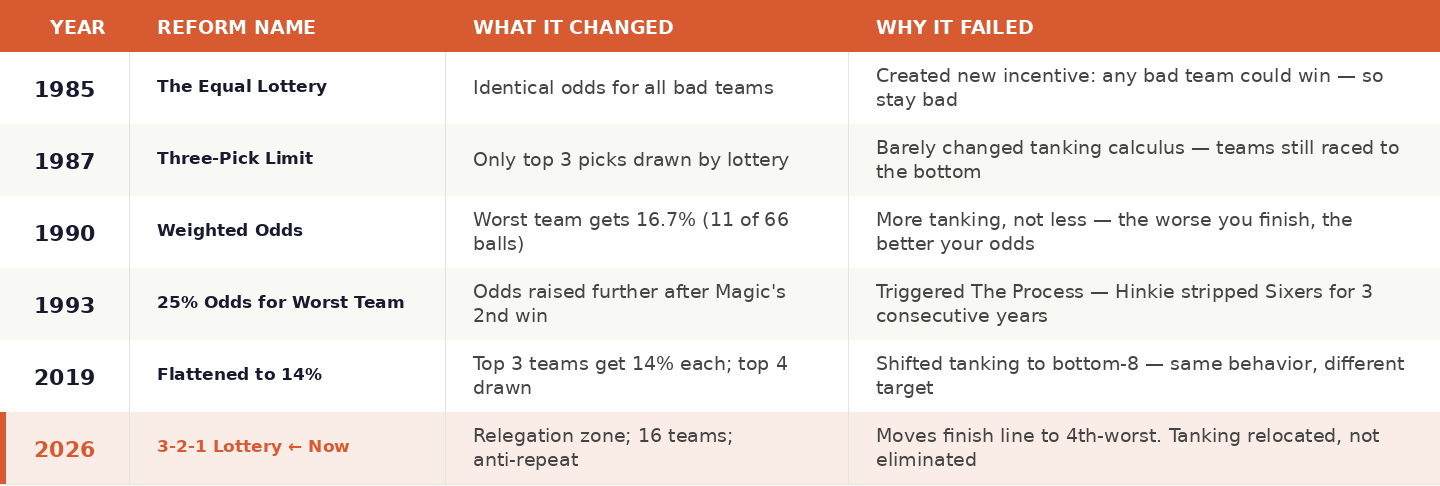
The NBA has modified its lottery system six times since its creation. Each time, the stated goal was the same: stop tanking. Each time, the result was the same: a different version of tanking.
1985 — The Equal Lottery
Every non-playoff team received the same odds — one envelope in a drum, equal chance at every pick. The Knicks, who had the third-worst record in the NBA, won the lottery and drafted Patrick Ewing. Conspiracy theories emerged immediately. The equal system created a new problem: with identical odds, any bad team had reason to stay bad. The fix had eliminated one perverse incentive and replaced it with another.
1987 — The Three-Pick Limit
The lottery would determine only the top three picks. The remaining non-playoff teams selected in inverse order of their regular-season records. The intent: reduce randomness. The result: barely changed the tanking calculus. Teams still competed to be as bad as possible.
1990 — The Weighted Lottery
The worst team received 11 of 66 ping-pong balls — roughly 16.7%. The intent: reward the very worst teams proportionally. The result: more tanking, not less. The system now explicitly told teams that the worse you finish, the better your odds. That is not an anti-tanking measure. That is a tanking instruction manual.
1993 — The Odds Increase
After the Orlando Magic won the lottery for the second year in a row despite having only a 1.5% chance, the system was weighted even more. The worst team's odds rose to 25%, effective with the 1994 draft. The result: The Process. Sam Hinkie looked at a 25% chance and decided to strip the Philadelphia 76ers to their studs for three consecutive seasons. The NBA had made the reward larger. Hinkie took the reward seriously.
2019 — The Flattened Odds
The three worst teams each received 14% odds at the top pick — down from 25%. Teams adapted. Instead of racing to the bottom, they began competing to finish in the bottom eight — maximizing lottery odds without the reputational cost of a full tank. The incentive shifted. The tanking did not stop.
2025-26 — The Season That Made Everything Worse
Six teams finished with fewer than 26 wins. The Jazz were fined $500,000 for "conduct detrimental to the league" — resting Lauri Markkanen and Jaren Jackson Jr. in fourth quarters of close games. The Pacers were fined $100,000 for violating the Player Participation Policy. Two franchises paid a combined $600,000 to lose games in a way the league could document. Many more did it in ways the league could not.
One factor that goes unmentioned in most coverage of this season: the 2026 draft class is historically deep. Darryn Peterson, AJ Dybantsa, Cam Boozer — three potential franchise players at the top, with viable starters projected through pick fifteen. Every analyst covering the May 28 vote has acknowledged this. Some of what looked like systemic failure in 2025-26 was a one-time class-driven surge. That does not excuse the tanking. It does mean any reform must work in lean draft years too, not just historic ones.
Forty years of modifications. The tanking problem is worse today than when the lottery was invented.
The Same Five Mistakes — In Every Reform, Every Time
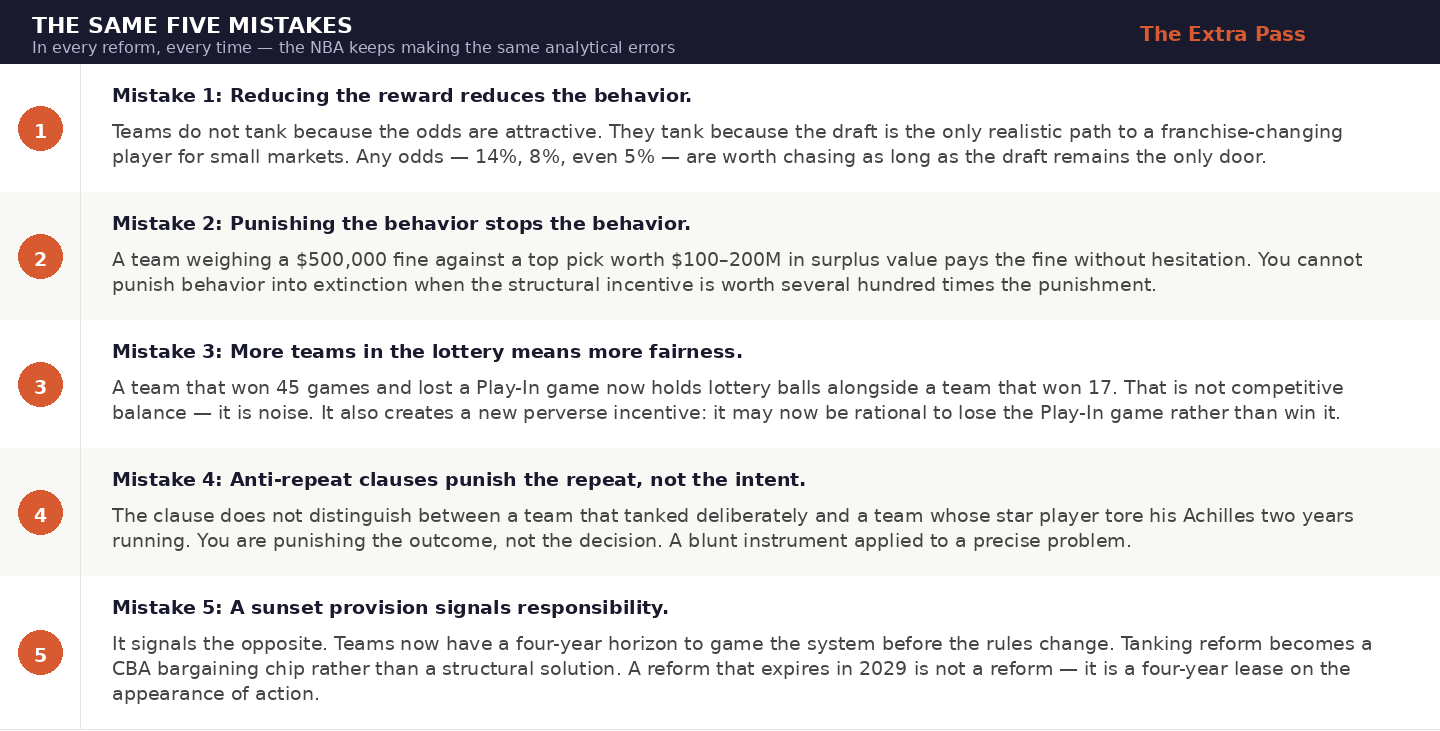
Before evaluating what the NBA should do, it is worth naming what it keeps doing wrong. The league has made the same five analytical errors in every reform cycle since 1985. The 3-2-1 Lottery repeats four of them.
Mistake 1: Reducing the reward reduces the behavior.
From 25% to 14% odds at the top pick. The logic sounds sound: make the prize smaller, and fewer teams will chase it. It is wrong. Teams do not tank because the odds are attractive. They tank because the draft is the only realistic path to a franchise-changing player for franchises in Memphis, Sacramento, or Utah. A team in a small market cannot outbid Los Angeles in free agency. It cannot absorb a superstar trade without gutting its roster. The draft is the only door. As long as that structural reality exists, any odds — 14%, 8%, even 5% — are worth chasing. You have reduced the jackpot without addressing why teams play the lottery in the first place.
Mistake 2: Punishing the behavior stops the behavior.
Fines. The Player Participation Policy. Documented violations. $500,000 to the Jazz. $100,000 to the Pacers. The implicit assumption: if losing is painful enough, teams will stop doing it deliberately. This ignores the arithmetic entirely. A team weighing a $500,000 fine against the value of a top draft pick — conservatively worth $50 to $200 million in surplus value over a rookie contract — pays the fine without hesitation. Every time. You cannot punish behavior into extinction when the structural incentive that produces the behavior is worth several hundred times the punishment.
Mistake 3: More teams in the lottery means more fairness.
Expanding from 14 to 16 lottery teams — now including Play-In losers. More access, more parity, more hope. In practice: a team that won 45 games and lost a Play-In game now holds lottery balls alongside a team that won 17. That is not competitive balance. That is noise. And it introduces a new perverse incentive the league has not publicly acknowledged: it may now be rational, in narrow circumstances, to lose the Play-In game rather than win it — because losing keeps you in the lottery while winning sends you to a first-round exit against the top seed. The reform designed to punish tanking has created a new tanking-adjacent decision point.
Mistake 4: Anti-repeat clauses punish the repeat, not the intent.
No team may receive more than three consecutive top-five picks. The intent is clear: stop Philadelphia-style multi-year tank jobs. The flaw is equally clear: the clause does not distinguish between a team that tanked deliberately and a team whose star player tore his Achilles two years running. Both receive the same penalty. You are punishing the outcome — consecutive bad records — rather than the decision to produce bad records deliberately. That is the equivalent of fining every driver caught going slowly without asking whether their brakes failed. Some teams finish last because they chose to. Others finish last because the basketball gods made that choice for them. A rule that treats both identically is not a reform. It is a blunt instrument applied to a precise problem.
Mistake 5: A sunset provision signals responsibility.
The league presents the 2029 expiration date as evidence of thoughtful, iterative governance. In practice, the sunset provision communicates three things the league does not intend to communicate. First: we do not believe this will work, or we would not need an exit. Second: teams now have a finite planning horizon for gaming the system — four years, then the rules change, so optimize for four years. Third: tanking reform is now on the same political calendar as CBA renegotiation, which means it becomes a bargaining chip rather than a structural solution. A reform that expires in 2029 is not a reform. It is a four-year lease on the appearance of action.
Where We Are Now — And What the 3-2-1 Plan Actually Does
The NBA's response to the worst tanking season in modern memory is the 3-2-1 Lottery. The name describes the core mechanic: non-playoff teams receive either three, two, or one lottery ball — depending on how bad their record was. More balls mean better odds at the top pick. The total pool contains 37 balls.
Teams finishing with the fourth through tenth-worst records receive three balls each — roughly 8.1% odds at the No. 1 pick. These are the teams the league wants to help: bad enough to need a star, not so bad they appear to be deliberately tanking.
Teams finishing with the three worst records — the so-called relegation zone — receive only two balls each, dropping their odds to 5.4%. For the first time in NBA history, the absolute worst teams are actively penalized in the draft order. The league is not just flattening the odds curve. It is reversing part of it.
The system also introduces two anti-repeat clauses: no team may win the No. 1 pick in consecutive drafts, and no team may receive more than three consecutive top-five picks. The intent is to prevent a Philadelphia-style multi-year strip-down from producing franchise players in unbroken succession.
Finally, the sunset provision — perhaps the most revealing detail in the entire proposal. A sunset provision is a built-in expiration date: the 3-2-1 system automatically terminates after the 2029 draft unless the Board of Governors votes affirmatively to renew or replace it. The league is running a four-year experiment with a contractual exit. The timing is deliberate — 2029 aligns with the expiration of the current Collective Bargaining Agreement. Translation: the league already knows it may need to change this again.
The relegation zone concept borrows terminology from European football — where the worst teams in a division are literally relegated to a lower league — but applies only the punishment logic, not the actual consequence. In European football, relegation means you lose your place in the competition entirely. In the NBA's version, relegation means you get slightly fewer lottery balls. It is the aesthetics of radical reform without the substance.
In practice, the 3-2-1 proposal moves the target. The sweet spot for maximizing lottery odds is now finishing with the fourth-worst record. The NBA has not eliminated the race to the bottom. It has moved the finish line up three spots.
The anti-repeat clauses punish success as much as failure. Under the consecutive-top-five rule, the San Antonio Spurs' rebuild that produced Wembanyama in 2023, Stephon Castle in 2024, and Dylan Harper in 2025 would have hit the structural ceiling exactly when most rebuilds gain momentum. The league is designing rules against arguably the most successful talent-acquisition sequence of the last decade.
The 3-2-1 Lottery does not solve tanking. It relocates it.
The Deeper Contradiction — A Socialist Enterprise Run by Capitalists
Before getting to solutions, it is worth stating plainly what nobody in the league's official communications will say.
The NBA is a capitalist enterprise composed of billionaire owners competing ferociously for wins, players, revenue, and fans. It generates over $11 billion annually, charges $4 to $6 billion for expansion franchises, and negotiated $76 billion in television deals through 2036. Every team is structured as a profit-maximizing business.
And yet. The NBA operates a salary cap that limits spending. It redistributes television money from large markets to small ones. It gives the worst teams the best players. It punishes teams for spending too much and rewards teams for losing.
This is not capitalism. This is a planned economy (Socialism) with a luxury box.
The owners vote simultaneously for fierce competition and strict limits on how fiercely they can compete. They want a free market for tickets and television rights, and a controlled market for players and draft picks. Neither mechanism works cleanly because they are pulling in opposite directions — and every reform of one creates new pressure on the other. This is not a problem that can be fixed by adjusting lottery odds. It is a structural contradiction built into the league's DNA in 1947 and never resolved. Whether that contradiction is ultimately a feature or a flaw of the NBA's model is a debate for another article. What matters here is simpler: as long as it exists, tanking is not a bug. It is a rational response to the system's own incentives. And no lottery reform — including the 3-2-1 — touches that.
The Five Tests — How We Evaluate Every Proposal
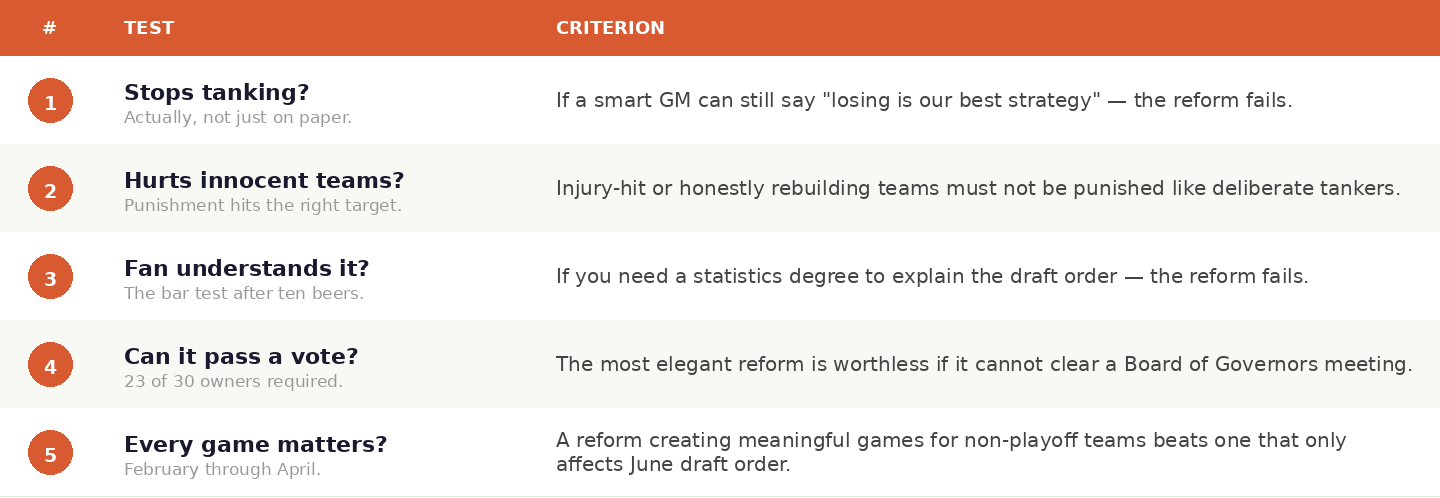
Before evaluating any reform proposal, we need a shared scorecard. Five questions. Every idea gets graded against the same five tests.
The Reform Landscape — Five Categories, Five Different Philosophies
Forty years of debate have produced dozens of reform proposals. They fall into five distinct categories — each with a different philosophy and a different answer to the same question: what is the NBA actually trying to achieve? We evaluate each against the same five tests.
Category 1 — The Straightforward System (The NFL Model)
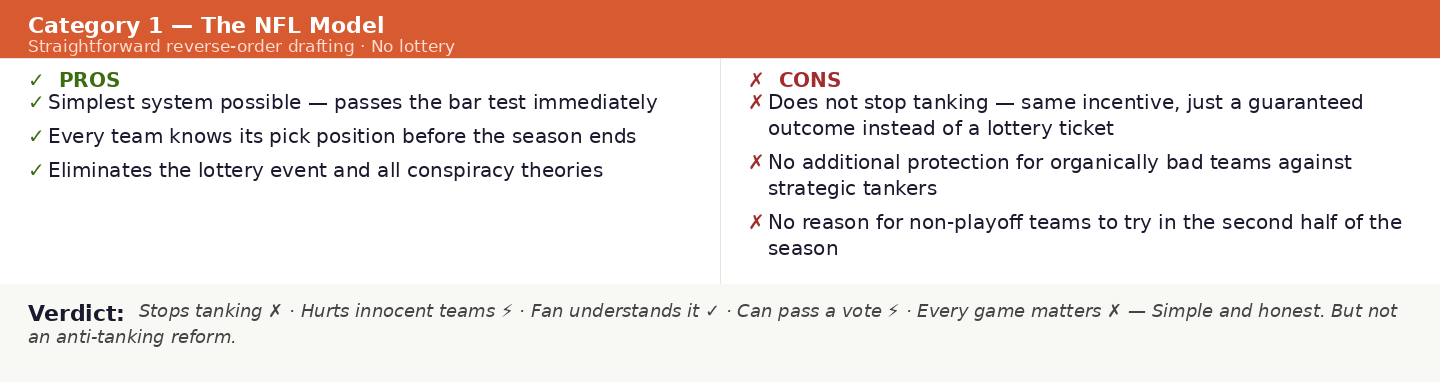
Before all the complexity, there is the obvious answer. The one that already works in America's most popular sports league.
The NFL uses pure reverse-order drafting. The worst team picks first. The Super Bowl champion picks last. No lottery. No ping-pong balls. No probability curves. When two teams finish with identical records, the tiebreaker is strength of schedule — but in the opposite direction from what intuition might suggest: the team with the weaker schedule receives the better pick. The logic is sound: if your record is the same as another team but you played easier opponents to get there, you are probably the worse team. A coin flip resolves any remaining ties.
Applying this to the NBA is slightly more complex — 82 games against an unbalanced schedule creates more variation than 17 NFL games — but Basketball-Reference already produces strength-of-schedule metrics for every team every season. The infrastructure exists. And crucially: it would also eliminate the NBA Draft Lottery as a televised event, which removes a few days of media coverage but would not trouble the average fan in the slightest.
The reason the NBA has never adopted this model is not technical. It is political. The lottery gives every bad team hope, even the ones that are not the worst. Removing the lottery removes that hope, and those teams vote against it every time.
Category 2 — Reward Winning, Not Just Punish Losing (The Second-Half Wins System)
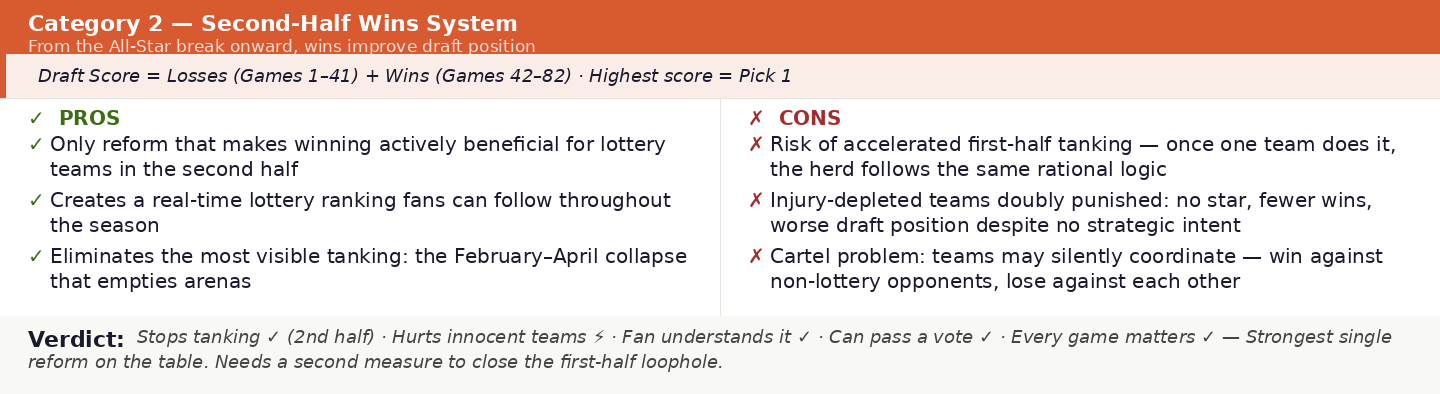
The most compelling category — and the only one that creates a positive incentive rather than a negative one. The core idea: from the All-Star break onward, wins improve lottery position rather than losses. The ten lottery teams (bottom five per conference) accumulate a draft score combining losses in the first half of the season with wins in the second half.
The Adam Gold Plan, first proposed at the 2012 MIT Sloan Sports Analytics Conference and officially adopted by the Professional Women's Hockey League in 2024, operates on a similar inversion: once eliminated from playoff contention, every subsequent win improves draft position. A Yahoo Sports / Boardroom-syndicated proposal from February 2026 extends this logic to a fixed calendar split using the All-Star break as the threshold.
One important caveat before citing historical data: any reference to past seasons as "proof" of this system's effect is a logical error. No team in NBA history has played under this rule. No team has ever known that second-half wins would improve its draft position. The behavior that would emerge — strategic effort in the second half, managed rest in the first — has never existed, because the incentive never existed. We cannot model the past to predict the future here. We can only model the structure of the incentive.
The timing challenge is real: the All-Star Game falls in mid-to-late February, leaving roughly 27 to 35 games in the second half depending on the calendar year. For the system to function cleanly, every lottery team must have played the same number of games before and after the break. This requires careful scheduling — not impossible, but not automatic either.
Category 3 — Sever Record From Pick Entirely (The Wheel)
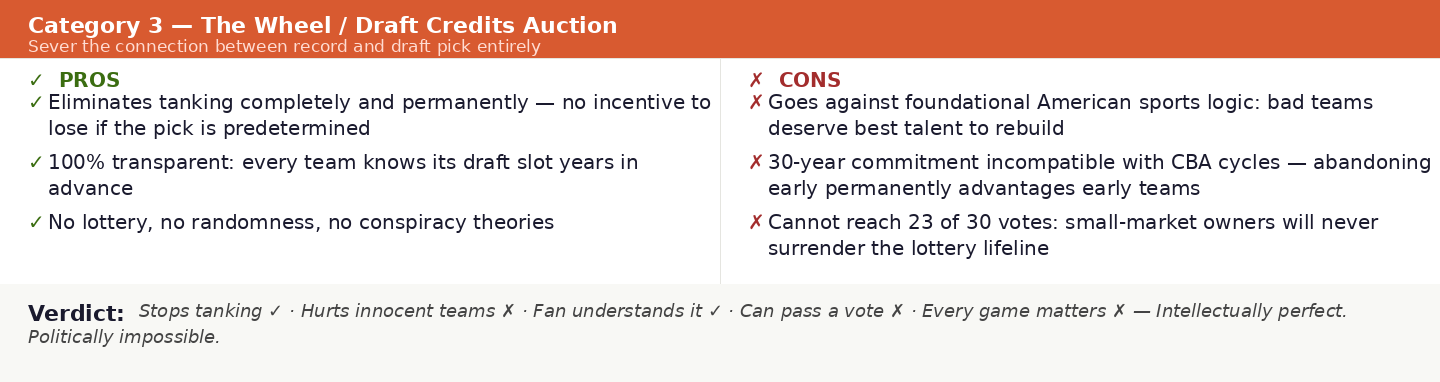
Mike Zarren's Wheel, first proposed in December 2013, is the most structurally clean solution. Every team cycles through all thirty draft slots over thirty years in a predetermined sequence. The pick is fixed before the season begins. Losing changes nothing. Tanking becomes structurally impossible — there is nothing to tank for.
The cycle is designed so every team receives a top-six pick at least once every five years and a top-twelve pick at least every four years. Predictability replaces randomness. Front offices can plan years in advance.
There is a version of the Wheel that is slightly more flexible — Zarren's own revised "Bucket Wheel" groups teams into tiers and uses a mini-lottery only within each bucket — but the core principle is unchanged: the connection between record and pick is severed completely.
A related variant surfaced in April 2026: Zach Lowe reported a "Draft Credits Auction" concept circulating in GM meetings. Each team receives 100 draft credits per year and bids them on individual picks. Credits can be traded, rolled over to future seasons, and deeper playoff runs consume credits. The mechanism is different — auction instead of fixed cycle — but the underlying philosophy is identical: break the link between losing and lottery position.
All three versions are theoretically elegant. All three are politically dead. And there is a structural fairness problem that goes beyond politics: if the Wheel is changed or abandoned after ten years, the teams that picked highest in the first decade receive a permanent advantage. For the system to be fair, it must run its full thirty-year cycle. No other reform in this article requires a thirty-year political commitment.
Category 4 — Make Losing Structurally Costly (Relegation)
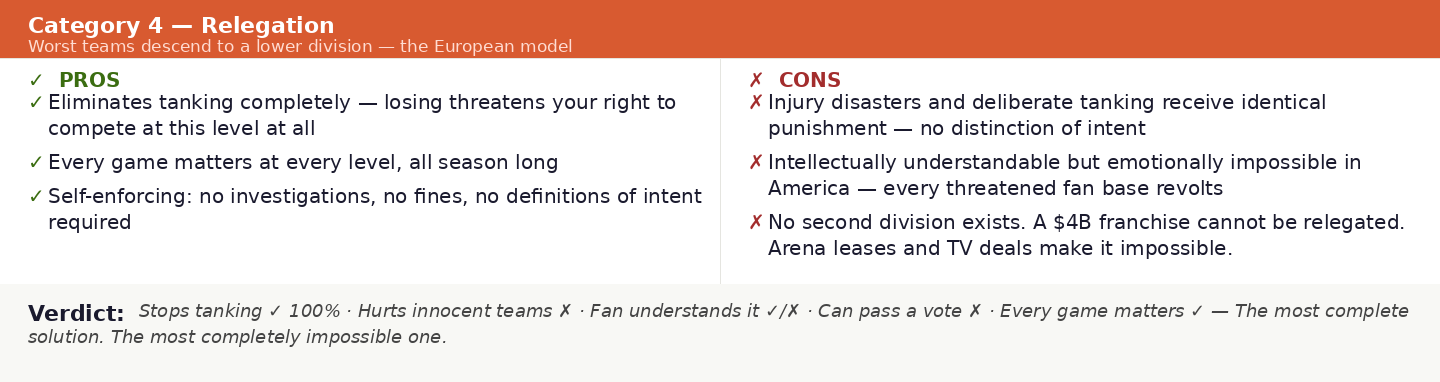
The European model. The worst teams in the league are relegated to a lower division at the end of each season. The best teams in the lower division are promoted. No draft lottery. No tanking. Every game at every level carries existential stakes.
It works in European football precisely because the consequence is real — Serie B is real, Bundesliga 2 is real, the Championship is real. Relegation does not threaten draft odds. It threatens your right to play in the league at all. That is the single most powerful anti-tanking mechanism ever devised in professional sport.
The NBA does not have a functional second division. The G-League exists but operates on fundamentally different economics. And a franchise that paid $4 billion for its NBA membership cannot be relegated to a league where that membership is worthless. The arena lease, the television deal, the sponsorship structure, the city relationship — none of it survives a one-year drop. The owners who would vote for relegation do not exist. The infrastructure that would make it viable does not exist. The American sports culture that would accept it does not exist.
Category 5 — Incremental Mechanical Tweaks (The League's Default)
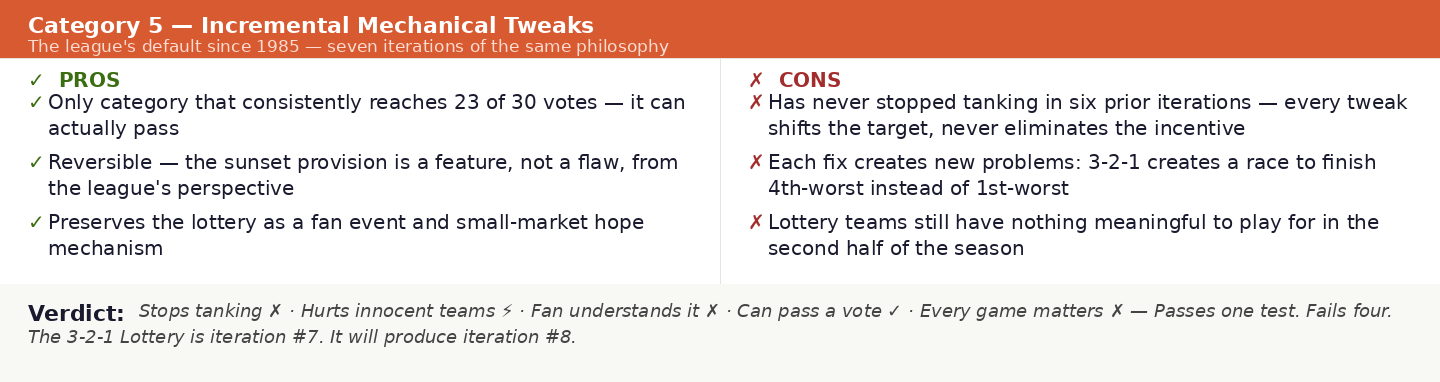
The 3-2-1 Lottery. The 2019 flattening. The 2017 flattening. The 1993 weighting. The 1990 weighting. The 1987 procedural change. The 1985 equal lottery.
Seven iterations of the same philosophy: adjust the odds, shift the incentive curve slightly, watch teams adapt, repeat. This is the league's revealed preference — not because it works, but because it is the only category that can pass a 23-of-30 vote. The 3-2-1 Lottery is the seventh iteration. It will produce the eighth problem that requires the ninth fix.
The Reforms That Would Actually Work — And Why They Never Will
Before naming what is achievable, it is worth naming what would actually work. Not the reforms that move the target. The reforms that eliminate it.
Five proposals — two combination packages and three standalone measures — score highest on the only test that matters for tanking elimination: does it make losing so painful that no rational front office would choose it deliberately?
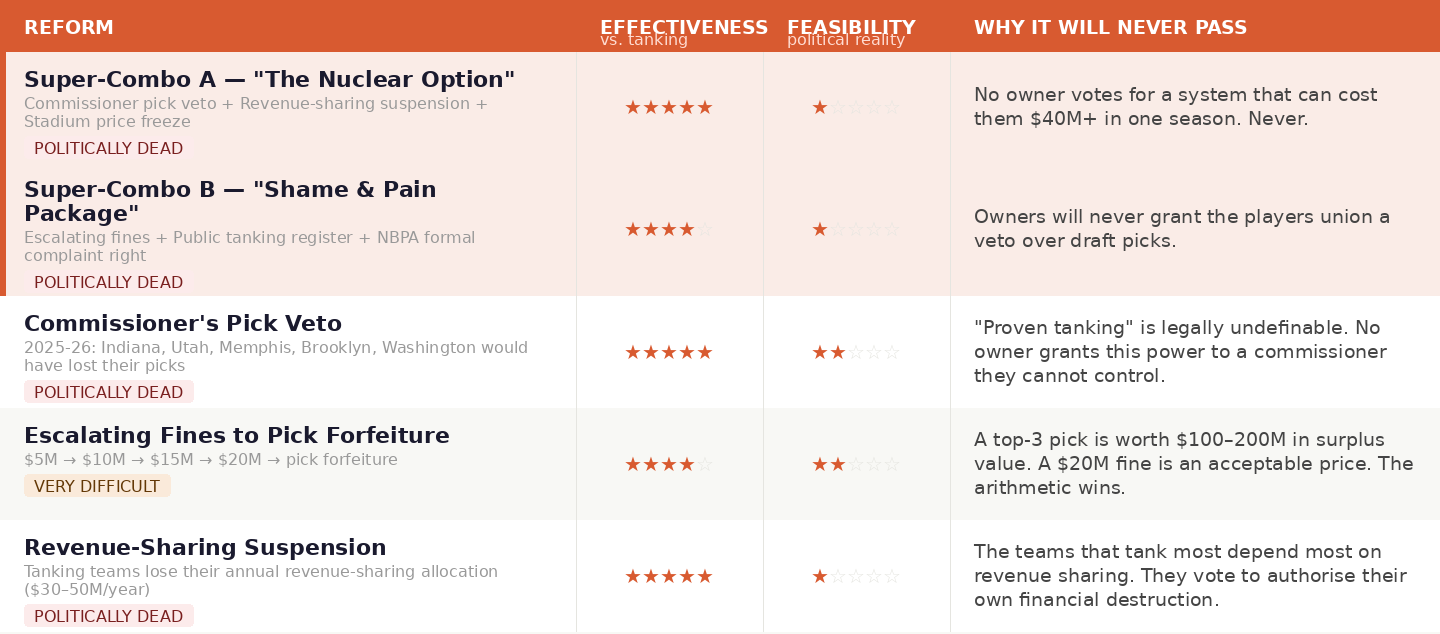
The most powerful single instrument is the Commissioner's Pick Veto. After a formal competitive-integrity investigation, the commissioner can strip a team of its lottery pick and redistribute it. Applied to 2025-26: Indiana, Utah, Memphis, Brooklyn, and Washington would likely have lost their picks. Chicago — genuinely bad, not strategically bad — would have emerged as the top selection. One decision. Immediate consequence. Maximum deterrence. The reason it will never pass is equally simple: "proven tanking" is legally almost undefinable. Every ownership group has lawyers. And no owner votes for a commissioner they cannot control to hold that kind of power.
The most financially devastating option is Revenue-Sharing Suspension. Teams found to be tanking lose their annual share of league revenue distribution — typically $30 to $50 million for small-market franchises. This hits precisely the teams that tank most aggressively, and it hits them where it hurts most: not the basketball budget, but the operating budget. The deterrent is existential. It is also politically suicidal — the teams most likely to tank are the teams most dependent on revenue sharing. They would be voting to authorize their own financial destruction.
Escalating fines to pick forfeiture — $5 million for a first violation, $10 million for a second, $15 million for a third, $20 million for a fourth, pick forfeiture for a fifth — is the most politically credible proposal on this list. It still sits at roughly 18% likelihood of passing. The arithmetic problem is unchanged: a top-four pick generates $100 to $200 million in surplus value over a rookie contract. A team that has decided to tank will pay $20 million happily. Every time.
The two combination packages amplify each individual mechanism. The Nuclear Option — commissioner veto plus revenue-sharing suspension plus stadium price freeze — stacks three simultaneous consequences that cannot all be challenged in the same courtroom. The Shame and Pain Package — escalating fines plus a public competitive-integrity register plus a formal NBPA complaint right — creates simultaneous institutional, financial, and reputational pressure from three directions at once.
Neither will pass. Together they represent the blueprint for a league serious enough about the problem to actually solve it. The NBA is not that league. Not yet.
The Shadow the 3-2-1 Plan Casts Forward
Even before the May 28 vote, the next version of the problem is already visible.
Under the 3-2-1 system, the optimal strategy shifts from "be as bad as possible" to "finish fourth-to-tenth worst." Teams will now manage their record with surgical precision — good enough to avoid the relegation zone, bad enough to maximize lottery balls. The Utah Jazz, fined $500,000 this season for overt tanking, would simply tank to a different target under 3-2-1. The behavior does not change. The destination changes.
The anti-repeat clauses will produce their first victim within two drafts. A team that genuinely needs consecutive high picks due to injuries or bad luck — not by choice — will be penalized by a rule designed for teams that game the system. The league will then need a medical-exception carve-out for the anti-repeat clause. Which will create a new gaming opportunity. Which will require a new fix.
The sunset clause expires in 2029 — aligned with the CBA opt-out window. The league is already building the timeline for the next reform debate into the current reform proposal.
My Verdict — The Only Combination That Actually Works
No single category passes all five tests. But two reforms combined come closer than anything the league has ever proposed — and both are explainable to a fan in a bar after ten beers.
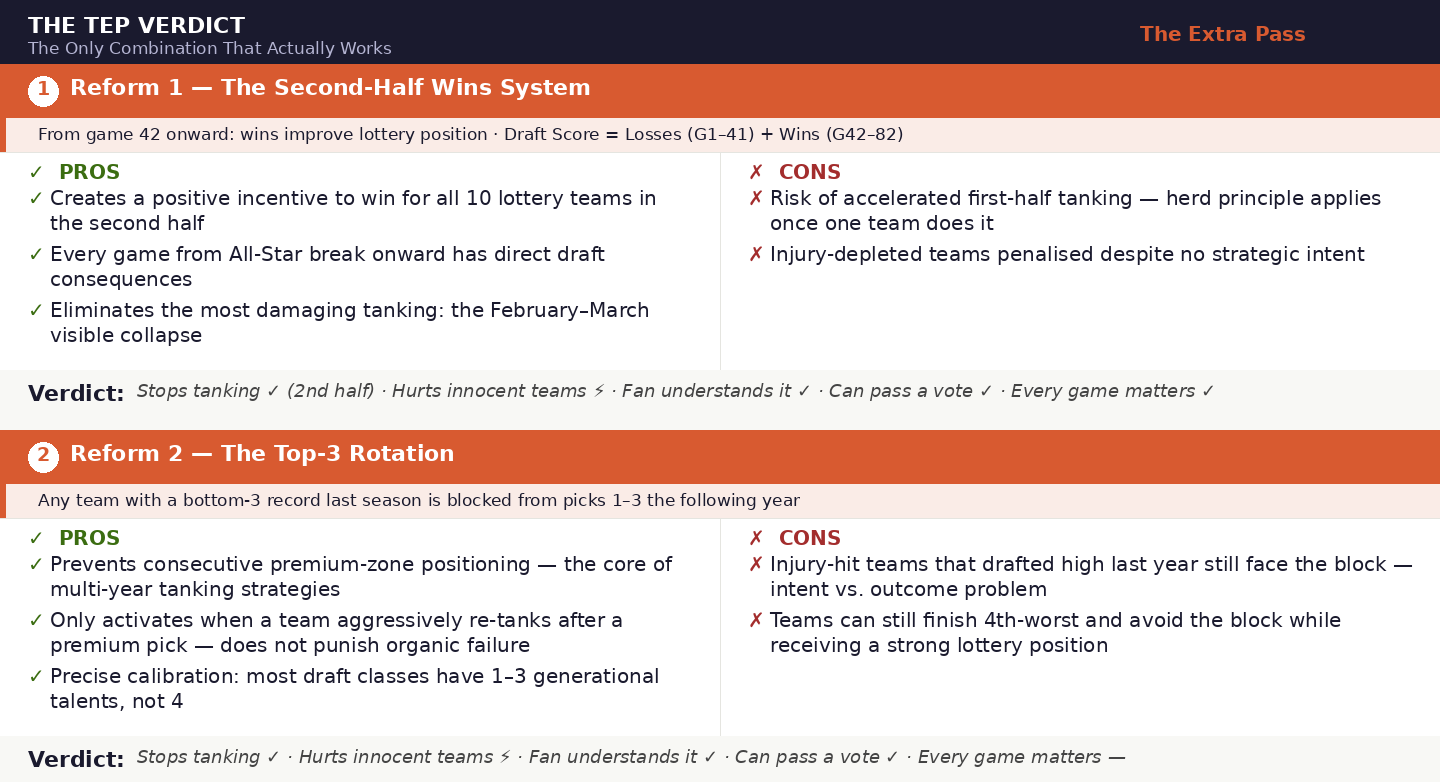
Reform 1: The Second-Half Wins System
From the All-Star break onward — specifically from game 42 of the season — wins improve lottery position for the 10 teams that miss the Play-In tournament entirely (the bottom 5 in each conference). Losses in the first half build the baseline draft position. Wins in the second half improve it. The formula:
Draft Score = Losses (Games 1-41) + Wins (Games 42-82). Highest score = Pick 1.
A team that tanks through the first half then wins in the second half gets credit for both. A team that tanks all season gets credit only for the first half. The incentive structure flips precisely when tanking becomes most visible and most damaging to the product — the stretch from February to April.
Applied to the 2025-26 Lottery Teams: Washington Wizards, Indiana Pacers, Brooklyn Nets, Chicago Bulls, Milwaukee Bucks (East) and Utah Jazz, Sacramento Kings, Memphis Grizzlies, New Orleans Pelicans, Dallas Mavericks (West). With realistic splits, teams that tried harder in the second half would move up — and teams that tanked through April would fall.
Test 1 ✓ | Test 2 ✓ | Test 3 ✓ | Test 4 ✓ | Test 5 ✓
Reform 2: The Top-3 Rotation
Any team that had one of the three worst records in the previous season is automatically excluded from lottery picks 1-3 in the following season. They land between picks 4-7 based on their current-season record. The three worst records of the current season — excluding any blocked teams — fill picks 1-3.
Applied to 2025-26: Dallas Mavericks had Pick 1 in 2025 (Cooper Flagg). Dallas finished 26-56 in 2025-26 — which would have placed them at Pick 7 by record anyway. The rule does not engage. But had Dallas tanked again to a bottom-3 record, they would have been blocked from picks 1-3 regardless. That is the deterrent.
The rule only activates when a team aggressively tanks after already receiving a premium pick. It does not punish teams that are organically bad. It does not punish injury-hit teams that happen to land in the bottom 10. It punishes only deliberate, consecutive premium-zone positioning. And it is calibrated correctly: most draft classes have one to three generational talents at the top, not four. Pick 4 is valuable — but it is rarely franchise-defining in the way Picks 1-3 are. The precision of the blocking zone matches the precision of the problem.
Test 1 ✓ | Test 2 ✓ | Test 3 ✓ | Test 4 ✓ | Test 5 —
Together:
The Second-Half Wins System changes the incentive structure for the entire second half of every season. The Top-4 Rotation closes the multi-year exploitation window. Neither requires abolishing the draft. Neither requires relegation. Neither destroys small markets. Both can be explained in two sentences.
In the spirit of applying to ourselves the same scrutiny we apply to others: this hybrid is not flawless. Reform 1 inherits the asymmetric-elimination problem from the Gold Plan family — a team mathematically out of contention in January has more games to accumulate "winning credit" than one eliminated in March. Reform 2 inherits a softened version of the Wheel's bad-team-locked-out problem: a franchise that drafted Pick 1 last year and then loses its new star to injury is still blocked from picks 1-3. The precision of the Top-3 threshold — rather than Top-4 — reduces but does not eliminate this risk. Neither flaw is fatal. Both are smaller than the corresponding flaws in the 3-2-1 plan. But pretending the combination is perfect would be exactly the kind of overclaim this article has criticized in every previous reform.
The 3-2-1 Lottery passes one test: it can probably get 23 votes on May 28. It fails the other four.
A League at War With Itself
Adam Silver is an intelligent commissioner operating inside a system that resists its own repair. The 3-2-1 Lottery is not a bad proposal — it is a proposal that does the politically possible while leaving the structurally necessary undone. It will pass on May 28, or it will fail as the 2014 proposal failed, and the league will return with a modified version before the 2028 CBA.
Either way, the fundamental contradiction remains. A socialist enterprise run by capitalists. A competitive league that votes to limit competition. A system that tells its worst teams that losing is the fastest path to winning — and then fines them for believing it.
The 3-2-1 Lottery casts its shadow forward already. The teams that will game it are already doing the math. The reform debate for the 2028 CBA window has already begun, even if nobody has said so out loud.
The loop continues. It has continued since 1947. It will continue until the league decides to reward winning rather than just punish losing — and has the courage to pass the reform that actually does that.
That reform exists. The league knows what it is. It just keeps voting for something easier.
Sources & Methodology
This article draws on primary reporting, official NBA records, and historical archives. All factual claims have been verified against the sources listed below. Where contemporary quotations are used, they are taken from on-the-record press appearances or formally attributed reporting.
The 3-2-1 Proposal (April–May 2026)
ESPN reporting by Tim Bontemps and Shams Charania, April 28 and May 13–14, 2026. Yahoo Sports coverage of the Board of Governors agenda. Adam Silver press remarks at All-Star Media Day, February 14, 2026. The 37-ball distribution and odds calculations (8.1% / 5.4% / 2.7%) are confirmed against NBA league office briefings reported by both ESPN and Yahoo.
Historical Lottery Iterations
NBA.com official draft lottery history. Basketball-Reference draft archives. CBS Sports "Complete History of the NBA Draft Lottery" (2023, updated 2025). Wikipedia's NBA Draft Lottery article (cross-checked against primary sources). 1985, 1987, 1990, 1993/1994, 2017, and 2019 reforms verified through multiple primary sources.
Houston Rockets 1983–84 and the Coin Flip Era
Grantland's oral history "The Greatest Team That Never Was" (Olajuwon / Sampson / 1980s Rockets). David Stern's contemporaneous quotation drawn from that source. Frank Layden's account of unnamed Houston executive cited in Filip Bondy's Tip-Off and contemporary reporting. The "9 of last 10" figure is verified via Basketball-Reference game logs; broader late-season patterns described in qualitative terms only.
2025–26 Season Data and Tanking Fines
Final standings: Basketball-Reference, ESPN, NBA.com. Jazz $500,000 fine (February 2026) and Pacers $100,000 fine (February 2026): NBA league office announcement, covered by ESPN, Yahoo Sports, and ClutchPoints. Quoted league language ("conduct detrimental to the league" for Jazz; "Player Participation Policy violation" for Pacers) drawn directly from the league's public statements.
Reform Proposals
Adam Gold Plan: presented at MIT Sloan Sports Analytics Conference 2012; officially adopted by the Professional Women's Hockey League in February 2024 (PWHL official communications, CBC Sports, The Hockey News). Mike Zarren's Wheel: Zach Lowe's Grantland reporting, December 2013; revised "Bucket Wheel" presented at MIT Sloan 2014. Zach Lowe's Draft Credits Auction concept: reported via Lowe's podcast and discussions, April 2026, coverage by Heavy.com and Opencourt-Basketball. Yahoo Sports / Boardroom-syndicated "Second-Half Wins" proposal: February 2026.
League Financials
NBA annual revenue: Forbes, Sportico, and league financial disclosures (2023–24 figures, projected forward). $76 billion media rights agreements (2025–26 through 2035–36): Disney/ESPN, NBC/Peacock, and Amazon Prime Video, finalized July 2024. Expansion franchise fee estimates ($4–6 billion range): Bloomberg, ESPN, The Athletic reporting, 2024–2025.
2025 NBA Draft
Pick order and selections verified via NBA.com, Basketball-Reference, NBC News live blog coverage, and Al Jazeera draft recap. The Spurs' three-year sequence (Wembanyama 2023, Castle 2024, Harper 2025) is documented across all major basketball outlets.
Editorial Disclosures
The "Second-Half Wins System" and "Top-4 Rotation" proposals in this article are the editorial position of The Extra Pass. They are presented as such — not as neutral journalism — and have been subjected in the body of the article to the same five-test scorecard applied to competing reforms. The self-critical paragraph in the TEP Verdict section names the inherited weaknesses of each component. Readers are encouraged to apply their own tests.
Where reporting on the 3-2-1 proposal evolves after publication — particularly following the May 28 Board of Governors vote — this article will be updated via dated update banner. The original text will not be silently revised.