FRANCHISE HISTORY: MEMPHIS GRIZZLIES
FRANCHISE HISTORY SERIES — #3 - Right Place At The Wrong Time. A Story About A Franchise That Could Not Make It In A Global City
2.2.
That is the career points-per-game average of Hasheem Thabeet, selected second overall by the Memphis Grizzlies in the 2009 NBA Draft. The same draft produced James Harden at third, Ricky Rubio at fifth, and Stephen Curry at seventh. Thabeet played five NBA seasons and averaged 2.2 points and 2.7 rebounds per game across 224 games for four franchises. Curry won four championships and changed what basketball looks like. The Memphis Grizzlies, holding the second pick in one of the decade’s deepest drafts, selected the player with the worst career output.
2.2 is not the whole story of the Memphis Grizzlies. It is the most concise version of their central tension: an organisation capable of building extraordinary things and simultaneously capable of extraordinary failure. The same front office that turned Marc Gasol — the 48th pick, received as a consolation prize in a trade the entire basketball world called robbery — into a Defensive Player of the Year, also selected Thabeet over Curry with the second pick in the draft. The contradiction is not the problem. It is the story.
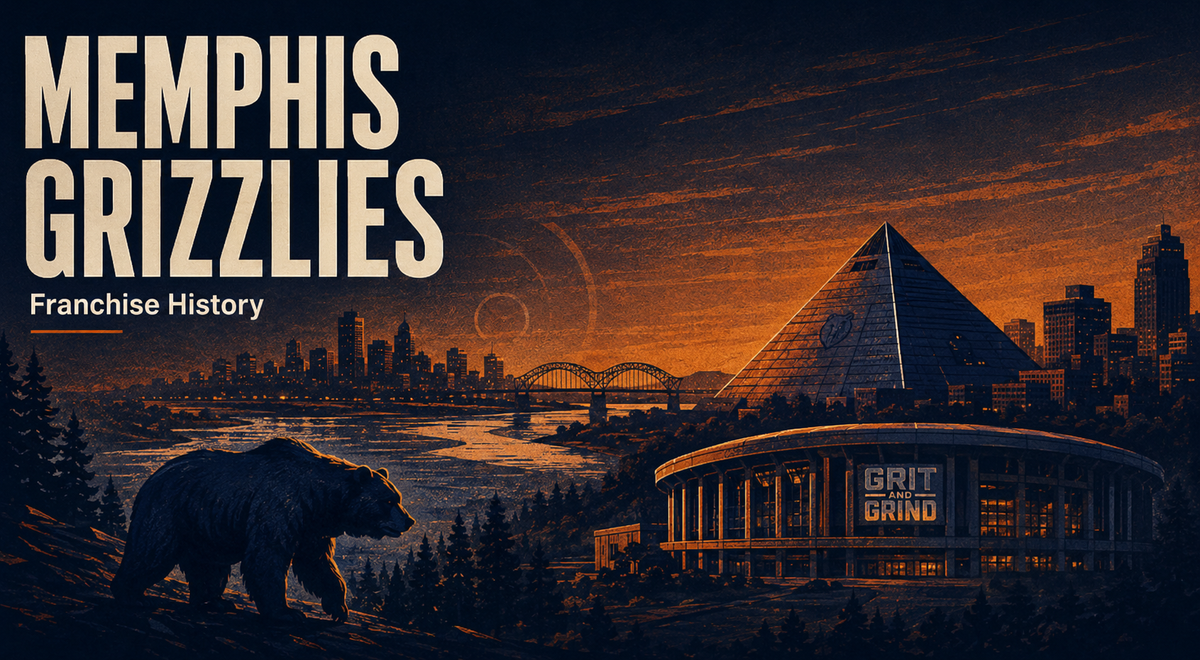
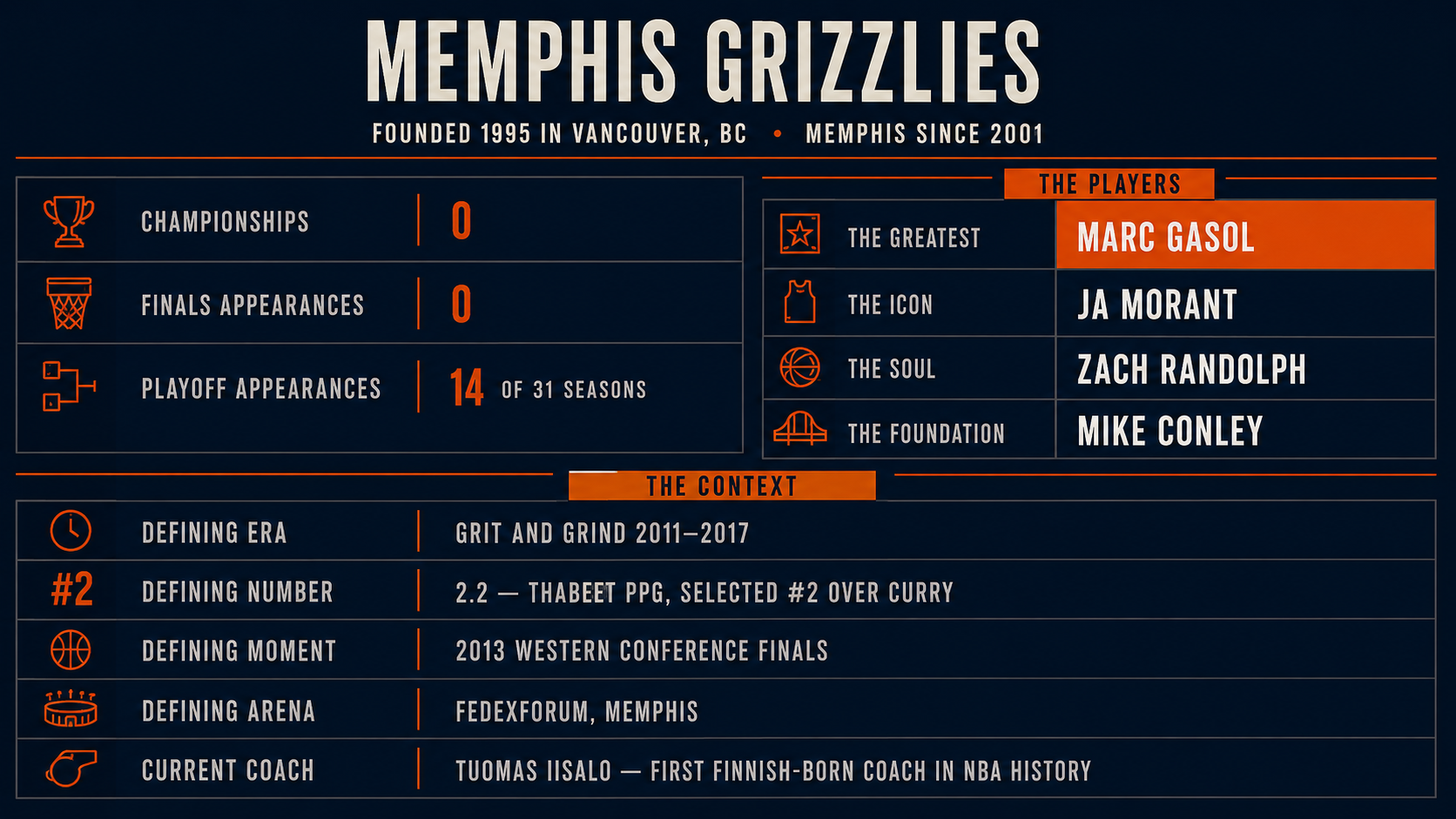
The Memphis Grizzlies have never reached the NBA Finals. They began as the Vancouver Grizzlies, where even their own first-round picks refused to report. They relocated to Tennessee in 2001 with nothing except a name and enough accumulated failure to fill a decade of losing. What they found in Memphis was a city that had been overlooked by American professional sports for too long — waiting, without knowing it, for a basketball team as unglamorous, as hard-working, and as underestimated as itself. For thirty-one seasons, that partnership has produced exactly one Western Conference Finals appearance, fourteen playoff seasons, and an identity so authentic that the city adopted it without hesitation.
Vancouver: 6 Seasons of Failure & the Player Who Refused to Show Up
The Vancouver Grizzlies entered the NBA in 1995 alongside the Toronto Raptors. Toronto became a legitimate franchise with a loyal fanbase and, eventually, a championship. Vancouver became a case study in structural failure. In six seasons, the Grizzlies won 101 games and lost 359 — a .220 winning percentage, the lowest in NBA history for any franchise that played at least five seasons. They never made the playoffs. They finished last in their division in all but one season. Their best record was 23–59, achieved in their final Vancouver season.
General manager Stu Jackson made a series of draft decisions that institutionalised the losing. Bryant Reeves, selected sixth in 1995, was signed to a six-year, $65 million extension in 1997 that immediately crippled salary cap flexibility. He averaged 12.5 points per game for his career and declined sharply after 1998 as weight and back injuries took hold, rendering his stationary low-post skill set progressively less valuable as the league moved toward pace-and-space. The franchise also missed Michael Finley (21st overall, 1995), drafted repeatedly at point guard without developing one, and traded a 2003 first-round pick for Otis Thorpe, who reportedly hated Vancouver. The Reeves contract was the structural lesson Vancouver never internalised: long-term commitments to players without mobility or perimeter creation are existential risks in a sport in motion.
Then came the defining moment: Steve Francis, second overall in 1999. The Maryland point guard had made clear — publicly, before David Stern even called his name — that he did not want to play in Vancouver. He cancelled a scheduled press conference on draft night, was traded to Houston in an eleven-player, three-team deal before the season began, and shared Rookie of the Year honours with Elton Brand in a Rockets uniform. None of it happened as a Grizzly.
Francis never played a game for Vancouver. He is, nonetheless, the player who most completely defined the franchise’s Canadian era — because his refusal to come summarised everything the organisation could not fix: a franchise that its own top picks did not want to join, in a city that was failing to give them a reason to change their minds.
Attendance fell every season. A weak Canadian dollar made the franchise financially unviable. The 1998–99 lockout accelerated the deterioration. Owner Michael Heisley, who purchased the team in April 2000 for $160 million with a stated commitment to keeping it in Vancouver, faced more than $40 million in operating losses for the 2000–01 season alone — and began exploring US relocation options within months. Memphis was announced as the destination on March 26, 2001. The NBA Board of Governors approved the move unanimously on July 3, 2001. The Vancouver Grizzlies played their last game on April 18, 2001 — ending one of the least successful six-year stretches in NBA franchise history.
Memphis, Pau Gasol, and the European Blueprint That Built the Foundation
The relocation to Memphis deserves context. Memphis was not the NBA first choice for the Grizzlies. Louisville, Columbus, and Kansas City were considered. Memphis won because of FedExForum and because civic leadership moved faster and more decisively than competitors. The franchise arrived partly by accident, partly by civic ambition, and partly because the NBA had run out of better options at that price point and timeline.
Jerry West arrived in Memphis in 2002 as president of basketball operations, having already assembled championship rosters in Los Angeles across three decades. His Memphis tenure from 2002 to 2007 was the most competent front-office stretch in franchise history before Zach Kleiman: he drafted Mike Miller, Shane Battier, and maintained a roster philosophy built around defensive players who could contribute without being the primary offensive option. He understood the Pau Gasol foundation he had inherited and built methodically around it.
Memphis in 2001 was not an obvious NBA destination. A mid-sized Southern city best known for blues music, Beale Street, and Elvis Presley, it had no previous major professional sports franchise. What it had was FedExForum — a new arena built specifically to attract a franchise — and a civic leadership that understood the symbolic importance of professional sports to a city’s sense of self.
The franchise’s first Memphis seasons were losing seasons: 23–59 in 2001–02, 28–54 in 2002–03. The arrival of Pau Gasol changed the trajectory immediately. Selected third overall by the Atlanta Hawks in the 2001 NBA Draft on June 27, his rights were traded the same night to the Grizzlies — still nominally the Vancouver franchise, days before the Board of Governors finalised the Memphis relocation — for Shareef Abdur-Rahim. The Spanish forward won Rookie of the Year with 17.6 points and 8.9 rebounds per game across all 82 games. He was the first international player to win the award. Under Jerry West, hired as president of basketball operations in 2002, the Grizzlies won 50 games in 2003–04 and made the playoffs for the first time in franchise history.
His Memphis years — six and a half seasons, 2001–2008, averaging 18.8 points, 8.6 rebounds, and 3.1 assists per game across 476 games — produced the only sustained star quality the franchise had possessed since arriving from Vancouver. He arrived from FC Barcelona at age 20, developed through a Spanish basketball system that produces players whose footwork, passing, and positional intelligence are built from a tradition of teaching basketball as a collective craft. His Rookie of the Year award preceded Manu Ginobili’s peak in San Antonio, Dirk Nowitzki’s MVP in Dallas, and the broader internationalisation of the NBA that the 2000s produced. His post-Memphis career extended what Memphis built into championships elsewhere: two titles with the Lakers in 2009 and 2010, a Finals appearance with San Antonio in 2013, and a championship with Toronto in 2019 — the same season the Grizzlies traded his younger brother Marc to Toronto. Both Gasol brothers won their first NBA championships in the same city. Memphis had one of them for six and a half years and the other for eleven. Neither ring is Memphis’s.
The context of the 2019 championship matters for Memphis. The Raptors clinched the title with a 114–110 win in Game 6 at Oracle Arena on June 13, 2019, three days after Kevin Durant ruptured his Achilles in Game 5. Marc Gasol averaged 12.0 points, 7.3 rebounds, and 2.7 assists across the six-game series, making the defensive reads and entry passes that organised the Toronto offence at moments the series demanded discipline rather than star creation. He was 34 years old, in his twelfth professional season and his first away from Memphis. Memphis watched from a distance, having received Delon Wright, Jonas Valanciunas, C.J. Miles, and two first-round picks in the trade. Those assets became part of the foundation that produced Ja Morant via the 2019 draft — which means the Marc Gasol trade is the most direct line between the Grit and Grind era and the Morant era. Memphis traded its greatest player and received the assets that allowed it to draft its next great player. The transaction is one of the most consequential in small-market franchise building since the Boston Celtics used the Robert Parish trade to acquire Kevin McHale in 1980.
After retiring in 2021, Pau Gasol returned to Girona BC for one symbolic season, then transitioned into basketball administration and philanthropy. Memphis was the beginning.
The Trade That Looked Like a Robbery and Built an Era
On February 1, 2008, the Memphis Grizzlies traded Pau Gasol to the Los Angeles Lakers. Memphis received Marc Gasol, Kwame Brown, Aaron McKie, Javaris Crittenton, and two first-round picks. The immediate reaction was brutal: Stephen A. Smith’s televised rant on ESPN — ‘Kwame Brown is gone! This man is a bonafide scrub. He can’t play!’ — became one of the most-replayed sports media moments of that NBA season. The consensus was that Memphis had been taken. The consensus was wrong.
Marc Gasol was 22 years old when he arrived in Memphis. He had been selected by the Lakers in the second round of the 2007 draft — the 48th pick overall — and immediately traded away, which meant Memphis received a player the Lakers had literally never considered worth keeping on their own roster. Over the next eleven seasons, he won Defensive Player of the Year in 2013, made three All-Star teams, averaged 15.2 points, 7.7 rebounds, and 3.4 assists per game across 769 Memphis games, and became the most architecturally important player in franchise history: organising the defence, serving as the half-court offensive hub, and setting the standard for competitive intelligence that defined Grit and Grind.
Marc Gasol is the most technically complete centre the franchise has ever possessed, and his technical qualities are worth describing in detail because they explain why the Pau Gasol trade produced something the basketball world did not anticipate. Where Pau was a high-post scorer and passer whose primary offensive value was perimeter-adjacent creation, Marc was a low-post organiser whose value was defensive architecture. His specific skill: reading pick-and-roll coverage before the ball was screened. In the Grit and Grind system, Gasol would position himself to anticipate whether the ball-handler would attack the paint, pull up for a mid-range shot, or kick to a corner shooter. His positioning before the play developed created the defensive structure that the rest of the scheme depended on. No analytics metric adequately captures this. His impact required watching, not reading.
Marc Gasol won the 2019 NBA championship — with the Toronto Raptors, four months after Memphis traded him. He raised the Larry O’Brien Trophy in a city that was not Memphis while wearing a jersey that was not Grizzlies blue. The trade that looked like a robbery was the foundation of the most successful era in franchise history. Both of those things are simultaneously true.
Mike Conley: The Most Underrated Player in the History of a City That Understands Being Underrated
Mike Conley was selected fourth overall in the 2007 NBA Draft from Ohio State, where he had played one season and been considered the third-most-important player on his own team. The Grizzlies, picking fourth, received over twelve seasons one of the most effective players at his position in the sport’s modern history.
Conley spent twelve seasons in Memphis and was never selected to the NBA All-Star Game during that time. In the five seasons between 2012–13 and 2016–17, he averaged 16.8 points, 6.0 assists, and 1.5 steals per game, shot 38% from three-point range, and was the offensive engine of a team that won 50 or more games three times. Those numbers, produced by a player at a small-market franchise in the Western Conference’s most competitive decade, generated no All-Star selections because the All-Star vote is a popularity contest in which small-market excellence is institutionally disadvantaged against large-market mediocrity.
The absence of All-Star recognition did not go unnoticed internally. Conley addressed it with characteristic equanimity: he consistently declined to frame it as injustice and redirected to team performance. This disposition — the refusal to demand individual recognition that the collective performance objectively justified — was the most Memphis thing about a player who was entirely of the city.
He was traded to Utah in July 2019 as the franchise’s rebuild accelerated. He later played with the Timberwolves and Warriors before retiring. His Memphis tenure — 12 seasons, 788 games, 14.9 points and 5.7 assists per game — is the longest by any single player in franchise history. He holds the franchise records in games played, assists, steals, and three-pointers made. His number 11 hangs in FedExForum alongside Marc Gasol’s 33, Zach Randolph’s 50, and Tony Allen’s 9.
Conley’s post-Memphis career is the most instructive chapter in the franchise’s alumni history for understanding what the organisation had possessed. In Utah, he was named an All-Star for the first time in his career in 2020–21 — his fourteenth professional season, his first away from Memphis. He was 33 years old. He averaged 16.3 points and 6.0 assists per game for the Jazz that season. The numbers were not dramatically better than his best Memphis years. The market was larger. The team was better positioned in the national media narrative. The All-Star selection arrived when he left Memphis and went to a team that received more attention. The irony is complete: Memphis produced the player, invested twelve seasons of development, and never received the institutional recognition. Utah collected the award in its first season.
The NBA’s All-Star voting system is built on popularity, not performance. Mike Conley was All-Star calibre across multiple seasons in Memphis. He was never selected. Memphis understood what the league did not — with the specific recognition of a city that has been underestimated in exactly the same way for its entire existence.
Grit and Grind: The Most Memphis Thing That Has Ever Happened in the NBA
The phrase was not invented. It emerged from a specific moment in February 2011: Rudy Gay was scratched from a game against Oklahoma City; Lionel Hollins inserted Tony Allen into the starting lineup and told him to guard Kevin Durant without preparation time. Allen felt his livelihood, his identity, everything was on the line. He played the game of his life. Memphis won. Hollins kept Allen in the starting lineup. The rest became franchise history.
The Grizzlies upset the first-seeded San Antonio Spurs in the first round of the 2011 playoffs — one of the largest postseason upsets in NBA history. The identity that crystallised around that run was genuine rather than manufactured, and it matched Memphis as a city so precisely that the city adopted it without hesitation.
The mechanics of the Grit and Grind defensive system are worth understanding in detail, because the system’s sophistication is consistently underestimated by descriptions that reduce it to ‘physical’ or ‘tough.’ Lionel Hollins’s defence was built on three analytically coherent principles. First: deny penetration at the point of attack. Tony Allen was the primary instrument — a guard who played perimeter defence with the physical commitment of a power forward, channelling opposing guards toward the strong side where Marc Gasol was waiting. Second: rim protection as a system rather than a position. Gasol protected the paint not by stationing himself as a traditional shot-blocker but by reading offensive rotations and arriving at the correct moment — which required basketball intelligence that no amount of athleticism can substitute for. Third: offensive simplicity as defensive energy conservation. The half-court offence was deliberate and efficient precisely because it preserved the energy the team needed to sustain defensive intensity through 35 minutes of a game. All four members of the core possessed exactly the intelligence and willingness to subordinate individual ambition to collective effectiveness that the system required.
The 2011 first-round upset of the San Antonio Spurs — who had gone 61–21 in the regular season — is the franchise’s most complete competitive statement. The full mechanics of that series belong to the Spurs rivalry that defined the era; what mattered for the identity was simpler. Memphis held the best team in the Western Conference to 88.7 points per game. The scheme was coherent enough that individual improvisation could not break it. The conventional analysis had given Memphis no path. Memphis took every path.
The core four — Gasol, Conley, Randolph, Allen — played seven consecutive postseasons together from 2010–11 through 2016–17. They won 50 or more games three times. They were the NBA’s longest-tenured four-man core for the duration of their run. None was a conventional superstar by large-market standards. All were better than their individual statistics suggested.
Zach Randolph arrived in Memphis in 2009 with a reputation as difficult, selfish, and divisive — traded from the Knicks for a combination of genuine talent and genuine trouble. He averaged 19.8 points and 11.2 rebounds per game in the franchise’s best regular season of 2012–13. He stayed eight years and became the most beloved Memphis Grizzly the city has ever produced. His jersey hangs from the rafters at FedExForum. That transformation — from liability to icon, from outsider to symbol — required Memphis specifically. A bigger market would have managed him differently. Memphis loved him.
Tony Allen averaged 8.1 points per game across his career. He was named to the NBA All-Defensive Team six times in his seven Memphis seasons — three First Team selections (2012, 2013, 2015) and three Second Team selections (2011, 2016, 2017). The ratio of those two statistics is the most accurate single measure of what Grit and Grind actually was: a team built around the conviction that defence is the primary competitive advantage in a league that consistently undervalues it, anchored by a player whose entire professional identity existed to prove that point.
Tony Allen deserves individual analytical treatment because his career statistics are the most misleading of any player the franchise has ever produced. His 8.1 career points per game is the number that appears in the headline. The number that matters: his career opponent field-goal percentage held under 42%, with peak defensive seasons holding opposing wing players to as low as 37% from the field. He achieved this against a rotation that included Kevin Durant, Kobe Bryant, James Harden, and Dwyane Wade in the Western Conference playoffs. The specific technique: Allen played closer to the offensive player than any other defender in the league, taking away the first two dribbles of every drive initiation and forcing opponents to make decisions at their weakest angles. He gave up height advantages and never claimed they did not matter. He overcame them through anticipation and physical commitment. Kobe Bryant himself, asked to name the toughest defender he ever faced, answered without hesitation: Tony Allen.
The era peaked in 2012–13 with a 56–26 record and the Western Conference Finals — a four-game loss to the San Antonio Spurs that confirmed both the ceiling and the quality of what Memphis had built. The ceiling was the Conference Finals. The quality was genuine enough to reach it.
Grit and Grind was built from players other franchises had undervalued, in a city other franchises had overlooked. Marc Gasol arrived as the consolation prize in a trade everyone called a robbery. Zach Randolph arrived with a reputation as damaged goods. Tony Allen averaged 8.1 points per game and made the All-Defensive Team six times in seven Memphis seasons. It was the most Memphis thing that has ever happened in professional basketball.
Memphis vs. San Antonio: The Rivalry That Defined the Western Conference’s Hardest Decade
Every great franchise has a rival that defines what it is by what it had to overcome. For the Lakers it was the Celtics. For the Bulls it was the Pistons. For the Memphis Grizzlies, across the most competitive decade of their history, it was the San Antonio Spurs. The two franchises met in four playoff series between 2004 and 2017. Memphis won one. The series Memphis won was the defining moment of the franchise’s existence. The series Memphis lost most decisively was the moment the franchise discovered its ceiling.
The 2004 first-round series was the franchise’s first playoff appearance — and a 4–0 sweep at the hands of the defending champion Spurs that confirmed how much developmental ground remained between Memphis and the Western Conference’s elite. Pau Gasol scored 22 points in Game 4, the highest individual playoff performance by a Grizzly to that point. It was not enough. The series was a primer on what postseason basketball required: not just talent, but specific tactical maturity that Memphis did not yet possess.
The 2011 first-round series remains the most important seven games in franchise history. The Spurs had finished 61–21, the best record in the Western Conference, with Tim Duncan, Tony Parker, and Manu Ginobili at the height of their integrated half-court system. Memphis was the eighth seed at 46–36, a team built around Marc Gasol, Zach Randolph, Mike Conley, and Tony Allen, with Rudy Gay injured and unavailable. The conventional analysis gave the Grizzlies no path. The defensive scheme Lionel Hollins designed for the series gave them every path. Zach Randolph bodied Tim Duncan in the post, denying him the clean catches that made Duncan unstoppable at his preferred angles. Tony Allen eliminated Tony Parker’s mid-range pull-up by forcing him left on penetration. Marc Gasol rotated from weak-side help to cut off the drive-and-kick that Manu Ginobili used as his primary creation mechanism. The scheme required every player to execute specific, non-intuitive defensive assignments without deviation. The Spurs could not solve it because the scheme was too coherent to break through individual improvisation. Memphis won the series 4–2 and held San Antonio to 88.7 points per game — one of the largest postseason upsets in NBA history.
The 2013 Western Conference Finals were the inverse outcome. Memphis arrived having won 56 games, beaten the second-seeded Oklahoma City Thunder in five games, and reached the conference final for the first and only time in franchise history. The Spurs swept them 4–0. The sweep margin obscures how close the games were — three of the four were decided by single-digit margins — but the series identified what Memphis lacked at the conference’s highest level: a half-court offensive creator who could break a disciplined defence without scheme assistance. The Spurs had Tony Parker and Manu Ginobili. Memphis had Mike Conley, who was excellent within structure and limited without it, and Zach Randolph, whose post game required specific spacing the Spurs methodically denied. The 2013 series proved the ceiling of what a defence-first roster could accomplish against a championship-calibre offensive system.
The 2017 first-round series — a 4–2 Spurs win — was the formal closing of the rivalry’s competitive era. Tony Allen would leave the franchise that summer. Zach Randolph would follow. The core that had defined Grit and Grind was dismantled within months of the final whistle. The rivalry as it had existed for six seasons ended with that series. What remained was the historical record: four series across thirteen years, the competitive character of an entire era forged against the Spurs’ methodical excellence, and the recognition that Memphis had built something that could beat San Antonio once and never finish above them in any decade-long evaluation.
The Spurs never lost an NBA Finals series during the years they faced Memphis. Memphis never reached an NBA Finals during the years they faced the Spurs. The two franchises were measured against each other by the same standard — disciplined defence, collective execution, undervalued players developed within a coherent system — and the gap between them is the gap between four championships and zero. That gap is not a failure of identity. It is the cost of the small-market reality that the franchise’s identity was built to overcome.
Hubie Brown: The 69-Year-Old Who Won Coach of the Year and Made Memphis Believe
Before Lionel Hollins, before Grit and Grind, before any Memphis coach had won a playoff game, there was Hubie Brown. Jerry West hired him in November 2002 — sixteen years removed from his last NBA head-coaching job, at the age of 69, after Sidney Lowe had opened the season 0–8. The hire was widely regarded as a stopgap. It became the foundation for everything the franchise would later build.
In 2003–04, his first full season, Brown coached the Memphis Grizzlies to a 50–32 record and the franchise’s first playoff appearance in any city — Vancouver or Memphis. The 22-game improvement over the prior season was one of the largest single-year turnarounds in NBA history. Brown was named Coach of the Year, the second time he had won the award (the first came in 1978 with the Atlanta Hawks, twenty-six years earlier — a span no other coach in NBA history has matched between Coach of the Year selections). His ten-man rotation — distributing minutes across players whose individual statistics underwhelmed but whose collective effort was disciplined — was the blueprint for what Memphis basketball would later become.
The 2004 first-round series against the San Antonio Spurs ended in a 4–0 sweep. The franchise’s first playoff appearance produced no playoff wins. Brown’s health collapsed early in the 2004–05 season; he resigned in November 2004, citing ‘unexpected health-related issues,’ and was replaced by Mike Fratello. The team continued to make the playoffs through 2006 but never won a postseason game in any of three first-round appearances under Fratello.
What Brown left behind was the conviction — proved by 50 wins — that a Memphis basketball team built on collective discipline could compete at the highest level. Hollins inherited that conviction. Grit and Grind was the next iteration of what Brown had started. The history runs through him.
Lionel Hollins: The Coach Who Built It and the Firing That Exposed the Organisation’s Limits
Lionel Hollins was a first-round pick of the Portland Trail Blazers in 1975 and won the 1977 NBA championship as a starting guard on the Blazers’ title team. He played eleven NBA seasons before transitioning to coaching, eventually finding his way to Memphis in three separate capacities: assistant coach, interim head coach, and then head coach from 2009 to 2013.
The specific way Hollins assembled his coaching staff reflected his philosophy. His assistant coaches were primarily defensive specialists. The staff was built around the conviction that defence could be taught systematically, that players with athletic limitations could compensate through scheme adherence, and that collective defensive intelligence could offset individual offensive talent deficits. The 2011 Spurs upset was the proof. The 2013 Western Conference Finals was the peak. The Hollins dismissal ended both.
His coaching philosophy was built on the same values as the team he constructed: defence as primary competitive advantage, physical toughness as non-negotiable baseline, collective function over individual expression. He did not design the Grit and Grind system in a drawing room. He discovered it in a game against Oklahoma City when he had no choice but to start Tony Allen, and then recognised what he had discovered and built the team’s entire identity around it. That act of recognition — seeing what worked and having the conviction to make it the team’s defining principle rather than a one-game adjustment — is the single most important coaching decision in franchise history.
After the 56-win season and the Western Conference Finals, the Memphis Grizzlies declined to renew Lionel Hollins’s contract. The stated reason was “philosophical differences” between Hollins and the new ownership group — specifically, Hollins’s resistance to the analytics-driven approach that Robert Pera’s management team, led by CEO Jason Levien and vice president of basketball operations John Hollinger, were implementing across the organisation. Contract talks broke down not simply over money but over fundamental disagreements about how basketball decisions should be made. Hollins was let go having coached the team to its best record, its deepest playoff run, and its most recognisable identity. Dave Joerger replaced him and won 50 games in 2013–14, but the front office began making decisions that contradicted the identity Hollins had built. The Chandler Parsons signing in the summer of 2016 — four years, $94 million, for a wing who played 95 games across the entire contract due to injury — ended Grit and Grind in practice even as the name survived another season on the jersey.
Hollins coached Memphis to its best record, its deepest playoff run, and its most durable identity. Then the organisation declined to renew his contract — not over money, but over how the franchise wanted to make basketball decisions going forward. The firing of Lionel Hollins in the summer of 2013 is the most consequential single decision in franchise history — because it ended the organisational coherence that Grit and Grind had required. Everything that followed has been the attempt to find it again.
The period from 2014 to 2017 is the most instructive for understanding how quickly success can be dismantled. The 2014-15 team went 55-27 and lost to Golden State in six games. The 2015-16 team went 42-40. Each deterioration was traceable to specific decisions: the Parsons contract consuming cap space; the Hollins dismissal creating a continuity break. By 2016-17, Randolph and Allen had departed as free agents. The franchise that had won 56 games in 2012-13 spent three years actively dismantling what it had built, one front-office decision at a time.
The Wilderness Years 2017–2019: How Quickly a Franchise Can Lose Itself
The summer of 2017 emptied the building. Zach Randolph signed with the Sacramento Kings. Tony Allen signed with the New Orleans Pelicans. The two emotional anchors of Grit and Grind left within weeks of each other, and the front office signalled the rebuild had begun before the franchise had publicly admitted it was rebuilding. Marc Gasol and Mike Conley remained — both in their thirties, both injured for significant portions of the seasons that followed.
David Fizdale, who had been hired in 2016 as Joerger’s replacement, was fired nineteen games into the 2017-18 season after a 7-12 start. The immediate cause was a benching — Gasol sat out the entire fourth quarter of a loss to the Brooklyn Nets — but the underlying friction was deeper: Fizdale and Gasol had clashed for months over playing style and roster usage. Management sided with the player. J.B. Bickerstaff took over as interim head coach and was confirmed permanent in May 2018 after the team finished 22-60 — the worst record since the franchise’s first Memphis season. The 2018-19 season produced 33 wins. Mike Conley played 70 games but missed the postseason chase. Marc Gasol was traded to Toronto in February 2019. Bickerstaff was fired in April 2019, fewer than twelve months after his permanent hiring.
Two seasons. Two missed playoffs. 55 combined wins across 2017-18 and 2018-19 — the same number the franchise had won in its best single season just five years earlier. The roster that had defined Memphis basketball for nearly a decade was dismantled in twenty-four months. The wilderness was real. What followed it — the 2019 draft, Ja Morant at second overall, Taylor Jenkins as head coach — was the franchise’s attempt to find its way back. Grit and Grind would not return. Something else had to be built.
March 2025: The Night the Whole Era Came Back
Tony Allen’s jersey was retired at FedExForum in March 2025. The entire Grit and Grind core returned: Marc Gasol, Mike Conley, Zach Randolph, Rudy Gay, former coaches, former staff. Allen stood at the microphone and said: ‘We weren’t no glitz and glamour-y team. You come in here, we might slap the shit out of you. That’s how we rocked.’ The crowd understood immediately. That is how Memphis has always rocked.
The ceremony was not merely nostalgic. It was an argument. The franchise had spent the previous three years in a Ja Morant-era of suspensions, declining efficiency, and organisational instability. The Grit and Grind core returning to FedExForum to retire the jersey of a player who averaged 8.1 points per game across his career was a reminder of what the franchise had been capable of producing — players whose value the statistics cannot fully contain, who required a city like Memphis to be fully valued, who left the building only when the franchise chose to dismantle what they had collectively become.
Allen’s six All-Defensive Teams remains the defining statistic of what the franchise built. The conditions that produced it — a coach who understood that defence wins championships, a city that valued effort over aesthetics, a roster whose collective intelligence exceeded the sum of its individual talents — are not guaranteed to reappear in any rebuild, regardless of how well the front office drafts or how thoughtfully the coach designs his system. Grit and Grind was the product of a specific alignment between players, coach, city, and moment that the franchise recognised too late and dismantled too quickly.
2.2: The Pick That Cost Memphis a Dynasty and What It Tells About Organisational Identity
The 2009 NBA Draft produced James Harden (third, Oklahoma City), Tyreke Evans (fourth, Sacramento), Ricky Rubio (fifth, Minnesota), Stephen Curry (seventh, Golden State), and DeMar DeRozan (ninth, Toronto). The Memphis Grizzlies held the second overall pick. They selected Hasheem Thabeet, a 7-foot-3 centre from Connecticut whose shot-blocking was considered elite and whose offensive limitations were considered manageable. He averaged 2.2 points and 2.7 rebounds per game across five NBA seasons.
The decision was not irrational given the information available and the analytical frameworks of 2009: Thabeet’s shot-blocking profile was genuine, and his physical dimensions suggested a rare defensive anchor. What the franchise missed was the direction the sport was moving. The NBA of 2009 was beginning the transition toward pace-and-space offences, high-volume three-point shooting, and positional versatility. Thabeet’s specific skill set — stationary rim protection, no perimeter mobility, no offensive creation — was already becoming obsolete as a primary organisational investment. The franchise identified the best available player by the criteria of the previous decade and missed the criteria of the next one.
Thabeet did not cost the franchise the Grit and Grind era — Marc Gasol filled the centre role in ways Thabeet never could have. But it remains the starkest evidence of an organisation that has historically struggled to identify what kind of basketball it is building toward when given a premium pick. The same front office that identified Marc Gasol’s value before the market did — recognising the 48th pick as the cornerstone of a decade-long competitive era — missed Stephen Curry at the second pick. The contradiction is the organisation, operating under different information sets with different frameworks in different moments. The lesson: the Grizzlies are excellent at identifying undervalued players. They are less excellent at identifying correctly valued ones.
Tuomas Iisalo, Pau Gasol, Marc Gasol: The Most European Franchise in the NBA
The Memphis Grizzlies are, by any measure, the most European-connected franchise in the NBA. They began their competitive identity with a Spanish forward who became the first international Rookie of the Year. They built their greatest era around his brother, the 48th pick in the 2007 draft, developed in the same Spanish system. They ended the Grit and Grind era and began the post-Grit rebuild with the NBA’s most consequential European coaching hire since the sport began recruiting from international systems.
Tuomas Iisalo was born in Helsinki, Finland, on July 29, 1982. He played fourteen professional seasons in Finland and represented the Finnish national team at two EuroBasket tournaments. He began coaching in 2014, then moved to Germany’s Basketball Bundesliga, where he spent five seasons with the Crailsheim Merlins — a coaching trajectory through ProB and Bundesliga that TEP’s German-speaking audience knows directly.
At Telekom Baskets Bonn from 2021 to 2023, he won the Bundesliga Coach of the Year award in consecutive seasons and led the club to the FIBA Basketball Champions League title in 2023. He then coached Paris Basketball to a 20–1 EuroCup record and the 2023–24 EuroCup Championship, winning EuroCup Coach of the Year in his first season in France — the best offensive record in that competition’s history. When Memphis named him permanent head coach on May 2, 2025, he became the first Finnish-born head coach in NBA history.
His coaching system — high-tempo, transition-oriented offence, with spacing principles derived from European basketball’s emphasis on collective movement rather than isolation — is recognisably shaped by his years in the Bundesliga and EuroCup. The 2025–26 season’s 25–57 record reflects a roster depleted by injuries and Morant’s instability rather than a failed system. Iisalo’s influence on how the franchise plays, how it develops Cedric Coward’s emerging capabilities, and what kind of basketball it aspires to produce is the most consequential European basketball influence on an American franchise’s future.
Pau Gasol: first international Rookie of the Year. Marc Gasol: Defensive Player of the Year, 48th pick, developed in Spain. Tuomas Iisalo: first Finnish-born NBA head coach, Bundesliga champion, EuroCup champion. No American franchise has a deeper European basketball connection across its history. Most of that connection produced its best results when nobody expected it to.
Beale Street, the Blues, and Why This Franchise Matches Its City Better Than Any Other
Memphis is the home of blues music, the birthplace of rock and roll, and the site of Martin Luther King Jr.’s assassination on April 4, 1968. It is a city with a per-capita income significantly below the national average, a majority Black population, and a history of racial inequality that has never been fully resolved. It is also a city with an extraordinary capacity for communal identity around cultural symbols that reflect its actual character rather than its aspirations.
The specific way Memphis shaped Grit and Grind goes beyond the generic narrative. Memphis has one of the highest poverty rates of any American major city, shaped by the Great Migration, the civil rights movement, and the specific industrial history of the Mid-South Delta. The community that formed around the Grizzlies saw in Zach Randolph’s transformation a version of the rehabilitation story it knew intimately — an outsider arriving with a difficult reputation and finding, in Memphis, the city that recognised what he carried without requiring him to perform something easier for public consumption.
The blues — the musical tradition that Beale Street embodies and that Memphis has been the global capital of since W.C. Handy transcribed its first formal compositions at the beginning of the twentieth century — is built on the same values as Grit and Grind basketball. The blues does not pretend difficulty away. It acknowledges suffering, names it precisely, and finds a form of dignity in the honest expression of what is hard. Zach Randolph’s transformation from difficult to beloved in Memphis is structurally identical to that tradition: a man who had experienced genuine hardship, who brought it with him to the city, and who found that Memphis recognised what he carried without requiring him to perform something easier for public consumption.
Tony Allen’s six All-Defensive Teams at 8.1 points per game career average is the statistical version of a blues lyric: the maximum expression of what matters most — collective defensive effectiveness — at the expense of the metric that gets the most individual attention. Memphis understood the trade-off completely. When Allen was traded in 2017, the city’s grief was not for a scorer it was losing. It was for the defensive identity he embodied, which the front office was choosing to dismantle.
In European terms, the Memphis Grizzlies during Grit and Grind were the Atlético Madrid of the NBA — not the club with the biggest budget or the most glamorous players, but the one whose identity matched its city so completely that the connection felt pre-political, almost primordial. Atlético supporters do not love their club because it wins the Champions League. They love it because it is theirs. Memphis felt the same way about Randolph, Allen, Conley, and Gasol.
Robert Pera: The Owner Who Is Difficult to Read and Expensive to Misunderstand
Robert Pera purchased the Memphis Grizzlies in 2012 for $377 million, becoming at 34 one of the youngest NBA owners in history. The founder of Ubiquiti Networks — a San Jose-based wireless networking technology company — he had no prior sports ownership experience and no stated vision for the franchise beyond his commitment to keeping it in Memphis.
His ownership style has been described by multiple league sources as genuinely difficult to reach during key decision moments, with a tendency to delegate authority broadly and intervene selectively and unpredictably. The firing of Lionel Hollins in 2013 — the organisation’s most consequential post-Grit decision — happened during Pera’s first full year as owner.
The organisational pattern under Pera’s ownership is consistent across four front office regimes: strong regular-season performance followed by first-round playoff exits, followed by coaching changes that do not address the underlying roster limitations. Chris Wallace served as GM from 2007 to 2019. His tenure included the Parsons contract, which is the franchise’s most expensive single personnel error. Zach Kleiman replaced Wallace in 2019 and has been the most analytically engaged front office leader in franchise history: he traded Marc Gasol for assets that funded the Morant era, drafted Desmond Bane in the second round, and assembled the 56-win 2021–22 roster before the Morant suspensions interrupted the developmental arc. Kleiman’s decision to fire Taylor Jenkins with nine days remaining in the 2024–25 season — after a 48–29 regular season, a play-in qualification, and a first-round sweep in which Morant’s declining performance was widely cited as the primary competitive limitation — was the most contested front office decision since the Parsons contract.
His tenure has coincided with significant franchise valuation appreciation: from $377 million in 2012 to $4 billion by 2025 according to Sportico’s NBA Valuations — not because of competitive success, which has been modest, but because the NBA’s national revenue structure makes even small-market franchises extraordinarily valuable in a constrained supply of major American professional sports properties. The franchise that Pera bought for $377 million is worth more than ten times as much thirteen years later. The basketball has been inconsistent. The business has been excellent.
Ja Morant: The Talent the Franchise Cannot Afford to Waste and Cannot Easily Replace
Ja Morant is the Icon on the Franchise Card and the franchise’s central unresolved question. In 2021–22, he won Most Improved Player and finished second-team All-NBA with 27.4 points and 6.7 assists per game. His explosiveness at the rim — the ability to accelerate from stillness to full speed in a single step, to convert contact into points at angles that appear physically impossible — produced highlights that travelled globally. His murals appear on multiple Memphis walls.
He accumulated an eight-game suspension in March 2023 for displaying a firearm on social media from a Denver nightclub. Two months later, he appeared in another video displaying a firearm. The NBA suspended him for 25 games to open the 2023–24 season, costing him approximately $7.6 million in salary — among the longest off-court non-criminal suspensions in league history. In November 2025, the Grizzlies suspended him internally for locker room conduct. His player efficiency rating declined in each of the last four seasons: from 24.4 in 2021–22 to 15.1 in 2025–26. He played 59 fewer games than projected across the last three seasons due to suspensions and injuries combined.
Jaren Jackson Jr., selected fourth overall in 2018, won Defensive Player of the Year in 2022-23 while leading the NBA in blocks per game. He has since missed 86 games across three seasons due to knee and meniscus injuries. When Morant and Jackson are both healthy, the Grizzlies are competitive at conference level. When either is absent, the roster lacks the individual quality to compensate. Building depth to function when both are unavailable has been the most persistent unsolved roster problem across three rebuilding seasons.
The case for keeping Morant: when healthy and engaged, he is genuinely one of the most exciting players in the NBA. His playmaking at his size and pace is legitimately rare. Cedric Coward at 13.6 points and 5.9 rebounds per game as a rookie represents the kind of development the organisation has historically done well. A healthy Morant alongside a developed Coward, a second year for Iisalo’s system, and the 2026 Draft represents a plausible path toward competitiveness.
The specific sadness of the Morant situation is most visible when his 2021–22 season is examined in detail. He averaged 27.4 points, 6.7 assists, and 5.7 rebounds per game. He shot 49.3% from the field. He had the second-highest player efficiency rating of any guard in the league. Memphis went 56–26, finished second in the Western Conference standings, and reached the second round of the playoffs before losing to Golden State in six games. That team — Morant, Jaren Jackson Jr., Desmond Bane, Dillon Brooks, Steven Adams — was broadly regarded as one of the five or six most promising young rosters in the league. The developmental curve suggested a team that would improve significantly in each of the next two or three seasons as its young players reached their peaks. The suspensions interrupted that arc. The 2022–23 season, in which Morant played only 61 games and the Grizzlies were eliminated in the first round, was the first visible evidence the arc had been interrupted. The four seasons that followed confirmed it.
The case for trading him: four consecutive seasons of efficiency decline, two NBA suspensions, an internal suspension, a locker room dynamic the franchise has been unable to stabilise, and a contract through 2027 at salaries that make roster flexibility impossible if the player is not performing at the level the contract assumes. A team that is 25–57 with its highest-paid player earning approximately $40 million per season cannot afford to defer the decision indefinitely. The 2026–27 season is the last year that deferral is available. Both choices carry risk proportional to the uncertainty about what Morant still is. What is clear is that the franchise has deferred the choice for three seasons, and that deferral has cost it draft positioning, roster coherence, and the ability to plan more than one year ahead.
FedExForum, Revenue Sharing, and Whether Memphis Can Stay in the NBA Long-Term
The Memphis Grizzlies’ 2024–25 revenue of approximately $301 million was among the lowest in the NBA. The Golden State Warriors generated $833 million in the same season. Memphis generates less than 40% of what the league’s top revenue team produces, before revenue sharing redistributes approximately $400 million annually from high-revenue to low-revenue franchises. Without that redistribution, the franchise’s economics would be significantly more precarious.
The FedExForum itself is worth examining as a civic achievement. Built in 2004 at a cost of $250 million in public bonds, owned by the City of Memphis, the arena was financed with the expectation that the Grizzlies would generate sufficient tax revenue to service the debt. Memphis has largely met those projections — though the analysis requires noting that the franchise generates economic activity that would not otherwise occur in the downtown core: hotel stays, restaurant revenues, retail traffic, and civic identity benefits measurable in real estate valuations rather than direct tax line items. The Grizzlies’ current lease runs through 2028–29. As of April 2026, the city and the franchise are negotiating a long-term extension tied to a proposed $550 million renovation package: an initial $80 million approved by Memphis City Council in 2025, approximately $230 million in earmarked state funding, and $240 million still under negotiation. The negotiation is, in that context, about whether the public investment in the original arena was sufficiently productive to justify a second investment of comparable scale. Memphis city leadership believes it was. So does the franchise.
In March 2026, the NBA Board of Governors unanimously voted to explore expansion to Seattle and Las Vegas, targeted for 2028–29. Adding two Western Conference teams creates an imbalance requiring movement of existing Western franchises to the East. Memphis, geographically the Eastern-most city in the Western Conference — closer to Atlanta, Charlotte, and Washington D.C. than to Los Angeles, Portland, or Denver — is the most logical relocation candidate for conference realignment purposes. This is not a relocation discussion; the franchise is committed to Memphis through at least 2029. It is a question of who the Grizzlies play as conference rivals.
National media money does not care about market size. Every team receives the same share. That equalisation is the structural mechanism that makes small-market NBA basketball financially viable. Memphis is not profitable despite its market. Memphis is profitable because of how the NBA distributes its national revenue.
The Championships That Never Came: Four Counterfactuals and One Honest Assessment
The Thabeet counterfactual is the most cited and the least consequential. Memphis selected Hasheem Thabeet second overall in 2009 when Stephen Curry was available at seventh. With Curry at second, the Grizzlies would have had a guard whose shooting and creation transformed every offensive possession of the Grit and Grind era. Marc Gasol still arrives via the 2008 trade; Mike Conley still develops alongside him; the defensive identity still emerges. But Curry replaces Rudy Gay as the first option, and the 2013 Western Conference Finals against San Antonio looks different — and might have ended differently. The cost: a championship window that could have stayed open three seasons longer.
The Hollins counterfactual is the most difficult to defend. Memphis fired Lionel Hollins in the summer of 2013 after the 56-win regular season and the Conference Finals run, because contract negotiations broke down over money. With Hollins extended, the Grit and Grind defensive system stays coherent through the Western Conference’s most competitive years. The 2014-15 team that lost to Golden State in six games in the second round — one game away from another Conference Finals — does not have a continuity break at head coach. The cost: at minimum one additional Conference Finals appearance, and the only window in franchise history where consecutive title runs were structurally possible.
The Parsons counterfactual is the most expensive. In July 2016, Memphis signed Chandler Parsons to a four-year, $94 million contract. He played 95 games across the entire deal due to injuries — 95 appearances out of a possible 246, at a cost of nearly one million dollars per game played. With that money spent differently, with Randolph and Allen extended rather than released, the 2016-17 and 2017-18 rosters retain the core that defined the team’s identity. The cost: the cap flexibility that ended Grit and Grind, the institutional knowledge the departing veterans took with them, and the demoralisation of a coaching staff watching its best players leave for reasons other than performance.
The Marc Gasol counterfactual is the one that resists clean answers. Memphis traded Gasol to Toronto in February 2019 — and watched him win a championship four months later. The return package funded the rebuild that produced Ja Morant via the 2019 draft. But Gasol at 33 was still a starting-quality centre, and a 2019-20 team built around Gasol, Conley, and Morant would have been older but immediately competitive. The cost depends on the measurement: by the Morant 2021-22 peak, the trade was correct; by everything that has followed since the suspensions, it remains contested.
Four decisions across ten years. Each one defensible in isolation. Each one costly in retrospect. The franchise that produced the Grit and Grind era was the same franchise that selected Thabeet, fired Hollins, signed Parsons, and traded Marc Gasol. The contradiction is not the problem. It is the nature of small-market basketball — where every decision has to be the right one, because there is no room to absorb a bad one.
The Memphis Model: What a Franchise With No Rings Has Proven About Basketball
What the franchise has produced over twenty-five years amounts to something that has no formal name within the NBA but has been widely recognised by analysts as the Memphis Model: build through undervalued draft picks, develop them in a system that rewards collective intelligence over individual production, retain them through long contracts because the city itself is part of the value proposition. The Memphis Grizzlies are not a franchise that attracts superstars in free agency. They have never signed a major free agent who chose Memphis over a larger market. They are not a franchise whose owner’s resources generate the kind of infrastructure that makes a city’s off-court offer competitive with Los Angeles or Miami or New York. What that context produces, when the organisational decisions are right, is something that glamour franchises cannot replicate: players motivated by the city itself rather than by what the city offers outside of basketball.
The evidence for the authenticity of the player-city connection is most visible in what the players did after their time with the franchise ended. Zach Randolph remained in Memphis. Tony Allen returns for community events. Mike Conley stayed twelve seasons when he could plausibly have demanded a trade to a contender. Marc Gasol stayed eleven and left only when the franchise chose to trade him. Asked in 2023 about his Memphis years, Marc Gasol said: ‘Memphis made me. I was not the player I became when I arrived. I became that player because of Memphis.’ That statement from a Hall of Fame-level player is not a promotional exercise. That retention is not explained by market size. It is explained by the relationship between a team that plays honestly and a city that loves it honestly in return.
The current rebuild’s primary evidence of continuing organisational competence is Cedric Coward. Selected 11th overall in the 2025 NBA Draft by the Portland Trail Blazers and immediately traded to Memphis on draft night, Coward arrived from Washington State as a player whose draft stock was built on length, shooting indicators, and defensive projection rather than on accumulated college production. He averaged 13.6 points, 5.9 rebounds, and 2.8 assists per game across 62 games in his rookie season, finishing on 47.1% shooting from the field after lower-back issues limited him in the closing weeks. His profile is recognisably consistent with the franchise’s historical development pattern: a player available at a discount relative to expected production, whose specific skill set — shooting range, athleticism, defensive effort — matches the system the coaching staff is building. Whether Coward develops into a starter-calibre wing or remains a complementary piece depends on factors his rookie season cannot yet determine. But his existence as a rookie producing 13.6 points and 5.9 rebounds while guarding the opposition’s best perimeter scorer is the clearest evidence that whatever organisational capacity identified Marc Gasol at 48th overall and Desmond Bane in the second round is still present within the Memphis front office structure.
The current rebuild has three primary assets heading into 2026-27: Coward, Jaylen Wells (a 2024 second-round pick out of Washington State who demonstrated in his rookie season the defensive instincts Memphis teams have historically valued above individual scoring), and the 2026 Draft lottery pick projecting in the top seven. Whether those assets can form the nucleus of a competitive team depends on Morant: his presence inflates the roster ceiling but consumes the cap space that roster building requires.
The Grizzlies are, at their best, a franchise that finds players other organisations undervalue and builds systems that make those players better than the market expected. They did it with Marc Gasol. They did it with Mike Conley. They did it with Zach Randolph. They did it, briefly and brilliantly, with Ja Morant before the arc bent. The question for the current rebuild is whether the organisational capacity that produced those outcomes twice is still present, or whether it departed with Lionel Hollins and never fully returned.
The 2025-26 season, beyond the 25-57 record, produced individual performances that suggested the organisational pattern had not entirely been lost. Coward’s 27-point, six-three-pointer rookie debut against the Indiana Pacers on October 25, 2025 — a 6-for-6 night from beyond the arc that made him the first rookie in franchise history to record at least six made three-pointers in a game without a miss — generated the kind of national attention the franchise had not received from a debutant since Pau Gasol’s first weeks in 2001. Coward’s 27-point performance against the Denver Nuggets on April 8, 2026, on 10-of-17 shooting against a top-tier opponent in a 136-119 loss, confirmed that the rookie season was not a sample-size illusion. Neither performance changed the floor of a 25-57 season. Both represent exactly the kind of organisational competence in identifying undervalued talent that has historically been the franchise’s primary competitive advantage. The 25-57 record is the floor. The question is what the organisation builds from it.
What Memphis Means for European Basketball Fans
For German-speaking European basketball fans, the Memphis Grizzlies are simultaneously one of the most distinctive franchises and one of the most difficult to follow consistently. Late-night Central European tipoff times make live viewing impractical. The franchise has no European-born star since the Gasol brothers. But what the franchise offers is the clearest argument in professional basketball for what the sport can be outside the glamour economy — and the most direct DACH connection in the league: a head coach who won back-to-back Bundesliga Coach of the Year awards at Telekom Baskets Bonn before reaching the NBA. Memphis is the test case for what the German basketball coaching development system can produce at the highest level. That is not a coincidence. That is the franchise being itself.
The Identity That Was Built for Two Cities: A Coda on Vancouver
In March 2026, the NBA Board of Governors voted unanimously to explore expansion to Seattle and Las Vegas, with new franchises targeted for 2028–29. Seattle’s identity is settled before the team has played a game: the SuperSonics name returns, the green-and-gold colours return, the 1979 championship banner — currently displayed in Oklahoma City — will return with them. The franchise does not need to be earned. It is being restored. Identity restored, location restored, history restored.
That precedent matters for Vancouver. The Grizzlies’ identity — Pacific Northwest, Canadian wilderness, an apex predator native to British Columbia and absent from Tennessee — was built for a city that lost the franchise before it could build anything with it. The name has now spent twenty-five years in Memphis, where the only bear population is black bears, where the geography produces no grizzlies, and where the franchise’s greatest era was branded with a phrase — Grit and Grind — that has nothing to do with the original mascot and everything to do with the city that adopted it. Memphis did not earn the Grizzlies name. Memphis earned the Grit and Grind identity. Those are not the same thing.
The closest precedent for what could happen next is the Charlotte–New Orleans Hornets sequence. Charlotte lost its Hornets to New Orleans in 2002. The replacement Charlotte franchise — the Bobcats, founded in 2004 — was named something the city did not feel attached to. New Orleans, holding the Hornets identity, eventually rebranded as the Pelicans in 2013. Charlotte reclaimed the Hornets name in 2014. Two cities, two identities, the historical record sorted to match the geography that produced the names. The franchise records of the original Hornets seasons remained with Charlotte. The continuity was symbolic rather than literal — and it was the right resolution.
If the NBA expands further beyond 32 teams in the next decade, Vancouver becomes the most logical Canadian candidate: a metropolitan area of 2.6 million, a Canadian dollar that has stabilised significantly since the 1990s, and a basketball market that the Toronto Raptors have validated for thirty years. A returning Vancouver franchise inheriting the Grizzlies name, the original turquoise-and-bronze colours, and the historical record of the Vancouver-Memphis franchise would be the cleanest possible restoration. Memphis would keep its franchise — whose identity is no longer Grizzlies in any meaningful sense, but Beale Street, blues, and Grit and Grind — under a new name. Memphis Sounds. Memphis Soul. Memphis Kings, the name that left Cincinnati for Sacramento via Kansas City and might one day find its rightful home in the city that produced Stax Records and BB King. Memphis Stax, even — a name no franchise has ever taken because no other franchise has earned it.
This is not a relocation argument. The Grizzlies are committed to Memphis through at least 2029, and the city has built a basketball culture that no front office should disturb. It is a structural argument about identity. The franchise was built for Vancouver, lost Vancouver, found its real meaning in Memphis, and grew an identity that no longer matches the name it carries. If the NBA’s expansion logic over the next decade allows for it, the most just outcome would be a return — not of the team, but of the name that always belonged to a city that lost it before it could build anything with it. Memphis would not lose its franchise. Memphis would lose the wrong name. The right name has been waiting in British Columbia for twenty-five years.
After Memphis: What the Grizzlies Alumni Did Next
Zach Randolph retired after two seasons with the Sacramento Kings following his Memphis departure in 2017. He has remained in Memphis as a genuine civic figure: investing in youth basketball programmes, attending community events, and maintaining a public presence in the city that adopted him as one of its most beloved public figures. His post-retirement relationship with Memphis is the most authentic version of what player-city connections can become when the connection was real rather than promotional. He did not move back to Memphis because his agent arranged a brand deal. He moved back because Memphis was the place where his life made the most sense.
Ja Morant, despite his suspensions and declining production, remains deeply connected to the Memphis community. His charitable work in Shelby County, his continued residence in the area during offseasons, and his stated desire to remain a Grizzly through whatever rebuild follows the current period suggest a player whose relationship with the city is not contingent on his on-court performance. Whether the franchise maintains that relationship through a potential trade or contract restructuring is one of the most delicate organisational decisions it will face in 2026-27.
Nobody wanted them. Steve Francis refused to report. Vancouver couldn’t fill the arena. The NBA approved the relocation unanimously. Memphis received them with open arms and an empty FedExForum and a city identity that turned out, entirely by accident, to match a basketball style nobody had yet named.
What followed — the 56-win season, the 2013 Western Conference Finals, Zach Randolph’s transformation from difficult to beloved, Tony Allen’s six All-Defensive Team selections in seven Memphis seasons, Marc Gasol’s Defensive Player of the Year, Mike Conley’s twelve seasons without a single All-Star selection in Memphis, Pau Gasol’s Rookie of the Year as the first international winner, Tuomas Iisalo’s arrival from Helsinki via Crailsheim and Bonn and Paris as the first Finnish-born NBA head coach — was built on nothing except the understanding that being underestimated is a competitive advantage if you know how to use it. The franchise found players and coaches before the market recognised what they were. It developed them within a system built on collective values. It watched them reach their peak in Memphis before the market caught up. The challenge now is sustaining the conditions that allowed that development to happen.
The career PPG of the second overall pick in the best draft of the decade is 2.2. The franchise that made that selection also turned the 48th pick in the 2007 draft into a three-time All-Star and a Defensive Player of the Year who won a championship four months after they traded him. Both decisions are the same organisation. The contradiction is not the problem. It is the story.
Further Reading: Books, Documentaries, and Reporting — With Editorial Notes
The Memphis Grizzlies have generated less written and filmed material than their competitive history warrants. The selections below cover what is available.
BOOKS AND REPORTING
Daily Memphian (online, paywalled): The most serious ongoing analytical journalism on the franchise. For sustained engagement with Memphis Grizzlies basketball, the Daily Memphian’s NBA coverage — particularly Damichael Cole’s reporting on the Morant era and the FedExForum negotiations — is the required source.
Jeff Pearlman, Three-Ring Circus (Houghton Mifflin Harcourt, 2020): Contains the most detailed account of Jerry West’s Memphis tenure as president of basketball operations from 2002 to 2007, including the draft and trade decisions that produced the first playoff appearances.
Grantland archive (ESPN, 2011–2015): Bill Simmons and Zach Lowe’s longform coverage of the Grit and Grind era is the best contemporaneous analytical journalism on what the franchise was building and why it worked.
DOCUMENTARIES
Tony Allen jersey retirement ceremony (Grizzlies official YouTube, March 2025). Required viewing for anyone who wants to understand what the franchise meant during its best era. Allen’s speech is the most complete expression of Grit and Grind available on film.
The Last Dance (ESPN/Netflix, 2020): Episodes 9 and 10 contain footage of the 1997 Bulls-Jazz Finals, not Memphis. However, Zach Lowe’s contemporaneous reporting on the 2013 Grizzlies-Spurs Western Conference Finals — archived at Grantland — is the closest written equivalent to what The Last Dance is for that era.
Tuomas Iisalo: A Journey Inside the Mind of Tuomas Iisalo (EuroCup, 2024). Available via the EuroCup’s official channels. Produced during his Paris Basketball season, this short documentary is the best available profile of the coach now responsible for the franchise’s next chapter.