
Euroleague Playoffs (2-7): The Biggest Surprise Of The Season vs. Big Money
Valencia wins Series 3-2
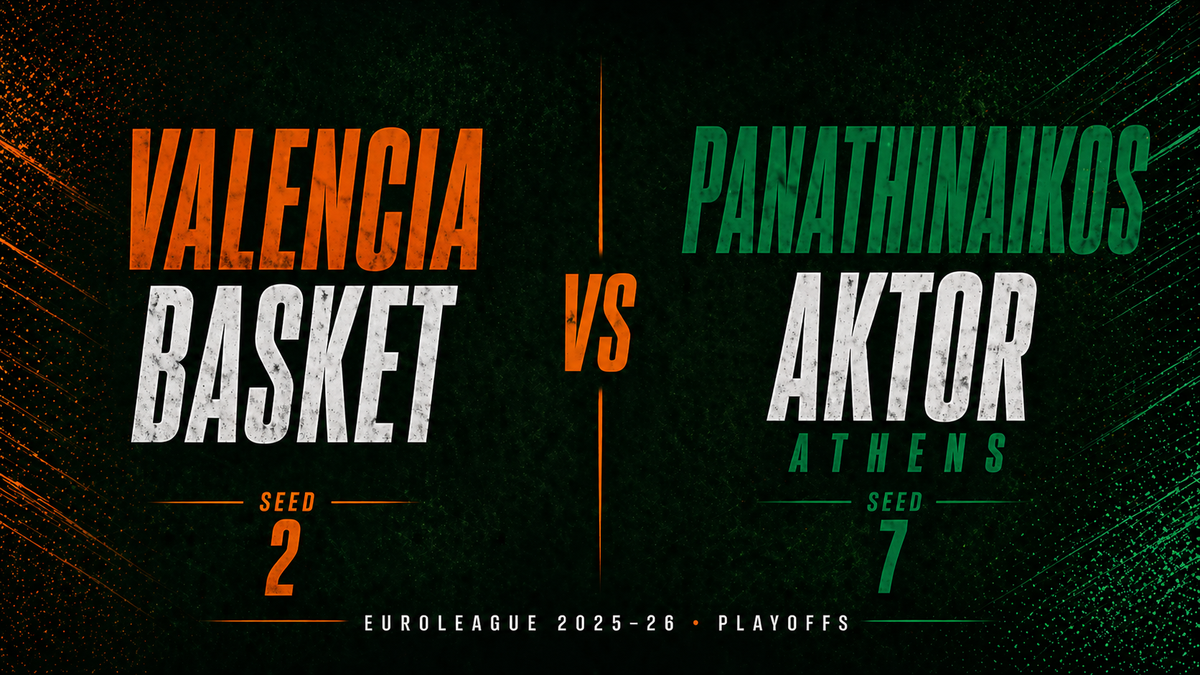
My prediction: Pana 3-1 · Valencia wins Series 3-2
Latest Game:
Game 5 - Valencia Basket Is Going to Athens
Valencia Basket 81 – Panathinaikos AKTOR Athens 64
Braxton Key played Game 5 with a broken nose, wearing a protective mask, and scored 12 points in 19 minutes. Two days after Valencia lost their second consecutive game in Athens, he had googled whether any team had ever overturned a 2-0 deficit in EuroLeague playoff history. Real Madrid had done it once, against Partizan Belgrade in 2023. Key posted the result on social media to get the energy going.
Valencia put the energy on the floor. 15,600 fans at the Roig Arena did the rest.
The final margin is 17 points. The PIR gap is 102 to 51 — a 51-point differential that represents the most complete Valencia performance of this entire series. Panathinaikos, one of the two or three pre-season title favourites, scored 64 points and is eliminated. Valencia Basket, who started this season with a goal of reaching the play-in, are going to the Final Four in Athens.
The Defense That Changed Everything
The Roig Arena's lowest-ever first-half points conceded in EuroLeague history is 23 — set against Villeurbanne in 2004 and matched in Game 5 against Panathinaikos. That number is not a statistical footnote. It is the structural explanation for everything that followed.
Panathinaikos needed 5 minutes to score their first basket. By then Valencia led 11-4 and the tone was set. Jean Montero — in this series primarily the playmaker, the creator, the architect — spent the opening minutes denying Cedi Osman receiving positions, blocking shots, suffocating the very offensive structure that had carried Panathinaikos to a 2-0 series lead.
Valencia held Panathinaikos to 10 points in the first quarter and 13 in the second. The Roig Arena crowd spent the first half not cheering baskets, but cheering stops. That is a different kind of crowd noise — and in Game 5 of a best-of-5, it is more powerful.
Badio Delivers His Best Game of the Series
Montero scored 12 points on 87.5% from the free-throw line and distributed 3 assists with a 24 PIR. Functional, intelligent, unselfish — everything the system requires. But Game 5's individual story belongs to Brancou Badio.
The guard scored 20 points on 50% two-point shooting, grabbed 5 rebounds, posted 2 steals and finished with a 25 PIR — the highest of any player in this game. He was a +17. His 14-point third quarter — answered every time Panathinaikos threatened a comeback, one basket after another at the moments the crowd needed them — was the performance that closed the series.
When Panathinaikos opened the third quarter with a 0-10 run to cut the gap to 48-42, it was Badio who answered. When Toliopoulos and Hayes-Davis hit back-to-back threes to make it a six-point game, Badio responded again. He scored 14 of Valencia's 21 third-quarter points. By the fourth, the contest was over.
Kameron Taylor contributed 9 points with a +20 plus/minus. Braxton Key added 12 with a +17. Sergio De Larrea scored 9 on 100% two-point shooting. This was not Montero carrying Valencia. This was Valencia as a collective, which is the only way this story makes sense.
Panathinaikos: The Collapse That Will Reshape a Club
64 points. In a series-deciding game, with a 2-0 lead already squandered, against a team Panathinaikos had beaten four times in the regular season. 64 points from a roster that spent the summer assembling Nunn, Osman, Shorts, Lessort and Hayes-Davis with one objective: the Final Four that was supposed to happen here, in Athens, for their own fans.
Kendrick Nunn finished with 9 points on 42.9% two-point shooting and a -18. TJ Shorts scored 0 points and was a -7 in under 6 minutes before being effectively benched. Osman managed 10 points. Lessort 8. Only Hayes-Davis with 15 points came close to his regular-season standard — and 15 points from your fifth-best player in a Game 5 elimination game is a collective failure, not an individual one.
The structural problem was the same across Games 3, 4 and 5: Panathinaikos shot 31.3%, 23.3% and 31.3% from three in the three games Valencia won. Their offensive system requires perimeter conversion to function — when it doesn't, Nunn's interior creation and Lessort's interior physicality cannot compensate for the scoring volume gap.
That problem is tactical. The consequences will be cultural. Panathinaikos are a club with an ownership structure — the Alafouzos family patriarch — that does not accept failure quietly. A 2-0 lead converted into elimination, at the hands of a team playing their first EuroLeague playoffs, will produce consequences. Whether those consequences arrive through roster changes, coaching decisions, or both is the most interesting Panathinaikos question of the off-season. One can imagine Valencia's Final Four run creating a particular shopping list for a club with deep pockets and injured pride.
Valencia Basket: The Star Is the Team
Pedro Martinez said before this season that reaching the play-in was the goal. Qualification for the EuroLeague playoffs followed. Then two away wins in Athens when the season was over. Then Game 5 in front of 15,600 people at the Roig Arena.
The Final Four in Athens is the fourth stage of a journey that was never supposed to reach it.
There is no single player who carries this story. Montero is the system's conductor — stable, precise, productive across every game of this series regardless of the result. Badio delivered the series-best individual performance when it mattered most. Key played Game 5 with a broken nose. Taylor was +20 in the most important game of the club's EuroLeague history.
The season's biggest surprise did not arrive through a single moment of individual brilliance. It arrived through five games of collective intelligence, defensive commitment and the refusal to accept that the series was over when everyone else had already decided it was.
Valencia Basket are going to Athens. Panathinaikos are going home.
The Roig Arena knew this was possible before Braxton Key Googled it.
Series History:
Preview
Before the season began, ask any of the 100 EuroLeague analysts which of these two teams would finish atop the league and which one might be lucky and get one of the last Playoff spots — and every single one of them would have given you the same answer. Panathinaikos first or second. Valencia seventh. And ... even that would have been considered a remarkable achievement for the Spanish club.
The regular season had other ideas.
Valencia Basket finished 26-12, second in the EuroLeague, the competition's highest-scoring team at 90.9 points per game, and the single greatest positive surprise of the 2025-26 campaign. Panathinaikos — the 2024 EuroLeague champions, the competition's most expensive roster, the club with the deepest historical pedigree in modern European basketball — finished seventh, limped through the Play-In, survived Monaco at home, and arrives in this quarterfinal carrying the weight of an underperforming season and the knowledge that their city, their fans, and their budget expected considerably more.
The regular season, however, is over. The seeding advantage belongs to Valencia — home court in a potential Game 5, should this series reach that point. Everything else belongs to Panathinaikos.
The Surprise That Wasn't — Once You Looked Closely
Valencia's 26-12 record was not built on luck or a forgiving schedule. It was built on a tactical identity executed with remarkable consistency by head coach Álex Mumbrú: the highest-scoring offense in the EuroLeague at 90.9 points per game, a three-point shooting percentage that ranked among the competition's best, and a collective cohesion that made Valencia more than the sum of its individual parts.
Jean Montero is the engine — 13.7 points and 4.6 assists per game, and the 2025-26 EuroLeague Rising Star. He is the kind of guard who makes the right decision before the defense has finished organizing, creating advantages that Valencia's shooters then convert with the reliability of a team that has drilled this system for two full seasons. Xabi López-Arostegui, Martin Hermannsson, Jasiel Rivero — the rotation extends deep, and every player within it understands their role precisely.
What Valencia represents is the anti-star model: no single player commands the fee that Panathinaikos's headliners command, no single name commands the cultural weight that Athens carries into every European game. What Valencia has instead is a system that is greater than any individual within it, and a season-long record that proves it.
The cliché writes itself: they are more than the sum of their parts. The cliché is also accurate.
Panathinaikos — The Weight of Everything
Panathinaikos arrived at this quarterfinal as the seventh seed after surviving the Play-In. That sentence should not exist for a club of their stature, budget, and historical expectation. It does, and it requires honest explanation.
The 2025-26 season was one of inconsistency without the structural excuse of significant injuries. Ergin Ataman — one of the most tactically sophisticated and demanding coaches in European basketball — runs a system of extraordinary complexity. His expectations are not modest. A former elite point guard who saw the game at a speed most players cannot match, he demands that every player on his roster know every set play, every exit option, every defensive assignment, and execute the correct read in real time. When Panathinaikos performs at their ceiling, they are nearly impossible to prepare for. This season, they performed inconsistently below it.
Kendrick Nunn leads the team at 18.6 points per game on 57.6% from two — a finishing efficiency that belongs to a player who has found his environment. TJ Shorts is the creator, the orchestrator, the player whose pace and vision set the tempo for everything Panathinaikos want to do offensively. Sasha Vezenkov — whom Nunn himself has named as the EuroLeague MVP — provides the stretch four dimension that opens the floor for Nunn's drives. The backcourt is genuinely dangerous. The front line is experienced. The coach is one of the best in the world.
And none of it produced a top-six regular season finish.
The Tactical Equation — What Decides This Series
The series turns on one question: can Valencia maintain their offensive identity against Panathinaikos's defensive attention?
Panathinaikos are not a team that allows opposing systems to function undisturbed. Ataman's defensive schemes are designed to disrupt rhythm, force early shot clock decisions, and make the correct read harder to execute. Valencia's system requires patience, spacing, and the willingness to run the same action multiple times until the defense collapses. In Valencia, with the home crowd, with the familiarity of their own system in their own building, they will execute it. In Athens, with 18,000 Panathinaikos supporters creating an atmosphere that is genuinely among the loudest and most intimidating in European basketball, execution under pressure becomes a different proposition.
The home court advantage in Games 3 and 4 — in Athens — is not a tactical advantage. It is an environmental one. Panathinaikos's fans do not merely support their team. They create a physical experience that changes what visiting players are willing to attempt under pressure. Valencia's system depends on collective precision. Collective precision under that kind of pressure is a different test.
Valencia must win Game 1. Not because the series is immediately over if they don't — but because a Game 1 loss in Valencia sends the series to Athens with Panathinaikos holding momentum, and in Athens, momentum becomes a structural advantage. If the series goes to Athens at 0-1, the realistic scenario for Valencia becomes very difficult, very quickly. The worst case — three games, all losses — becomes plausible.
The Prediction
Panathinaikos 3-1.
Valencia will win one game — most likely Game 1 at home, where their system functions at its peak and the crowd gives them the early momentum they need. That win will make this feel like a series. And it might. If they lose game 1, then the series is quickla over.
Panathinaikos are structurally the better team, and in a best-of-five, structure wins. Nunn and Shorts in Athens, Games 3 and 4, with 18,000 supporters creating the loudest atmosphere in European basketball — that is where this series ends. Valencia's collective precision is genuine. It is not sufficient against individual quality of this caliber in an environment this hostile.
Ataman will make one tactical adjustment after Game 1 that Valencia does not have an answer for. He always does. The regular season was inconsistent. The playoffs are where Panathinaikos remember what they are.
Valencia gave European basketball one of its best regular season stories of the decade. Game 1 may give them one more night to celebrate it.
After that, Athens decides.
Game 1 - Valencia Proves They Belong — And Still Leaves Empty-Handed
Valencia Basket 67 – Panathinaikos AKTOR Athens 68
Valencia Basket had 15 offensive rebounds. They shot 90% from the free-throw line. They outrebounded Panathinaikos 40-34 and had 17 assists to Panathinaikos's 10. Jean Montero, the season's breakout story, finished with 19 PIR and 15 points.
None of it was enough. Panathinaikos won 68-67 on the road, in Valencia, in a game they were losing for most of the first quarter, with a team PIR of 71 against Valencia's 82. They won despite losing the rebounding battle by six, despite Kendrick Nunn managing only a 9 PIR on 21 points. They won the way experienced champions win ugly games: by surviving until the moment matters and then executing when it does.
This is the paradox at the heart of this series. Valencia proved in Game 1 that they belong among the best teams in the EuroLeague. And Panathinaikos proved that belonging and winning are two different things.
Panathinaikos Found a Way Without Being Panathinaikos
Ergin Ataman's team came to Valencia and shot 18.2% from three. To put that in context: Panathinaikos ranked in the middle of the pack from distance during the regular season, which wasn't good enough then. In Game 1 they were catastrophically worse. Six-of-nineteen, nine-of-thirty-nine from distance across both teams combined — this was a half-court grind in the Roig Arena, not the open-court basketball either team prefers.
And still Panathinaikos won.
The reason is structural experience. Nunn's 21 points came on 62.5% two-point shooting — he found ways to score even when his three-ball failed him. Mathias Lessort contributed 12 points and 7 rebounds with a 19 PIR, doing the interior work that kept Panathinaikos alive on the glass when Valencia was feasting on offensive rebounds at the other end. And Ataman's substitution patterns — keeping his rotation tight in the fourth quarter, trusting his veterans in the decisive moments — reflect a coaching staff that has been in these exact situations before.
Valencia's Martinez had a different problem: his team created more, controlled more, dominated the statistical categories that usually decide games — and still lost by one.
68 Points Is the Number That Defines This Series
Panathinaikos scored 68 points in a road playoff game against Valencia Basket, the second seed and the competition's biggest positive surprise of the season. 68 points from a team with Nunn, Lessort, Trae Shorts and the supporting cast Ataman has assembled is not a tactical adjustment — it is a structural ceiling that this group keeps hitting.
The concern is not that Panathinaikos won. It is that they won playing well below their offensive potential and still only won by one point. In Athens, in Game 3 and 4, the crowd will help. But if the offensive limitations persist, a Valencia team that shot 60.6% from two and created at will in their own building will find ways to exploit them.
Valencia, meanwhile, face a more complicated question. They outplayed the 2024 champions at home, controlled the game for long stretches, and lost by a single possession. The psychological damage of that kind of defeat can be significant in a best-of-5 where there are no throwaway games. TEP's pre-series prediction: Panathinaikos 3-1. That prediction assumed Panathinaikos would take Game 1 on the road and establish series control early. Game 1 delivered exactly that — by the thinnest possible margin.
A One-Point Game That Shifted Everything
In a best-of-5, home-court advantage is structural. Valencia had it, used it effectively, and still went home with a loss. Panathinaikos travel back to Athens not just with a series lead but with something more valuable: the knowledge that they can win on the road when nothing is working offensively.
Valencia needs to win Game 2. In their own building, with their crowd, against a team that shot 18% from three and still beat them by a point. If they cannot find a way to close that game, the Roig Arena stops being an advantage and starts being a source of doubt.
Panathinaikos didn't come to Valencia to play their best basketball. They came to win Game 1.
Mission accomplished.
Game 2 - Valencia Fights Back — But Panathinaikos Finds a Way. Again.
Valencia Basket 105 – Panathinaikos AKTOR Athens 107 (OT)
The fourth quarter ended 95-95. Valencia had outplayed Pana for four quarters, scored 105 points — the highest total of any team in these playoffs — shot 66.7% from two, generated 27 assists against 11 turnovers, and still needed overtime to decide it.
Then they lost that too.
Panathinaikos won 107-105 in overtime, taking a 2-0 series lead on the road at the Roig Arena in front of 14,656 fans who had every statistical reason to expect a different result. Two games in Valencia. Two Panathinaikos wins. Both by the thinnest possible margin. The series is not over. But the pattern is.
Hayes-Davis Is the Player This Series Needed
In Game 1, Panathinaikos won ugly — 68 points, 18.2% from three, survived by experience alone. Ataman needed someone to complement Nunn's scoring load. Game 2 produced the answer.
Nigel Hayes-Davis scored 27 points on 5-of-9 from three and went 6-of-6 from the free-throw line. His PIR of 29 was the highest on either team. In overtime specifically — the five minutes that decided this series's trajectory — Hayes-Davis was the primary reason Panathinaikos converted. Cedi Osman added 16 points on 100% two-point shooting and 60% from three, with 8 rebounds and a 26 PIR. Juancho Hernangomez hit 3-of-4 from three in 18 minutes off the bench.
This is what Game 1's 68-point performance obscured: Panathinaikos have multiple capable offensive contributors. They chose not to use them in Game 1 because they didn't need to. Game 2 required more, and Ataman's roster produced more. That is the definition of a championship-caliber squad.
Kendrick Nunn finished with 19 points and 17 PIR — efficient, functional, but not dominant. He didn't need to be dominant. That is the difference between Panathinaikos and the teams they beat.
Valencia Did Everything Right and Lost Anyway
The statistical summary of this game is almost incomprehensible as a loss for Valencia. They outrebounded Panathinaikos 35-31. They had 27 assists — 7 more than Panathinaikos. Their PIR was 123 to Panathinaikos's 119. They shot 66.7% from two. Jean Montero scored 21 points on 100% two-point shooting with 6 assists and a 25 PIR. Sergio De Larrea came off the bench for 18 points on 57.1% from three in over 20 minutes.
Valencia played their best basketball of the series and went to overtime. They played well in overtime and lost.
The free-throw line is the brutal explanation. Panathinaikos shot 15-of-15 — 100% — over the full game including overtime. Valencia shot 13-of-23 — 56.5%. That 43.5-percentage-point gap, across a game decided by two points, is the margin. Panathinaikos converted every free throw they were given. Valencia left points at the line at exactly the moments they needed them most.
Pedro Martinez has no tactical fix for that. Free-throw shooting is execution, not scheme.
The Score Evolution Tells the Real Story
Look at the score evolution chart: two lines tracking each other across 45 minutes, never separated by more than five or six points at any stage, converging at 95-95 when regulation ended. This was not a game that Panathinaikos controlled. It was a game they refused to lose.
That distinction matters enormously for Game 3 in Athens. Valencia proved in Games 1 and 2 that they can compete with Panathinaikos possession-for-possession for 40 minutes. They have the offensive firepower — 105 points in Game 2 is proof — and the defensive structure to make every game close. But close games in Athens, against a team that shoots 100% from the free-throw line and has Hayes-Davis available for exactly the moments that decide overtime periods, are not Valencia's preferred terrain.
TEP's pre-series prediction was Panathinaikos 3-1. After two games, that prediction looks conservative. The real question is no longer whether Panathinaikos reach the Final Four. It is whether Valencia can win a single game.
Athens on Saturday. The Roig Arena Answered Nothing.
In a best-of-5, going down 0-2 requires winning three straight — the third and fourth back in Athens if they get there. Valencia showed in Game 2 that they have the quality to make this a series. They showed in Game 1 that winning the statistical battle is not enough. And they showed in overtime that Panathinaikos will find a way when the game reaches its most critical moments.
Game 3 is in Athens. The crowd will be different. The pressure will be entirely on Valencia.
Panathinaikos have now won two road games in this series by a combined three points. They haven't even played at home yet.
Game 3 - Valencia Refuses to Die — Athens Gets Its First Shock
Panathinaikos AKTOR Athens 87 – Valencia Basket 91
Panathinaikos led this series 2-0. They were playing at home in Athens. The Telekom Center held 19,012 fans who had every reason to expect a coronation.
Valencia outscored them in every single quarter.
24-18. 28-21. 23-27. 16-21. The quarter-by-quarter breakdown is the cleanest statistical summary of what happened: Valencia didn't steal this game in the final minutes. They controlled it from the opening tip, beat Panathinaikos at their own home over 40 minutes, and reduced a series that looked like a formality to 2-1.
Jean Montero scored 16 points, distributed 9 assists and finished with a 21 PIR. Valencia's system — 9 assists to Panathinaikos's 22, but 63.6% two-point shooting against 59.5% — imposed its terms on an Athens building that had been waiting to celebrate. The crowd left with questions instead.
Valencia Found What Athens Was Missing
Panathinaikos shot 34.5% from three in Game 3. Valencia also shot 34.5% from three. This was not a game decided by the perimeter. It was decided in the paint, on the boards, and in the quality of individual shots created.
Valencia shot 63.6% from two. Jean Montero went 8-of-10 from two. Brancou Badio contributed 16 points on 80% two-point shooting. Kameron Taylor added 14 points on 80% from two. The Roig Arena had produced this version of Valencia in Games 1 and 2 — aggressive, interior-first, converting at elite rates — and Panathinaikos had no defensive answer for it at home in Athens.
The PIR gap tells the structural story: Valencia 110, Panathinaikos 97. A 13-point differential in a game Valencia won by 4. Their quality advantages were larger than the scoreboard suggested.
Nikolaos Rogkavopoulos led Panathinaikos with 18 PIR — a role player producing the team's best individual performance in a game where Kendrick Nunn managed only 13 points and a 6 PIR, Cedi Osman 10 points, and the offensive production that had carried Games 1 and 2 simply didn't materialise at the level Ataman needed.
The Matchball That Wasn't
Panathinaikos had a matchball in Game 3 and failed to convert. They had played two road games in Valencia and won both. Returning home with a 2-0 lead, their task was straightforward: finish the series in front of their own crowd.
TEP's pre-series prediction was Panathinaikos 3-1. After Games 1 and 2 — both won by Panathinaikos on the road by the thinnest margins — the prediction looked conservative. After Game 3, it looks exactly as uncertain as the series is.
The tactical problem Ataman faces is specific: Valencia's interior shooting is too efficient for Panathinaikos's frontcourt to contain. Lessort, Nunn and Osman can create — but they cannot stop Montero's penetration and the open looks it generates for Taylor and Badio in the paint. In Athens. In front of 19,012 fans. Valencia shot 63.6% from two.
Game 4 is the second matchball. Same arena. Same crowd.
Valencia will not fold twice in the same building.
Game 4 - Montero Puts on a Show — Valencia Steal the Series Lead
Panathinaikos AKTOR Athens 86 – Valencia Basket 89
Jean Montero scored 29 points, distributed 7 assists, grabbed 7 rebounds and finished with a 45 PIR. He did it in Athens, in front of 19,031 fans, with a matchball on the table for Panathinaikos.
45 PIR. To put that number in context: Dan Oturu's playoff-record performance in Game 1 of the Madrid series reached 38 PIR. Montero's Game 4 is the highest individual performance index of the entire quarterfinal round — across all four series, across all 14 games played.
Valencia win 89-86. The series is 2-2. Panathinaikos have lost two consecutive matchballs at home in Athens, squandering a 2-0 series lead that had looked like a Final Four ticket. Valencia travel back to the Roig Arena for Game 5 with the momentum of the entire playoffs behind them.
The 45 PIR Performance
Montero shot 5-of-6 from two, 4-of-6 from three, 7-of-7 from the free-throw line. He had 7 assists and 3 steals. He was on the floor for 30 minutes and was a -5 plus/minus — meaning Valencia won despite Montero's lineups being outscored, which reflects the chaos of a 3-point game rather than any individual failure.
This was not a carry job. It was a system performance from the player who makes Valencia's system function. Montero's 9 assists in Game 3 created the open shots that Valencia's shooters converted at 63.6% from two. His 7 assists in Game 4 — combined with his own 29 points — made Valencia's offense impossible to defend because Ataman's rotations could not simultaneously contain Montero's scoring and his creation.
Cedi Osman kept Panathinaikos in it: 26 points on 80% two-point shooting and a 25 PIR. Kendrick Nunn scored 19 points on 100% two-point shooting. Both were genuine contributors in a game Panathinaikos lost anyway. That is the Panathinaikos problem in three words: not enough around them.
Two Matchballs. Zero Conversions.
Panathinaikos had Game 3 at home with a 2-0 lead. Lost by 4. They had Game 4 at home with a chance to go 3-1. Lost by 3.
Two games. Seven combined points. That is how close Panathinaikos came to the Final Four — and how decisively Valencia refused to let them arrive.
The fourth quarter tells the Game 4 story precisely: Panathinaikos scored 30, outscoring Valencia's 29. They were competitive when it mattered. They shot 23.3% from three across the full game — 7-of-30 — and that number is the explanation for everything. A team with Nunn, Osman, Shorts and Hayes-Davis generating 23.3% from distance cannot close a series against a Valencia team shooting 34.5% from the same spots.
Ataman's tactical problem has been consistent across two home losses: his perimeter players cannot find shots against Valencia's switching defense, and his interior players cannot compensate for that volume of missed threes. In Game 4, Panathinaikos shot 56.3% from two — their best interior performance of the series — and still lost.
The Momentum Equation
Valencia arrive at the Roig Arena for Game 5 having won two consecutive road games in Athens, the second against 19,031 fans with everything at stake. They have Jean Montero producing a 45 PIR performance. They have an interior offense that shoots over 60% from two in hostile environments. They have Pedro Martinez's system operating at its absolute peak.
TEP's pre-series prediction was Panathinaikos 3-1. That prediction is now wrong. The series is 2-2, momentum belongs entirely to Valencia, and Game 5 is at the Roig Arena.
Panathinaikos have lost their home. Valencia have found theirs again.
The Roig Arena on Tuesday will be the loudest it has been all season.
Game 5 - Valencia Basket Is Going to Athens
Valencia Basket 81 – Panathinaikos AKTOR Athens 64
Braxton Key played Game 5 with a broken nose, wearing a protective mask, and scored 12 points in 19 minutes. Two days after Valencia lost their second consecutive game in Athens, he had Googled whether any team had ever overturned a 2-0 deficit in EuroLeague playoff history. Real Madrid had done it once, against Partizan Belgrade in 2023. Key posted the result on social media to get the energy going.
Valencia put the energy on the floor. 15,600 fans at the Roig Arena did the rest.
The final margin is 17 points. The PIR gap is 102 to 51 — a 51-point differential that represents the most complete Valencia performance of this entire series. Panathinaikos, one of the two or three pre-season title favourites, scored 64 points and are eliminated. Valencia Basket, who started this season with a goal of reaching the play-in, are going to the Final Four in Athens.
The Defense That Changed Everything
The Roig Arena's lowest-ever first-half points conceded in EuroLeague history is 23 — set against Villeurbanne in 2004 and matched in Game 5 against Panathinaikos. That number is not a statistical footnote. It is the structural explanation for everything that followed.
Panathinaikos needed 5 minutes to score their first basket. By then Valencia led 11-4 and the tone was set. Jean Montero — in this series primarily the playmaker, the creator, the architect — spent the opening minutes denying Cedi Osman receiving positions, blocking shots, suffocating the very offensive structure that had carried Panathinaikos to a 2-0 series lead.
Valencia held Panathinaikos to 10 points in the first quarter and 13 in the second. The Roig Arena crowd spent the first half not cheering baskets, but cheering stops. That is a different kind of crowd noise — and in Game 5 of a best-of-5, it is more powerful.
Badio Delivers His Best Game of the Series
Montero scored 12 points on 87.5% from the free-throw line and distributed 3 assists with a 24 PIR. Functional, intelligent, unselfish — everything the system requires. But Game 5's individual story belongs to Brancou Badio.
The guard scored 20 points on 50% two-point shooting, grabbed 5 rebounds, posted 2 steals and finished with a 25 PIR — the highest of any player in this game. He was a +17. His 14-point third quarter — answered every time Panathinaikos threatened a comeback, one basket after another at the moments the crowd needed them — was the performance that closed the series.
When Panathinaikos opened the third quarter with a 0-10 run to cut the gap to 48-42, it was Badio who answered. When Toliopoulos and Hayes-Davis hit back-to-back threes to make it a six-point game, Badio responded again. He scored 14 of Valencia's 21 third-quarter points. By the fourth, the contest was over.
Kameron Taylor contributed 9 points with a +20 plus/minus. Braxton Key added 12 with a +17. Sergio De Larrea scored 9 on 100% two-point shooting. This was not Montero carrying Valencia. This was Valencia as a collective, which is the only way this story makes sense.
Panathinaikos: The Collapse That Will Reshape a Club
64 points. In a series-deciding game, with a 2-0 lead already squandered, against a team Panathinaikos had beaten four times in the regular season. 64 points from a roster that spent the summer assembling Nunn, Osman, Shorts, Lessort and Hayes-Davis with one objective: the Final Four that was supposed to happen here, in Athens, for their own fans.
Kendrick Nunn finished with 9 points on 42.9% two-point shooting and a -18. TJ Shorts scored 0 points and was a -7 in under 6 minutes before being effectively benched. Osman managed 10 points. Lessort 8. Only Hayes-Davis with 15 points came close to his regular-season standard — and 15 points from your fifth-best player in a Game 5 elimination game is a collective failure, not an individual one.
The structural problem was the same across Games 3, 4 and 5: Panathinaikos shot 31.3%, 23.3% and 31.3% from three in the three games Valencia won. Their offensive system requires perimeter conversion to function — when it doesn't, Nunn's interior creation and Lessort's interior physicality cannot compensate for the scoring volume gap.
That problem is tactical. The consequences will be cultural. Panathinaikos are a club with an ownership structure — the Alafouzos family patriarch — that does not accept failure quietly. A 2-0 lead converted into elimination, at the hands of a team playing their first EuroLeague playoffs, will produce consequences. Whether those consequences arrive through roster changes, coaching decisions, or both is the most interesting Panathinaikos question of the off-season. One can imagine Valencia's Final Four run creating a particular shopping list for a club with deep pockets and injured pride.
Valencia Basket: The Star Is the Team
Pedro Martinez said before this season that reaching the play-in was the goal. Qualification for the EuroLeague playoffs followed. Then two away wins in Athens when the season was over. Then Game 5 in front of 15,600 people at the Roig Arena.
The Final Four in Athens is the fourth stage of a journey that was never supposed to reach it.
There is no single player who carries this story. Montero is the system's conductor — stable, precise, productive across every game of this series regardless of the result. Badio delivered the series-best individual performance when it mattered most. Key played Game 5 with a broken nose. Taylor was +20 in the most important game of the club's EuroLeague history.
The season's biggest surprise did not arrive through a single moment of individual brilliance. It arrived through five games of collective intelligence, defensive commitment and the refusal to accept that the series was over when everyone else had already decided it was.
Valencia Basket are going to Athens. Panathinaikos are going home.
The Roig Arena knew this was possible before Braxton Key Googled it.