
Exit Report — Maccabi Rapyd Tel Aviv
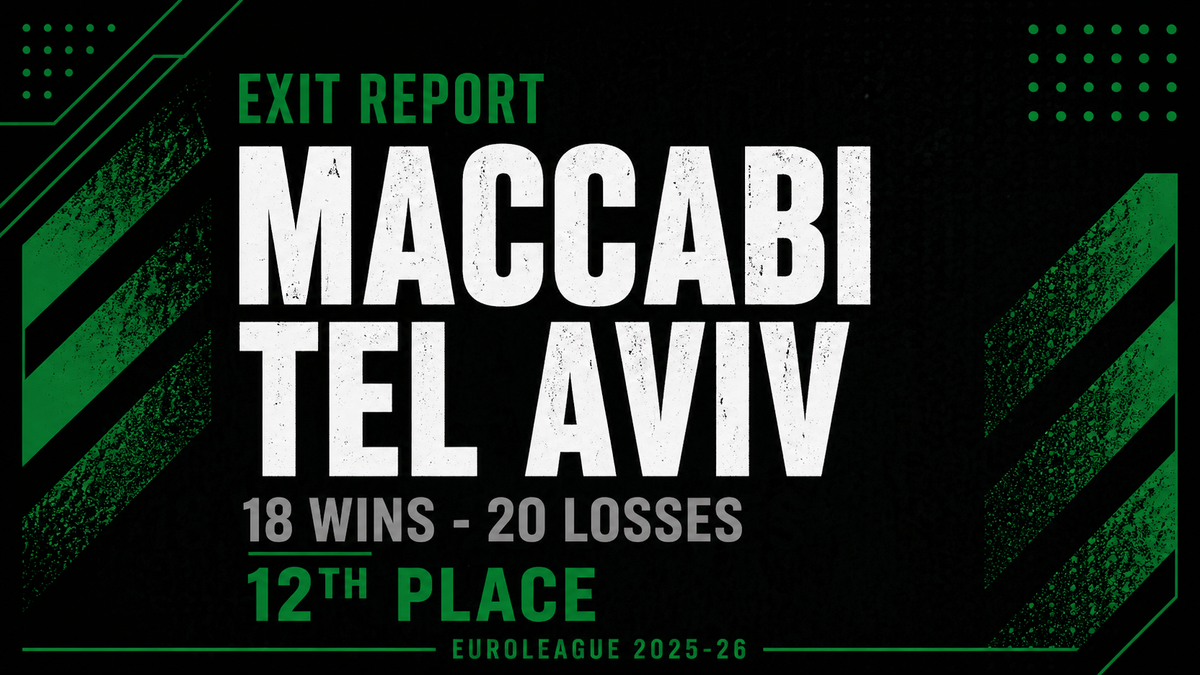
Place: 12 | EuroLeague Season
The Roster
Maccabi played the entire season without a home arena in Tel Aviv due to the ongoing security situation, hosting all games at the Aleksandar Nikolić Hall in Belgrade. Every single one. That context is not a footnote — it is the structural condition under which every tactical decision, every recruitment choice, and every result must be evaluated.
Their roster was built for competitiveness rather than contention: Lonnie Walker IV, Roman Sorkin, Jimmy Clark III, Jaylen Hoard, TJ Leaf, Tamir Blatt. A functional group without a genuine first option capable of consistently closing games under pressure. The team averaged 90.1 points per game with a PIR of 100.1 — numbers that suggest a competitive unit. The point differential of -100 tells the more honest story.
18-20. 12th place. Outside the Play-In by the narrowest margin.
The Coach
Oded Kattash managed the team through circumstances that have no modern EuroLeague precedent. Playing every home game in hostile or neutral territory — no crowd, no familiar floor, no psychological advantage — is a structural disadvantage that appears nowhere in the official statistics but defines every result.
Within those constraints, Kattash kept Maccabi competitive across all 38 rounds. A .474 winning percentage with this roster, in these conditions, reflects professional coaching under sustained adversity. The Play-In remained within reach for most of the season and slipped away only in the final stretch.
The System
Maccabi played fast and offense-first — 90.1 points per game, 19.9 assists per game, and a pace that created scoring opportunities against every opponent. The defensive side was the consistent failure point: a Net Rating of -100 over 38 games indicates that for every point they scored, they conceded marginally more. They could outscore most teams for stretches but couldn't sustain defensive discipline for full games.
The formula produced competitive results against mid-table opponents. Against the top half of the competition — teams with defensive infrastructure and interior size — Maccabi's lack of a true rim protector was exposed repeatedly. Their 2.4 blocks per game and 35.8 rebounds per game placed them in the lower third of the competition in both categories.
The Players
Lonnie Walker IV (15.2 Pts, PIR 12.6) was the team's most dangerous offensive weapon — a guard capable of taking over games with his athleticism and shot creation. Roman Sorkin (13.5 Pts, PIR 14.1) was Maccabi's most consistent performer: efficient from the field at 57% on two-pointers, reliable on both ends. Jimmy Clark III (9.5 Pts, 1.3 Stl, 4.3 Ast) was the team's best two-way player — his defensive energy and 1.3 steals per game placed him among the competition's leaders.
Tamir Blatt (7.1 Pts, 5.2 Ast) managed the offense with composure, contributing to a 19.9 assist average that ranked among the EuroLeague's best. Jaylen Hoard (11.7 Pts, 7.1 Reb) provided frontcourt physicality. TJ Leaf (9.1 Pts, 63.1% on twos) was efficient in limited minutes.
What Maccabi lacked throughout was a player capable of manufacturing a basket in the final two minutes of a close game when the offense stalls. Walker had that capability on good nights. On neutral nights, Maccabi had volume scorers but no closer.
The Outlook
The first and most obvious variable is external: if the security situation allows Maccabi to return to Tel Aviv and play home games at the Menora Mivtachim Arena, the entire competitive picture changes. Home court in the EuroLeague is not a minor factor — it is worth three to five wins across a season at this level. Maccabi went 11-8 at their neutral home in Belgrade. In a real home environment, that number is meaningfully higher.
Assuming a return to Tel Aviv, the summer priority is clear: Maccabi needs a dominant interior presence. The -100 point differential was driven primarily by the inability to protect the paint and rebound consistently. A true center — physical, mobile, capable of anchoring the defense and providing post-scoring — would transform this team's ceiling from Play-In contender to genuine playoff threat. Hoard is a forward, not a center. Leaf is a stretch big. Neither solves the problem.
The second need is a primary creator. Tamir Blatt distributes efficiently but is not a player who generates advantages in isolation. Walker creates off the dribble but is streaky. What Maccabi lacks is a guard who combines consistent shot creation with the ability to set up teammates from the pick-and-roll — a true combo guard who makes the offense unpredictable rather than readable. The current system's 19.9 assists per game is built on movement and spacing, not creation. Adding one player who can break down a defense individually would unlock the rest of the roster.
The core is worth keeping. Sorkin, Clark, Hoard, and Blatt form a legitimate foundation. Walker's future depends on his own decision-making — he has the talent for a bigger contract elsewhere. If Maccabi can retain him while adding a center and a creator, they are a different team next season.
The conditions were against them in 2025-26. The basketball is good enough to compete. One more piece — and a real home floor — and Maccabi is back in the Play-In conversation.