Exit Report — FC Bayern München Basketball
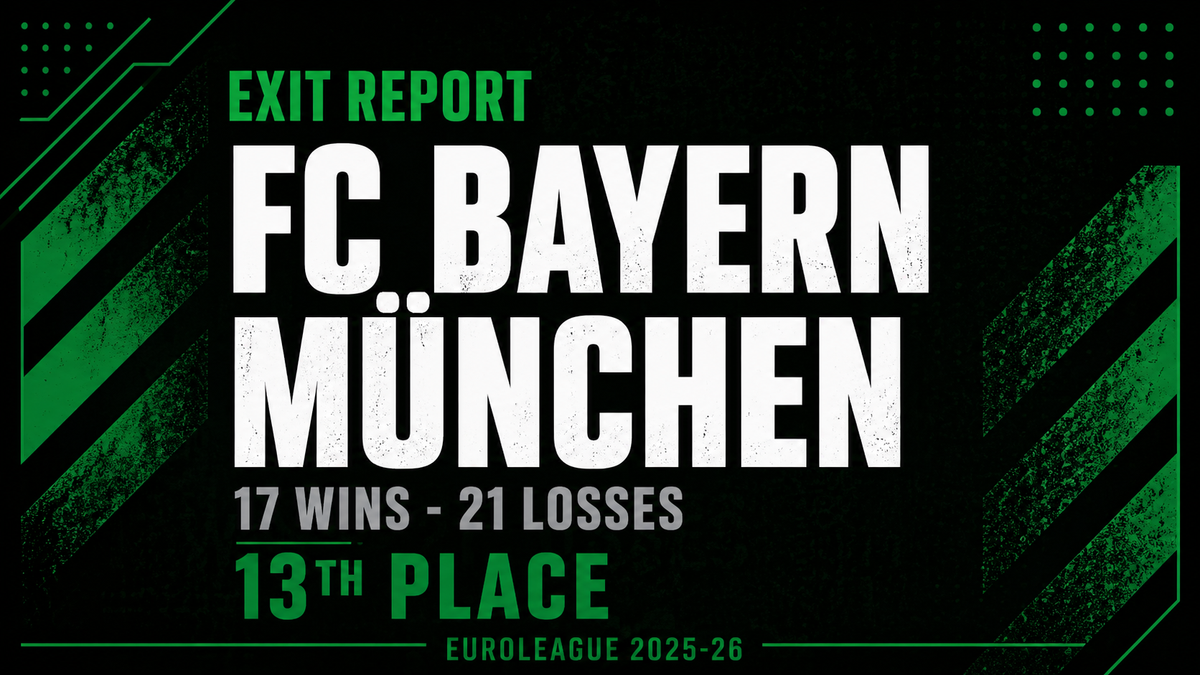
Place: 13 | EuroLeague Season
The Roster
Bayern entered 2025-26 as a club with genuine ambitions after a promising Play-In campaign the previous season. The summer brought significant departures: Carsen Edwards — EuroLeague scoring leader in 2024-25 — left for Virtus Bologna. Nenad Dimitrijević moved on. In their place came Spencer Dinwiddie (11 games, 11.7 Pts before injury ended his season early), a collection of role players, and a roster that looked functional on paper but lacked the alpha scorer Edwards had provided.
The official numbers: 80.8 points per game, 33.1 rebounds, 18.6 assists, PIR of 85.8 — all below-average for the competition. A point differential of -105 over 38 games. 17-21, 13th place.
The foundation wasn't wrong. The construction around it was.
The Coach — A Season in Two Halves
Gordon Herbert arrived at Bayern's bench in 2024 with a strong reputation — German national team head coach, EuroBasket silver medalist, Play-In architect in his first Bayern season. None of that mattered when the results stopped coming.
Bayern opened with a nine-game losing streak — the joint-longest in the competition alongside Efes. By December 20, with the team sitting 19th at 5-12, the decision was made. Herbert was dismissed. His son Daniel remained on the coaching staff under the successor.
Svetislav Pešić walked through the door two days later.
The 75-year-old Serbian legend — EuroLeague winner as a coach, Olympic gold medalist with Serbia, one of the most decorated figures in European basketball history — took over a team that had lost confidence, identity, and any recognizable defensive structure. What followed was the most interesting coaching story of Bayern's season.
Under Pešić, Bayern went 12-9 in the EuroLeague. Not spectacular. But functional, competitive, and occasionally excellent. The nine-game losing streak became history. The defensive rating improved. The rotations stabilized. Players who had looked lost under Herbert found defined roles and executed them.
The numbers tell the story cleanly: Herbert's Bayern were a bottom-two team. Pešić's Bayern were a middle-of-the-table team. The ceiling didn't change dramatically — the floor did. Pešić's final game in charge, a 95-69 demolition of Panathinaikos in the final round, was Bayern's most complete performance of the season and sent a clear message about what this squad was capable of when properly organized.
What Pešić did was not magic. It was structure, authority, and the kind of clear expectation-setting that a young, unsettled roster responds to. Bayern's players knew exactly what was required of them from the first day of his tenure. That clarity had been absent before December.
The System
Herbert attempted pace-and-space basketball without the defensive infrastructure to sustain it. Bayern's first-half defensive rating placed them among the worst three teams in the competition. Offensively, 80.8 points per game ranked them in the bottom five — a damning indictment of a roster with genuine individual talent.
Pešić installed halfcourt discipline. The offense became more structured — fewer transition attempts, more deliberate execution in the half-court, clearer hierarchy of decision-making. The defensive intensity improved measurably. Bayern's road record under Pešić — 5-14 for the season, but significantly better in the second half — reflected a team that had learned to compete away from home.
The system under Pešić was not elaborate. It was disciplined. At Bayern's current roster level, discipline was more valuable than complexity.
The Players
Andreas Obst (14.5 Pts, 37.8% 3P, Season-High 37 Pts) remains the article's central figure — covered extensively in the Surprise Players report, and the reason this season is not a complete write-off. His contract extension through 2029 is Bayern's most significant off-court development of the year. Vladimir Lucic (8.0 Pts, 33 games started) was the veteran anchor — professional, reliable, and the kind of presence a young roster needs in difficult moments.
Isiaha Mike (9.6 Pts, 37 games) was consistent across both coaching regimes — a wing who defended and scored without demanding a primary role. Justinian Jessup (8.2 Pts, 96.8% FT) shot the ball efficiently and provided spacing. Wenyen Gabriel (6.1 Pts, 3.5 Reb) brought athleticism and energy off the bench. Johannes Voigtmann (3.7 Pts, 23 games) — limited by injury — never found his footing but remains a valuable playmaking center when healthy.
Spencer Dinwiddie's injury was the season's cruelest blow. In 11 games before going down, the experienced NBA guard averaged 11.7 points and provided exactly the creation and composure Bayern needed at point guard. His presence for a full season would have changed the trajectory of Herbert's tenure significantly. Whether Dinwiddie returns healthy for next season is one of the most important questions Bayern's front office faces this summer.
The Outlook
The coaching question is not settled. It is the question.
Svetislav Pešić announced the end of his coaching career after the season concluded. His tenure at Bayern was a rescue operation — professional, effective, and always understood by both sides as temporary. He came in December to stop the bleeding. He succeeded. He will not be back.
Bayern now need a head coach. And the profile they require is, in honesty, close to impossible to fill.
The ideal candidate understands European basketball at the highest level — capable of attracting and managing name free agents, commanding respect in EuroLeague locker rooms, and competing tactically with Ergin Ataman, Sarunas Jasikevicius, and Sergio Scariolo. That is the baseline. Every club at this level needs that.
But Bayern are not every club. They are a football club that happens to have a basketball division — and that structural reality shapes everything. The basketball operation functions within the gravitational pull of one of the world's most powerful football institutions. The culture is German, the internal politics are layered, the expectations from above are formed by football logic. A coach who cannot navigate that environment — who treats Bayern as a pure basketball posting without understanding the institutional context — will not last.
German language ability helps. Not as a prerequisite, but as a signal of cultural alignment and long-term commitment to the market. The domestic BBL is the foundation of the fanbase and the pathway for developing German players like Obst, Voigtmann, and the next generation coming through. A coach who dismisses the domestic competition misses the point of what Bayern Basketball is trying to build.
The candidates who combine all of this — elite EuroLeague pedigree, institutional intelligence, cultural sensitivity, German market understanding — are few. Almost none. It is, as coaching searches go, close to squaring the circle.
What Bayern cannot afford is another hire that treats the job as a stepping stone or a late-career posting without genuine engagement with the club's identity. Herbert was competent but the fit was never right. The next appointment needs to be built to last.
Get the coach right, keep Obst, fix the point guard position, add potent and dominand wing scorer as well as a starting caliber center. In that order. The basketball is fixable. The coaching market is the hardest problem Bayern face this summer — and they need to solve it before anything else makes sense.