Exit Report — Paris Basketball
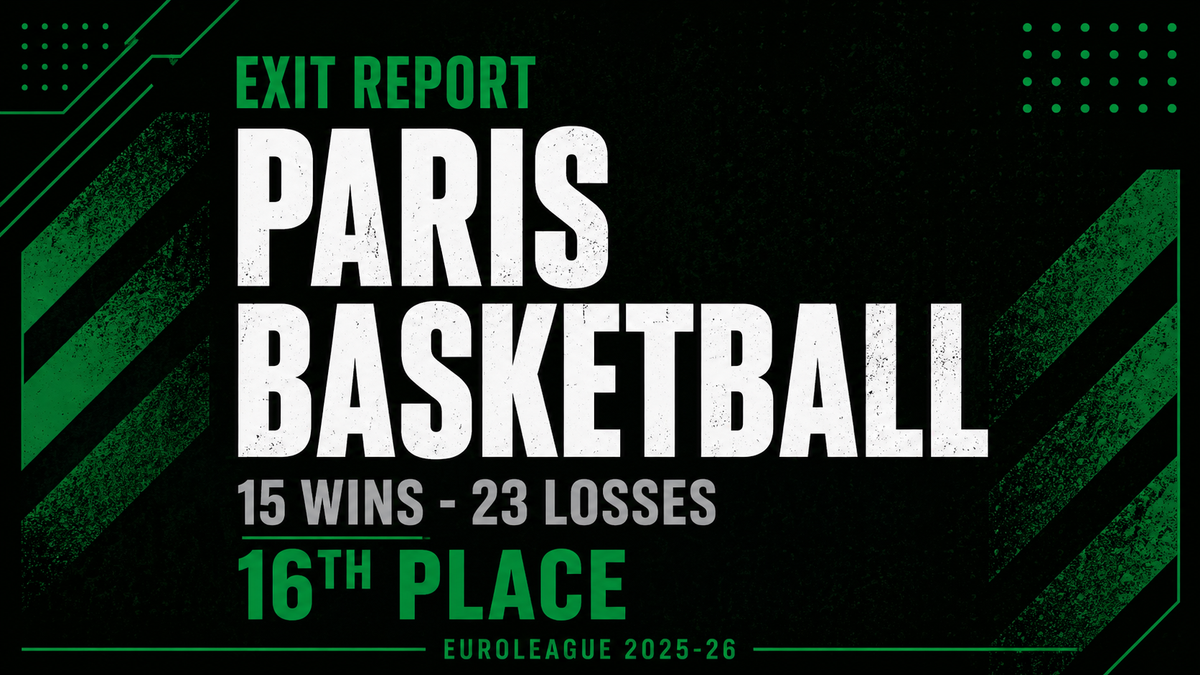
Place: 16 | EuroLeague Season
The Roster
The context first: Paris lost TJ Shorts, six of their seven top scorers, and their head coach Tiago Splitter — who departed for the Portland Trail Blazers — in a single summer. Every preseason analysis ranked them among the most vulnerable clubs in the competition. Every preseason analysis was partially wrong.
Nadir Hifi (18.9 Pts, PIR 17.6) became the EuroLeague's scoring leader and one of the stories of the season. Around him: Justin Robinson (14.6 Pts, PIR 14.4), Jared Rhoden (11.1 Pts), Lamar Stevens (9.3 Pts), Allan Dokossi (5.0 Pts, 5.5 Reb), Mouhamed Faye (4.6 Pts, 5.0 Reb). A rebuilt team held together by one transcendent individual performance and a system that maximized collective movement.
15-23. 16th place. Point differential of -34. Those numbers understate what Paris actually accomplished with this roster.
The Coach
Francesco Tabellini replaced Splitter and did something genuinely difficult: he built a functional EuroLeague identity around a single player without making the system entirely dependent on that player's individual decisions. Hifi was the engine, but Paris moved the ball — 17.5 assists per game — ran structured actions, and competed in most games until the final minutes.
The defensive failures were structural rather than motivational. Paris ranked near the bottom of the competition defensively (PIR 92.9, bottom five) because they did not have the personnel to guard EuroLeague wings and bigs. Tabellini couldn't manufacture size and athleticism that wasn't there. What he could control — effort, system, cohesion — was consistently present.
For a first-year head coach at this level, with this roster, that is a meaningful achievement.
The System
Pace, ball movement, and Hifi. Paris played the fastest-paced offense among the bottom-half teams — 90.1 points per game, 37.3 rebounds (highest among eliminated teams), 17.5 assists. They scored with most opponents and were outscored by most opponents. The formula worked against weaker competition and broke down against physical, defense-first teams.
Their home record of 8-11 is functional. Their road record of 7-12 is competitive for a team of this talent level. The 0-0 overtime record reflects how rarely Paris had the depth to win extended games. The last ten games went 5-5 — a team that competed professionally until the end.
The Players
Hifi's season is documented in the Surprise Players report. The supporting cast earned its own recognition. Justin Robinson (14.6 Pts, 4.5 Ast) was the team's second option — a guard capable of creating both for himself and others, whose presence made Hifi's workload manageable. Jared Rhoden (11.1 Pts) provided consistent scoring off the bench with surprising efficiency. Lamar Stevens (9.3 Pts) was the defensive anchor Paris needed — physical, communicative, willing to guard the opponent's best forward every night.
Allan Dokossi (5.0 Pts, 5.5 Reb, 71.7% 2P) was the team's most efficient inside finisher — a center who converted nearly everything he attempted around the basket. Mouhamed Faye (4.6 Pts, 5.0 Reb, 38 games) provided interior presence and defensive rebounding in a role he handled professionally. Leopold Cavaliere (3.1 Pts) developed as a rotation piece while still finding his feet at EuroLeague level.
The team's 37.3 rebounds per game — highest among all eliminated teams — reflects a roster that competed physically even when outmatched in talent.
The Outlook
The entire Paris summer hinges on one question: does Nadir Hifi stay or go to the NBA?
His contract contains an NBA exit clause. He is 23 years old. He led the EuroLeague in scoring this season. NBA scouts have been watching him all year. Former Paris coaches Tiago Splitter (Portland) and Tuomas Iisalo (Memphis) know his game intimately and have already recommended him to their respective front offices. The probability of Hifi testing the NBA market this summer is high.
If Hifi leaves, Paris must find a new identity immediately. Robinson and Rhoden are legitimate EuroLeague contributors but not primary engines. The club would need to replace not just the scoring volume but the creative foundation of the entire offensive system. That requires a signing of genuine ambition — a proven EuroLeague guard in the 16-18 points range who can operate as the clear first option and run Tabellini's system with authority.
If Hifi stays — whether through loyalty, a strong contract offer, or a decision to develop further in Europe before the NBA — Paris have something real to build on. A second full season together, with Hifi now established as one of the competition's elite guards, would give Tabellini the platform to add complementary pieces rather than rebuild from scratch.
Either way, Paris needs interior reinforcement. Dokossi is efficient but limited in minutes. Faye is developing. Against the physical bigs of the EuroLeague's top ten, Paris were repeatedly exposed in the paint. One genuine center — capable of defending in drop coverage, rebounding at a high rate, and providing post-scoring — would transform the defensive profile.
The coaching is right. The system is right. The identity is forming. What Paris does with Hifi's future determines whether 2026-27 is a step forward or another rebuild.