Exit Report — Kosner Baskonia Vitoria-Gasteiz
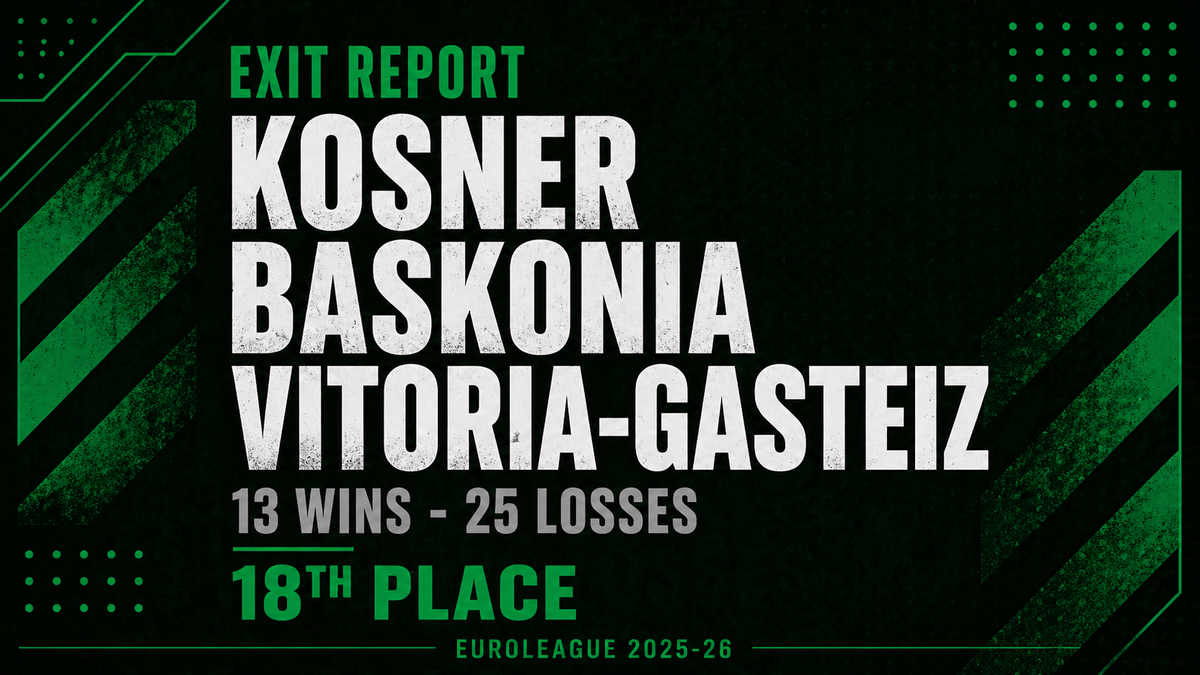
Place: 18 | EuroLeague Season
The Roster
Baskonia arrived at 2025-26 as a club in transition, having shown promising signs the previous season — a Play-In appearance built around Markus Howard and Chima Moneke. Then Moneke left for Crvena Zvezda and became DPOY. Howard remained, but missed significant stretches due to injury. The roster was rebuilt under first-year head coach Paolo Galbiati with new arrivals including Timothé Luwawu-Cabarrot, Kobi Simmons, Trent Forrest, Tadas Sedekerskis, and Rodions Kurucs.
Official numbers: 88.3 points per game, 33.4 rebounds, 19.0 assists, 6.1 steals, PIR of 95.4. Point differential of -162. 13-25, 18th place. Road record: 2-17. One of the worst road records in EuroLeague history.
The Coach
Paolo Galbiati coached his first EuroLeague season and walked into one of the competition's harder situations: a rebuilt roster, elevated expectations from a fanbase scarred by mediocrity, and a schedule that offers no time to build chemistry. His debut was historically bad — six consecutive losses to open the season, one of the worst starts in modern EuroLeague history.
Baskonia eventually stabilized. There were stretches of genuine quality — wins over Real Madrid and competitive games against top-half opponents — that showed Galbiati's tactical flexibility. But the structural problems were too deep to overcome consistently.
Sedekerskis's ankle surgery in November removed the team's captain and primary leadership voice for most of the season. Without him, Baskonia lacked the veteran presence that holds a young, unsettled group together in difficult moments. His absence is not an excuse for 13-25 — it is context for understanding how a roster that had genuine pieces ended up with a road record of 2-17.
The System
Baskonia attempted to play fast offense with modern spacing — the system matched their personnel in theory. In practice, a defensive rating that placed them among the worst three teams in the competition destroyed the formula. They could score (88.3 ppg, competitive for mid-table) but couldn't stop anyone reliably. Every win required a shootout. Every loss against a disciplined team was a blowout risk.
The 2-17 road record is the season's defining number. In 17 away games, Baskonia won twice. That is not bad luck. That is a team that cannot maintain defensive focus and execution outside its own building.
The Players
Timothé Luwawu-Cabarrot (18.2 Pts, 54.8% 2P, 41.2% 3P, PIR 16.4 in 36 games) was the statistical story of the season — career numbers in scoring on a team that finished 18th. His output was genuine: efficient from both ranges, capable of creation off the dribble, and consistent across 36 games. The context is brutal. He was frequently the only reliable offensive option, which elevated his usage and his numbers simultaneously.
Trent Forrest (10.9 Pts, 4.4 Ast, PIR 14.5) was the team's best playmaker — steady, professional, and one of the few players whose defensive engagement never wavered. Kobi Simmons (11.1 Pts, 64.1% 2P, PIR 10.8) provided interior scoring with surprising efficiency. Eugene Omoruyi (10.7 Pts, PIR 11.1) was a competent rotation forward. Hamidou Diallo (12.1 Pts in 13 games) showed explosive capability before his own injury interrupted the season. Markus Howard (10.4 Pts in 23 games) was limited by injury and never the force he had been previously.
Tadas Sedekerskis (8.0 Pts, 78.4% 2P in 13 games before surgery) was the most efficient player on the roster when healthy. His minutes-per-game suggest a player whose impact was disproportionate to his usage. Losing him in November was the season's most damaging individual blow.
The Outlook
The foundation question is Galbiati. He deserves a second season — the injuries, the roster construction problems above him, and the difficulty of coaching a first EuroLeague campaign simultaneously deserve recognition. A full season without Sedekerskis's ankle surgery, without Howard's missed games, with a roster that has one year of system familiarity, looks different.
But the defensive identity problem cannot wait for natural improvement. Baskonia need to add a genuine perimeter defender — a wing capable of guarding the opposition's best player every night. Moneke did that role and his absence has never been properly addressed. The summer's most important signing is not an offensive upgrade. It is a defensive anchor.
The second priority is interior depth. Baskonia's center rotation — Khalifa Diop, Mamadi Diakite, Chiek Diallo — had moments but lacked the commanding presence that changes defensive dynamics. One physical, mobile center capable of protecting the paint and anchoring drop coverage would transform the team's defensive profile from porous to competitive.
Luwawu-Cabarrot's future is the third variable. He is 30 years old, in the form of his career, and on a roster that cannot maximize what he does. Whether he remains at Baskonia or uses this season's performance to attract a larger contract elsewhere will determine how Galbiati builds his second season. If he stays, Baskonia have a genuine offensive weapon. If he leaves, the roster loses its only proven creator.
Sedekerskis returning healthy is the baseline. Everything else builds from there.