
Exit Report — Virtus Olidata Bologna
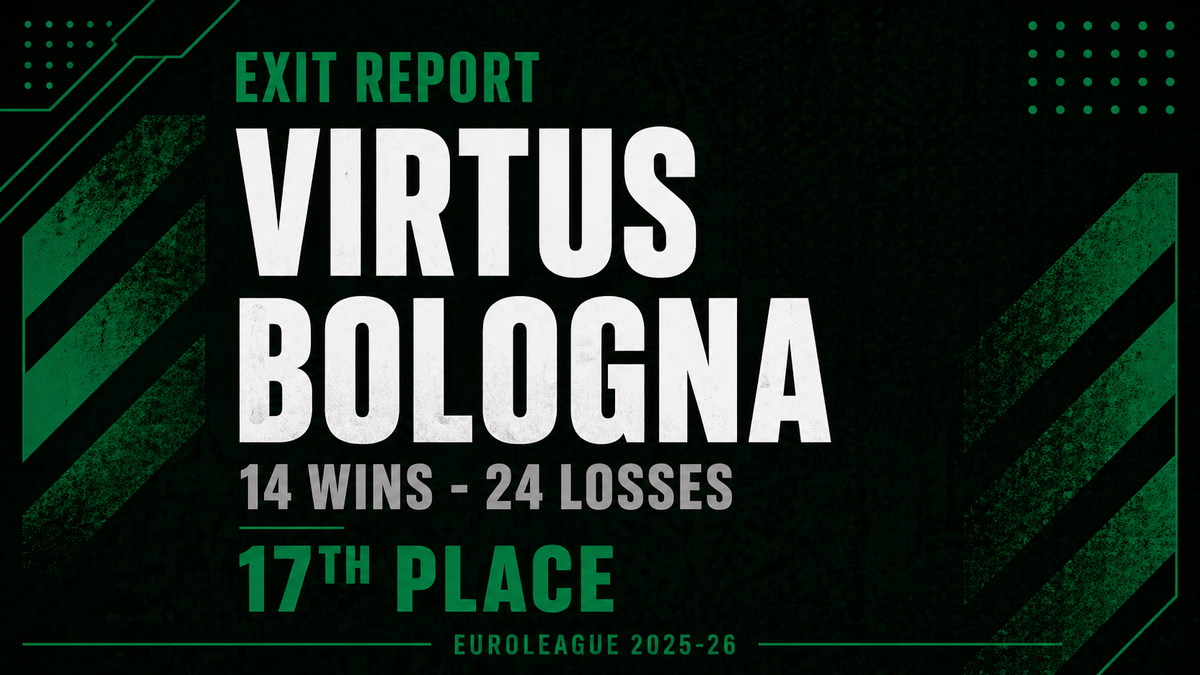
Place: 17 | EuroLeague Season
The Roster
Virtus arrived at 2025-26 carrying the weight of a summer that generated more headlines than most clubs in Europe. Carsen Edwards — EuroLeague scoring leader at Bayern the previous season — joined as the headline acquisition alongside Luca Vildoza, one of the competition's elite defensive guards. The expectation was a step forward from the 11th-place finish of 2024-25, genuine contention for a playoff spot.
The official numbers: 81.8 points per game, 33.5 rebounds, 19.3 assists, 6.6 steals, PIR of 88.8. Point differential of -175 over 38 games. 14-24, 17th place. Road record: 5-14.
The gap between the offseason narrative and the April reality is the core of Virtus's season.
The Coach
Ettore Messina resigned on November 24 with Virtus at 6-6. His stated reason: a personal decision to step away from coaching at this level. The announcement shocked the league.
Nenad Jakovljević — promoted from the assistant staff — took over immediately. His record as head coach for the remainder of the season: 8-18. The numbers are not flattering, but the context matters: he inherited a mid-season transition, an unsettled roster, and the aftermath of a coaching change that nobody had anticipated. Jakovljević kept the team professional, maintained rotation discipline, and finished the season without a collapse. The 2-8 record in the last ten games reflects accumulated fatigue and a roster that was never replenished mid-season.
What Messina's resignation revealed is more important than the coaching change itself. A coach of his authority and experience does not walk away from a 6-6 record without serious reasons. The official statement said personal decision. Whatever the true sequence of events — whether locker room friction, front office tension, or genuine personal circumstances — the dysfunction started before Jakovljević's tenure and the results reflect it throughout.
The System
Virtus under Messina played structured halfcourt basketball — patient, deliberate, defense-anchored. Under Jakovljević the principles continued but without the same enforcement authority. The team's 19.3 assists per game suggests ball movement, but 81.8 points on those possessions indicates movement wasn't generating quality shots consistently.
Defensively, 6.6 steals per game placed Virtus among the competition's better teams — largely a reflection of Vildoza's individual brilliance — but the overall defensive rating told a different story. A point differential of -175 over 38 games means Virtus were outscored by more than four points per game on average. They competed, but rarely dominated.
The road record of 5-14 is the systemic problem in numbers: a team that could execute at home with crowd support and collapsed in hostile environments. Of their 14 wins, 9 came at home. Away from Bologna, they won 5 times all season.
The Players
Carsen Edwards (17.3 Pts, 46.7% 2P, 31.9% 3P, PIR 11.0) had the scoring volume. The efficiency was not there. At Bayern, Edwards operated as the primary option with a system built entirely around his movement and decision-making. At Virtus, he was expected to coexist within Messina's structure — to be part of a collective rather than the engine of it. The transition was never smooth, and the 31.9% three-point shooting over 36 games reflects a player who never found his rhythm from deep.
Luca Vildoza (7.6 Pts, 4.4 Ast, 1.4 Stl) was Virtus's most impactful player relative to his scoring line. His defensive work — including the competition's steals leadership — was consistent and valuable. As a playmaker he was reliable; as a scorer he was limited. The combination of Vildoza and Edwards was supposed to be complementary. In practice, they occupied overlapping roles without a clear hierarchy.
Matthew Morgan (13.5 Pts, 61% 2P, PIR 12.2) was Virtus's most efficient scorer — a forward who converted consistently around the basket and provided the kind of quiet, reliable output the roster needed more of. Saliou Niang (7.1 Pts, 65.2% 2P, 5.0 Reb) was excellent as a physical, mobile forward. Mouhamet Diouf (8.0 Pts, 59.8% 2P, PIR 10.5) gave Virtus a genuine interior option who finished with authority. Derrick Alston Jr. (10.0 Pts, PIR 8.7) provided perimeter scoring depth.
Karim Jallow (5.3 Pts, 37 games) was a professional rotation wing. Alen Smailagic (7.4 Pts) provided energy in a bench role.
The Outlook
The coaching question must be resolved before anything else. Jakovljević was a placeholder — competent under impossible circumstances, but not the long-term answer for a club of Virtus's ambition and history. The summer's most consequential decision is finding a head coach capable of commanding respect in a veteran locker room, building defensive identity, and winning the close road games this team consistently lost. The candidate needs a resume that matches the weight of the Virtus name.
The roster's central problem is balance. Edwards is a scorer, not a system player. Vildoza is a system player, not a scorer. The two were signed to complement each other and instead revealed each other's limitations. The summer question is whether Edwards returns — his contract situation and willingness to accept a different role — or whether Virtus uses the position to bring in a guard with a more complete offensive profile.
Interior reinforcement is the second priority. Diouf and Niang were functional but neither commands the paint with the authority a playoff-caliber team requires. One genuine center — physical, dominant on the glass, capable of protecting the rim — would change Virtus's defensive profile significantly.
The most important thing Virtus can do this summer is clarify roles before the season starts. The dysfunction was not primarily about individual talent — the roster had genuine quality. It was about a collection of players who never understood their hierarchy within the system. That is a coaching and front office failure, and it must be corrected before adding more pieces.