FRANCHISE HISTORY: GREEN BAY PACKERS
FRANCHISE HISTORY SERIES - #1 The Town That Owns Its Team.
Up Up in the Nord
The waiting list for Green Bay Packers season tickets currently contains 148,000 names. The city of Green Bay has a population of 106,000. The list is longer than the city itself — and has been for years. There are families in Wisconsin who registered their newborn children the day they came home from the hospital. Those children may wait sixty years before their tickets arrive.
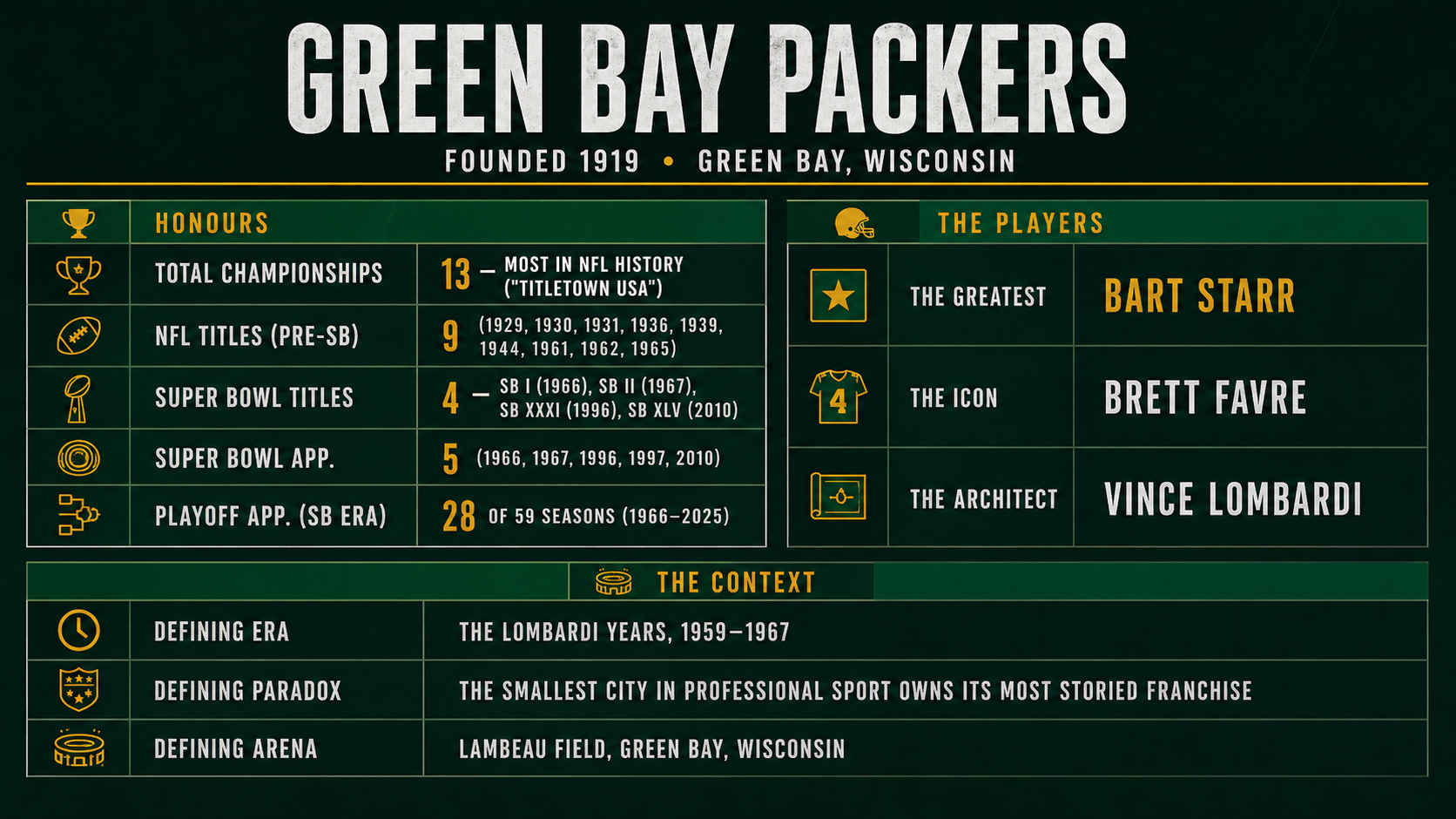
Green Bay is the smallest market in North American professional sports. It has no Fortune 500 headquarters, no international airport worth the name, and a metropolitan area that most NFL owners would not consider viable for a franchise. It has 13 NFL championships — more than any other team in the history of the sport. It has the trophy named after its greatest coach, a stadium the city owns, and a franchise that 538,967 people legally co-own. No individual can buy it. No billionaire can move it.
This is the paradox the Green Bay Packers have always carried: an institution built in conditions that should have made it impossible, producing results that have made it inevitable. The story of how a meat-packing town in Wisconsin became the spiritual center of American football is not a story about luck. It is a story about a community that decided, once and permanently, that its team was not a commodity.
$500 and a Meat Packer's Promise
The Packers were not built. They were scraped together.
On August 11, 1919, Curly Lambeau — a 21-year-old shipping clerk at the Indian Packing Company in Green Bay — walked into his employer's office and asked for $500. He wanted money for uniforms and equipment for a football team. The company agreed, on one condition: the team would carry their name. The Indian Packing Company would be bought out by the Acme Packing Company less than two years later, the original sponsor gone before the franchise had played a single professional game. But the name stayed. The Packers remained.
Lambeau was not the only founder. George Whitney Calhoun, the sports editor of the Green Bay Press-Gazette, organized the meeting that night in the editorial rooms of the newspaper and recruited the original players. The pairing made sense: Lambeau handled the football, Calhoun handled the publicity. The Press-Gazette's daily coverage was the only thing keeping the early Packers visible to the city they represented. Without Calhoun's reporting, the franchise's existence would not have outlived its first financial crisis. The Packers Hall of Fame recognizes Calhoun as co-founder. He served the franchise in unpaid roles until his death in 1963.
Lambeau himself was a force of nature. He played halfback on the field and coached from the sideline, ran practices, signed players, and led the team for the next 29 years. His first season, the Packers went 10–1 against regional amateur opposition, outscoring their opponents 565 to 12. The field had no fence. Spectators passed a hat through the crowd to cover costs. When the weather turned and rain insurance fell three one-hundredths of an inch short of the coverage threshold, the franchise lost $1,500 in a single afternoon — a sum that nearly ended everything before it had started.
In 1921, the Packers joined the American Professional Football Association, the nascent league that would become the NFL a year later. Green Bay was its smallest member — smaller than Canton, Ohio; smaller than Hammond, Indiana; smaller than Rock Island, Illinois. The league didn't know what to do with them. It still doesn't, exactly. But it has learned to accept that Green Bay is not an aberration. It is an argument.
The Hungry Five and the Birth of Something Permanent
By 1923, the Packers were financially ruined. Lambeau had temporarily surrendered the franchise after a disastrous financial season. What happened next defined everything that followed.
The Hungry Five — Andrew B. Turnbull, Curly Lambeau, Lee Joannes, Dr. W. Webber Kelly, and Gerald F. Clifford — raised enough capital to reconstitute the team as the Green Bay Football Corporation, a nonprofit organization owned by its shareholders. The fans became the owners. Their investment was their community. Any profits would go back into football operations; if the franchise was ever sold, the proceeds would go to the American Legion, not to private individuals.
Turnbull was the central figure. The owner of the Green Bay Press-Gazette, he was the one who convinced Lambeau and Calhoun to play a Thanksgiving game in November 1922 against Duluth in driving rain — a game that would lose money but which Turnbull insisted had to happen because canceling would kill the franchise outright. He promised to organize local businessmen to keep the team alive afterward. He delivered. A meeting held in December 1922 at the Beaumont Hotel drew 150 community leaders. By August 1923, the Green Bay Football Corporation was incorporated. Turnbull served as its first president from 1923 to 1928 and remained on the board until 1949. Without him, the franchise dies in 1922. There is no Lombardi, no Lambeau Field, no NFL story to tell about the smallest market in professional sport. Turnbull was the godfather.
This structure, established in 1923 and refined through subsequent stock sales in 1935, 1950, 1997, 2011, and 2021–22, is what makes the Packers genuinely unique in American professional sport. As of 2025, exactly 538,967 people hold shares across 5,204,625 outstanding units. No individual controls the franchise. No billionaire can relocate it to another city to maximize revenue. The Packers belong to Green Bay in a legal, structural, and permanent sense that no other sports franchise in the United States can claim.
In every other major American sport, a franchise is a private asset. The Packers are a public trust — owned by no one and everyone simultaneously. That distinction is not sentimental. It is structural, legal, and permanent.
In every other NFL franchise, a single owner or ownership group controls the asset and can, within the league's rules, relocate, sell, or restructure as they choose. The Packers cannot be sold to a private buyer. The articles of incorporation stipulate that in the event of sale, proceeds go to the Green Bay Packers Foundation — not to shareholders. This is not sentiment. It is a legal mechanism that has kept the franchise in a city of 106,000 people for over a century, against every economic logic that would argue for moving it to a larger market.
Three Straight, Then Three More: Lambeau's Dynasty
Lambeau spent the 1920s building the infrastructure of a dynasty. In 1929, he signed three established NFL players — halfback Johnny Blood, guard Cal Hubbard, and guard Mike Michalske — off rival teams, instantly upgrading Green Bay's talent level. The result was a three-year championship run: 1929, 1930, 1931. No NFL team has won three consecutive titles since the modern playoff era began in 1933.
What made those early Packers remarkable was not just the winning — it was the method. Lambeau was an early believer in the forward pass at a time when ground-based football dominated the sport. His collaboration with receiver Don Hutson in the late 1930s and early 1940s was decades ahead of its time. Hutson, who joined the team in 1935, retired in 1945 with 99 receiving touchdowns — a record that stood for 44 years until Steve Largent broke it in 1989. He invented routes that defensive backs had no vocabulary to describe. In a league that still thought of passing as a gimmick, Hutson was running a modern NFL offense.
The Packers won three more championships in 1936, 1939, and 1944 — six titles in sixteen years. By any standard, Lambeau's era belongs among the great coaching runs in professional sports history. And then it ended, abruptly and badly. By 1949, Lambeau had alienated the board, burned through goodwill, and found himself at the center of a power struggle over the franchise's future. He resigned. The team he had built from nothing entered a decade of irrelevance.
The Players Lambeau Built His Dynasty Around
Six championships do not happen without players, and the Packers of the Lambeau era produced a roster of names that would be foundational to the league's first half-century. Most are now ghosts to modern fans — known only to historians and the curators of the Pro Football Hall of Fame. But each shaped what professional football would become.
Johnny Blood McNally was the most colorful player of the era — a halfback who ran with abandon, drank with conviction, and treated training rules as suggestions. He had taken his nom de guerre from a movie marquee advertising Rudolph Valentino's "Blood and Sand" because he wanted to preserve his college eligibility. Lambeau acquired him from the Pottsville Maroons in 1929, watched him score touchdowns and miss curfew with equal frequency, and built the running game around him through three consecutive championships. He was inducted into the Pro Football Hall of Fame as a charter member in 1963.
Cal Hubbard was the largest man in the league — a 6-foot-5, 250-pound tackle when most linemen were sub-220 — and the only person elected to both the Pro Football Hall of Fame and the Baseball Hall of Fame (he umpired in the American League after his playing career). Mike Michalske, the guard who arrived alongside Hubbard in 1929, was the first guard ever elected to the Pro Football Hall of Fame. Together with Hubbard, he gave Lambeau a line that physically dominated the league through three championship seasons.
Clarke Hinkle was, in Lambeau's own words, the greatest player he ever coached. A fullback, linebacker, kicker, and punter who played both ways for ten seasons (1932-1941), Hinkle led the NFL in rushing in 1937 and was the league's defining defender against the Bears' Bronko Nagurski — their head-to-head collisions in the 1930s were the league's first marquee individual rivalry. Arnie Herber, the quarterback who threw to Don Hutson, won three championships and was the NFL's first true downfield passer at a time when the forward pass was treated as a desperation tactic. Both are in the Hall of Fame.
These were the men who built the foundation. By the time the Packers won their sixth championship in 1944, the franchise had produced more Hall of Famers than any team in the league. The dynasty would end with Hutson's retirement in 1945. The infrastructure those players had built would carry the franchise's reputation through a decade of losing — until Lombardi arrived to restore it.
The Wilderness: A Decade of Losing, and One New Stadium
The 1950s were not kind to Green Bay. In the ten seasons between Lambeau's departure and Vince Lombardi's arrival, the Packers won more than six games exactly once. They finished last in their division multiple times. The franchise that had won six championships was now a destination that talented players tried to avoid.
There was one significant achievement in this period: in 1957, the Packers opened a new stadium on the south side of Green Bay. Built at a cost of $960,000 and financed jointly by the Packers and the city — voters approved the bond issue with 70.3% support in April 1956 — the facility seated 32,500 people on opening day, September 29, 1957, when the Packers defeated the Chicago Bears 21–17 before a capacity crowd dedicated by Vice President Richard Nixon. It was named City Stadium. After Lambeau's death on June 1, 1965, it was renamed Lambeau Field on August 3, 1965 — a monument to the man who built the franchise, commissioned by the city he built it in.
But in 1958, none of that mattered. The Packers finished 1–10–1 — their worst season in franchise history. The board of directors understood that a structural solution was required, not a marginal improvement. They hired Vince Lombardi.
What Lombardi Understood That Everyone Else Didn't
Lombardi arrived in Green Bay in January 1959 with no head coaching experience at the professional level. His résumé was five years as the backfield coach of the New York Giants. He was 45 years old. At his introductory press conference at Green Bay's Hotel Northland, he told the assembled journalists, in the line that would define his tenure: "I want it understood that I'm in complete command." The room understood. The franchise had just finished 1-10-1 with players who had been deciding their own discipline. There was no question about what was being offered, or what was being demanded.
In his first season, the Packers went 7–5 and Lombardi was named NFL Coach of the Year. In his second, they reached the NFL Championship Game. Over the next seven years, they won five NFL championships — including three consecutive titles from 1965 to 1967 — and the first two Super Bowls ever played. Lombardi compiled an 89–29–4 regular-season record in Green Bay, arriving after the franchise's worst season ever. No team has won three straight championships since the modern postseason began. The crowning achievement of the three-peat has never been replicated.
What Lombardi understood was not tactical — every NFL coach of that era knew how to run the sweep. What he understood was organizational. He believed that ambiguity was the root cause of losing — and he eliminated it ruthlessly.
The football itself was almost monastically simple. Lombardi's offense ran a small playbook, executed at a level of precision that defenders could see coming and still not stop. The signature play was the Power Sweep — guards Jerry Kramer and Fuzzy Thurston pulling, the fullback leading, Paul Hornung or Jim Taylor following at full speed — a play opposing defenses scouted, drilled against, and continued losing to for nine straight years. The point was not deception. The point was that the Packers would do the simple thing better than anyone else could defend it. "Run to daylight," Lombardi called it. The phrase became the title of his book, and the operating principle of his coaching: tactics matter less than execution; execution flows from clarity; clarity flows from elimination of doubt.
Lombardi: The Man Behind the Trophy
The Lombardi the public came to know — the granite-jawed disciplinarian whose face still appears on every NFL motivational poster — was a manufactured product, partly self-curated, partly imposed by a media that needed a single image to fit the achievements. The actual man was more complicated, and more interesting.
He was the son of an Italian-American butcher in Brooklyn, raised Catholic, briefly considering the priesthood before football pulled him toward Fordham, where he played on the famous offensive line known as the Seven Blocks of Granite. He coached high school football in New Jersey for eight years, then moved to Fordham, then to the U.S. Military Academy at West Point under Red Blaik — the experience that shaped his approach to discipline more than any other. He was 45 years old when Green Bay hired him. He had spent twenty-five years coaching, almost entirely at levels below the NFL. He had been passed over repeatedly for head coaching jobs in part because of unspoken bias against Italian-American Catholics in the executive ranks of the league. By the time he reached Green Bay, he was both ferociously prepared and quietly furious — a combination the Packers' veterans recognized from their first meeting in February 1959.
His most famous line — "Winning isn't everything; it's the only thing" — was not original to him. It had been used by UCLA coach Red Sanders years earlier. Lombardi disliked the formulation in any case. The version he actually preferred was different and more telling: "Winning isn't everything, but the will to win is the only thing." The distinction matters. The first reading is brutalist; the second is closer to philosophical. Lombardi was not arguing that the score was the only thing that counted. He was arguing that the willingness to subordinate everything else — comfort, ego, individual preference — to a collective goal was what separated organizations that achieved from organizations that did not.
He was harder on his players than any coach of his generation, and they loved him for it in retrospect, often resented him in the moment. Henry Jordan, the Hall of Fame defensive tackle, delivered the line that has followed Lombardi ever since: "He treats us all the same — like dogs." The line was meant fondly. The reality behind it was that Lombardi made no distinctions of race or background — at a moment in American football when such distinctions were structurally embedded in the league. His Black players, including Willie Davis, Herb Adderley, and Willie Wood, played roles of central importance on his championship teams. He demanded the same of all his players, and he protected them equally from external pressure.
After the third consecutive championship in 1967, Lombardi resigned as head coach in February 1968 to focus on his duties as general manager. The decision was emotional and immediate, made within days of Super Bowl II. He found administrative work boring almost instantly. By February 1969, he had taken the head coaching job in Washington, where he led the Redskins to their first winning season in fourteen years. Less than a year later, in June 1970, he was diagnosed with intestinal cancer. He died on September 3, 1970, at the age of 57. The Super Bowl trophy was renamed in his honor before the next championship game. Every franchise that wins it takes the Lombardi Trophy home. None of them built it.
From Super Bowl II to his death: just over two and a half years. The trophy outlives the man, the way trophies do. The man's name outlives everyone who hoists it.
The Players Lombardi Built His Dynasty Around
Lombardi did not arrive in Green Bay with a roster of stars to assemble. He arrived with the scattered remains of a 1-10-1 team — and with one decisive structural advantage: the Packers had drafted exceptionally well throughout the late 1950s under personnel director Jack Vainisi. Bart Starr was already on the roster (drafted 1956). So were Forrest Gregg (1956), Paul Hornung (1957), Jim Taylor and Ray Nitschke (both 1958), and Jerry Kramer (1958). The 1958 draft alone — Taylor, Nitschke, Kramer, Dan Currie — produced four players central to the championship teams. Vainisi died of a heart attack in November 1960, age 33, before he could see what his work had built.
Paul Hornung was the engine. The 1956 Heisman Trophy winner from Notre Dame, he was the first overall pick in the 1957 draft and floundered through three positions and three seasons before Lombardi arrived and made him the halfback in the Power Sweep. He won the NFL MVP in 1961. He set a single-season scoring record (176 points) that stood for forty-six years. He was suspended for the entire 1963 season for gambling on NFL games — a violation he never fully explained, and which Lombardi never publicly criticized him for. He returned in 1964, played three more seasons, and retired with three NFL championships and a Hall of Fame plaque.
Jim Taylor was the contrast — a fullback from LSU who treated every carry as a personal grievance and finished his career with five 1,000-yard rushing seasons. He was the 1962 NFL MVP, the only Packer running back ever to win it. Together with Hornung, he gave Lombardi a backfield that could run the same play repeatedly and still gain four yards a carry against defenses that knew exactly what was coming.
Ray Nitschke was the soul of the defense — a middle linebacker who played the position with a controlled fury that became the visual template every NFL middle linebacker has since been measured against. He arrived as a third-round pick in 1958, drank his way through his early seasons, married, sobered up, and became a Hall of Famer. Forrest Gregg, the right tackle, was called the finest player he ever coached by Lombardi himself — high praise from a man who coached half a Hall of Fame roster. He later became head coach of the Packers in the 1980s, with markedly less success.
On defense, the Packers built around four future Hall of Famers: Willie Davis at defensive end (acquired in a trade from Cleveland that remains one of the great heists in NFL history), Henry Jordan at defensive tackle, Herb Adderley at cornerback, and Willie Wood at safety. None of these names carries the weight of Starr or Lombardi in the public memory. All of them were on the field when those championships were won. The Packers of the 1960s had eleven Hall of Famers on their roster simultaneously — a concentration of talent unmatched by any team in NFL history except possibly the 1970s Steelers.
The Ice Bowl: December 31, 1967
The temperature at kickoff was minus-13 degrees Fahrenheit. The wind chill, by modern calculations, was somewhere between minus-36 and minus-48. The grass underneath the sideline heating system had frozen anyway, because the heating system itself failed when temperatures collapsed overnight. The referees' whistles froze to their lips on the opening kickoff and could not be used for the rest of the game; calls were made by voice. Officials communicated by waving arms. A spectator died of exposure in the stands. Two members of the half-time marching band were hospitalized. The CBS cameras filming the game malfunctioned in the cold. By the second half, the field had become essentially a sheet of ice, hard enough that players' cleats found no purchase and ball-carriers ran in straight lines because turning was impossible.
The 1967 NFL Championship Game between the Packers and the Dallas Cowboys is the most-watched cold-weather event in American sports history, and the most mythologized single game in NFL history before the era of the Super Bowl. The Packers led 14-0 at the start. Dallas scored ten points in the second quarter and another seven on a 50-yard halfback option pass in the fourth. With 4:50 remaining, the Packers had the ball at their own 32-yard line, trailing 17-14, with a frozen field, a stadium full of people who could no longer feel their hands, and Bart Starr in the huddle.
What followed has been replayed for nearly six decades. Twelve plays, sixty-eight yards, the Packers grinding toward the Cowboys' goal line one short gain at a time on a field where short gains were the only kind possible. Two carries by Donny Anderson got the ball to the one-yard line. On third down with sixteen seconds remaining, no time-outs, the field goal that would tie the game obviously available, Lombardi told Starr to run a quarterback sneak. The play was called 31 Wedge: Jerry Kramer and Ken Bowman block Jethro Pugh down at the line of scrimmage, Starr follows with the ball. Kramer and Bowman moved Pugh exactly the half-step required. Starr followed. The Packers won 21-17.
Two weeks later they defeated Oakland 33-14 in Super Bowl II. Lombardi retired from coaching a month after that. The Ice Bowl was, in retrospect, his last great game on a sideline he had owned for nine years — a game decided by execution at the limit of what executable football could be in the conditions where it was being played. There has not been a championship game played in conditions remotely that severe since. There never will be. The NFL learned from the Ice Bowl that its product cannot survive what Green Bay can survive.
The Ice Bowl did not just produce a championship. It produced a piece of mythology that the franchise has been able to draw on for fifty-eight years and counting. Every cold-weather home game at Lambeau Field still inherits from that afternoon. The Packers did not invent winter football. They taught the league what winter football could be.
Four Decades, Four Quarterbacks: The Line That Defines the Franchise
No franchise in NFL history has maintained elite quarterback play across as many consecutive decades as Green Bay. From Bart Starr's first championship in 1961 to Jordan Love's emergence in 2024, the Packers have had a de facto franchise quarterback for sixty-three of the last sixty-five years. This is not luck. It is organizational culture — the willingness to plan ahead, draft for the future, and absorb the short-term pain of transition so that the machine keeps running.
Four quarterbacks. Four Hall of Fame trajectories — three confirmed, one on the way. And two of the most spectacular, ego-driven, self-destructive departures in the history of professional sport, delivered by men who couldn't be more different as human beings, and couldn't be more identical in their inability to accept that their time was over.
Bart Starr. Brett Favre. Aaron Rodgers. Jordan Love. The line holds — even when the men in it try to break it.
Bart Starr's statistical profile does not leap off the page by modern standards. What it does is reveal a quarterback who played at an extraordinarily high level in the moments that mattered most. He was drafted by the Packers in the 17th round of the 1956 draft — the 200th overall pick — a selection so obscure that even Green Bay barely believed in him. His career postseason passer rating of 104.8 stood as the NFL record for fifty-four years, until Patrick Mahomes finally surpassed it in January 2022. He was the MVP of Super Bowl I and Super Bowl II. He delivered the Ice Bowl sneak. In ten postseason games he went 9–1. Starr was not a gunslinger — he was an instrument of precision, and Lombardi's system allowed him to function at the outer limit of his abilities year after year.
Brett Favre arrived in 1992 in a trade from Atlanta — Green Bay surrendering a first-round pick for a quarterback the league had not yet recognized — and immediately became the most compelling player in the sport. He won three consecutive NFL MVP awards from 1995 to 1997, a feat no quarterback before or since has matched. He led Green Bay to back-to-back Super Bowls, winning Super Bowl XXXI against the New England Patriots 35–21. He started 297 consecutive regular-season games — a record at the position that has not been approached. He threw for 61,655 yards as a Packer. He also threw 336 career interceptions — the most in NFL history by a margin of more than thirty over second place. His relationship with risk was not a flaw in his game; it was the game itself.
Aaron Rodgers arrived in 2005 as Favre's backup and waited three years to start. When he did, he produced one of the most statistically efficient stretches in quarterback history. He holds the all-time NFL record for career passer rating at 102.6. He has five seasons with more than 4,000 passing yards and five or fewer interceptions — while the rest of NFL history has five such seasons combined. He won four NFL MVP awards. He led the Packers to Super Bowl XLV in February 2011, defeating the Pittsburgh Steelers 31–25, earning the game's MVP award.
Drama Queens in Green and Gold: The Favre and Rodgers Exits
Here is what makes the Packers' quarterback story genuinely unusual — not just as a football narrative, but as a study in how elite performers relate to institutions that made them. Brett Favre and Aaron Rodgers are entirely different human beings. One is a Mississippi country boy, a gunslinger who played football like a barroom brawl — emotional, reckless, magnificent. The other is a California intellectual, a student of the game who reads defenses the way academics read texts, and whose sense of his own specialness grew, year by year, into something that eventually became untethered from reality. They share almost nothing in personality or philosophy.
Except this: both turned their exits from Green Bay into multi-year theatrical productions. Both put their own narrative above the organizational needs of the franchise that had given them everything. Both left in ways that were smaller than the careers that preceded them.
Favre held the Packers hostage with annual retirement theater for four consecutive years. Rodgers spent his final Green Bay seasons becoming progressively less invested in the team while becoming progressively more invested in himself.
Favre's exit was a slow-motion hostage situation. From 2005 onward — the year the Packers drafted Rodgers — Favre's annual retirement deliberations became a franchise-wide event. Would he return? Would he not? The uncertainty made it impossible to plan. The Packers could not properly develop Rodgers, could not communicate a genuine transition timeline to the locker room, could not operate with any certainty about their quarterback situation from one spring to the next. This was not accidental. Favre knew that his indecision gave him leverage. He used it.
A detail that belongs in the record: in 1996, midway through his greatest stretch, Favre publicly admitted a dependency on the painkiller Vicodin and checked into rehabilitation for 46 days. He returned, played the following season, and won Super Bowl XXXI. Whatever one thinks of the retirement theater that followed, this moment reveals something real about the man — genuine vulnerability, genuine courage, and a relationship with extremes that defined everything he did on and off the field.
When the Packers finally moved on after the 2007 season, Favre reversed course — again — and demanded to return. The organization, having committed to Rodgers, declined. He was traded to the New York Jets. And then, after one season in New York, he signed with the Minnesota Vikings — Green Bay's most bitter rival. He played at Lambeau Field in 2009 wearing purple, threw four touchdown passes, and led Minnesota to a 30–23 victory. Whatever one thinks of the sporting merit of his performance, the symbolism was unmistakable: a man who had been the face of the Green Bay Packers chose, when given the opportunity, to try to beat them while wearing their enemy's colors.
This is what happens when an athlete's ego outgrows the institution that built it.
Rodgers' departure followed a structurally identical arc, which is remarkable given how different the two men are. Where Favre was operatically emotional, Rodgers was coldly architectural. Where Favre played retirement theater with tears and press conferences, Rodgers used podcasts, darkness retreats — including a multi-day sensory deprivation session in 2023, after which he announced his intention to join the Jets — and carefully constructed media appearances to signal his unhappiness. The methods differed. The underlying dynamic was identical.
The friction began the moment the Packers drafted Jordan Love with the 26th overall pick in 2020. Rodgers was furious — not consulted, or at least not adequately. The idea that Green Bay would dare to plan for his succession while he was still performing at an elite level was, in Rodgers' framing, a betrayal. He won back-to-back MVP awards in 2020 and 2021. He used the public attention those awards generated to air his grievances at length and in detail.
What became apparent during his final Green Bay seasons was that Rodgers had begun to disengage. He reduced his participation in offseason workouts — the voluntary sessions through which a franchise quarterback builds chemistry with receivers and establishes offensive rhythm. Younger players who needed that time with him were left without their quarterback's full engagement. The franchise absorbed this quietly, because Rodgers was still producing, and because the leverage a four-time MVP holds over any organization is essentially absolute.
Rodgers won four MVPs, a Super Bowl, and the NFL's all-time passer rating record. He also spent his final years in Green Bay becoming, incrementally, a worse teammate — and seemed not to notice.
He was traded to the New York Jets in the spring of 2023. He tore his Achilles tendon on the fourth offensive play of his first game as a Jet. He returned for the 2024 season, and the Jets won five games. Then came the move to Pittsburgh — Rodgers' third franchise in three years, a pattern so structurally similar to Favre's late-career wandering that the parallel essentially writes itself. With the Steelers in 2025, Rodgers performed: 24 touchdowns, 7 interceptions, a 10–7 record, an AFC North division title. The wild-card loss to Houston ended the season. As of April 2026, he has not retired or re-signed. The Steelers are waiting. This, too, is familiar.
Rodgers Beyond Football: When Intelligence Becomes Its Own Trap
Aaron Rodgers is genuinely intelligent. This is not a qualifier — it is a relevant fact, because his intelligence is central to his self-understanding, and that self-understanding is central to understanding how his career ended.
Rodgers has spent the better part of a decade constructing a public identity around his difference from other people — his curiosity, his willingness to question received wisdom, his refusal to accept consensus. In his telling, this is what separates him from the herd: he thinks for himself. The problem is that this framework — the framework of the independent thinker who sees through mainstream deception — is structurally indistinguishable from the framework that produces conspiracy theories.
One could argue he is simply asking questions, refusing to accept easy answers. But there is a meaningful difference between intellectual humility — which updates its priors when confronted with evidence — and contrarianism, which treats disagreement with consensus as evidence of sophistication. Rodgers, when challenged on his public positions on vaccines, COVID, or medical science, has not updated. He has doubled down. That is not a sign of independent thought. It is a sign of an identity too invested in its own specialness to risk being wrong.
Truly intelligent people tend to update their priors when evidence contradicts them. Rodgers, when challenged, doubled down. That is not skepticism — that is ego dressed in the language of inquiry.
This matters for the Green Bay story because it helps explain the final years. A quarterback who believes he is uniquely insightful — in football, in philosophy, in medicine, in geopolitics — is a quarterback who has, by definition, less to learn from his organization, his coaches, and his teammates. The disengagement was not random. It was the behavioral expression of a worldview in which Rodgers had progressively less to gain from participation and more to lose by subordinating himself to institutional demands.
Green Bay, to its credit, managed this dynamic better than most franchises would have. They gave Rodgers his awards, his public tributes, his MVP celebrations. They absorbed his absences. They took his criticism with professional silence. And then, when Jordan Love was ready, they traded him. Cleanly, professionally, without drama on their end. The drama that followed was entirely Rodgers' own.
Twenty-Four Years in the Wilderness
The period from Lombardi's resignation in February 1968 to Ron Wolf's hiring in November 1991 is the longest sustained drought in Packers history — and the period least often discussed in the franchise's mythology. Twenty-four seasons. Five winning records. Two playoff appearances. Five different head coaches, none of whom finished his tenure with a winning career mark in Green Bay.
Phil Bengtson inherited the team Lombardi left behind and went 20-21-1 over three seasons before resigning. Dan Devine arrived from Missouri in 1971 with a national reputation as a college coach and produced one division title (1972) before regressing and resigning after 1974. Bart Starr — the player Packers fans wanted as coach — accepted the job in December 1974 and went 52-76-3 over nine seasons before being fired in 1983, having spent most of his tenure handcuffed by Devine's disastrous trade for an aging John Hadl. Forrest Gregg followed and went 25-37-1 in four years before leaving for SMU. Lindy Infante's four seasons produced one playoff team (1989) and three losing records.
The losing was not the only problem. The franchise was drifting administratively. Ownership structure that had once been a source of strength was becoming, by the 1980s, a structural disadvantage: a board of directors deciding football matters by committee, no single executive empowered to make hard calls, no clarity about what kind of organization the Packers wanted to be. Bob Harlan, who became team president in 1989 after eighteen years in administrative roles, recognized this and acted decisively in November 1991 by hiring Wolf and giving him complete authority over football operations. The structural fix preceded the football fix. Wolf hired Mike Holmgren in January 1992 and traded for Favre a month after that. The drought ended that fall.
There is a tendency in retrospective franchise histories to compress periods of failure into a sentence and move on to the next era of success. The 1968-91 stretch deserves more attention than that. It was nearly a quarter-century. It contained an entire generation of fans who were born after Super Bowl II and reached middle age before the Packers won another playoff game. It was, for that generation, the entire experience of being a Green Bay fan. What Wolf and Harlan and Holmgren and Favre delivered starting in 1992 was not just a return to relevance — it was the redemption of a community that had, by the time it happened, almost forgotten what relevance looked like.
Ron Wolf: The General Manager Who Rebuilt the Franchise
If Vince Lombardi is the most important coach in Packers history, Ron Wolf is the most important executive — and the gap between his public profile and his structural significance is one of the strangest disparities in modern NFL history. Wolf had been around professional football for thirty years before he arrived in Green Bay in November 1991. He had worked under Al Davis with the Oakland Raiders for two decades, helping build the dynasties of the 1970s and 1980s. He had served as personnel director of the New York Jets in the late 1980s, where he had identified Brett Favre as the best quarterback prospect in the 1991 draft and watched the Falcons take him one pick before the Jets could. He arrived in Green Bay with a single condition: complete authority over football operations. Bob Harlan agreed. Within seven years, the Packers had won a Super Bowl.
What Wolf understood, in a way few of his peers did, was that the modern NFL would be defined by free agency — and that the market for proven veterans would be smaller and more inefficient than the market for young talent. He built primarily through the draft (Favre was technically a trade, but the principle held), supplemented strategically with veteran acquisitions, and resisted the trade-deadline panic moves that had defined his immediate predecessors. Twenty-six rookies he drafted made the Pro Bowl. He hired Mike Holmgren over five other suitors. He signed Reggie White when no one expected White to consider Green Bay. He drafted Aaron Rodgers in 2005 — three years after retiring from the GM job, having recommended Rodgers to his successor Ted Thompson. The Wolf-Thompson-Gutekunst chain of front-office continuity is now thirty-four years deep. Every general manager who has held the job has, in some structural sense, been a continuation of Wolf's project.
He retired in February 2001 and almost entirely disappeared from the league afterward. He gave few interviews, accepted few honors, declined most opportunities to capitalize on his reputation. The Packers Hall of Fame inducted him in 2011. The Pro Football Hall of Fame elected him as a contributor in 2015. By that point, the franchise he had rescued was nearly two decades into its second great era — an era he had architected, watched from a distance, and apparently felt no need to be publicly credited for.
The Holmgren Era: West Coast Football Comes to Wisconsin
Mike Holmgren arrived in Green Bay in January 1992 as an assistant from Bill Walsh's coaching tree — three years as the offensive coordinator of the San Francisco 49ers, two Super Bowl rings, and a reputation as the most thoughtful play-caller in the league not named Walsh himself. He was Wolf's first major hire as general manager. Five other teams had wanted him. He chose Green Bay.
What Holmgren brought was the West Coast offense — Walsh's revolutionary system of short, timed, horizontally-attacking passing routes that emphasized accuracy, rhythm, and quarterback decision-making over arm strength and downfield power. The system was almost grotesquely well-suited to Brett Favre, who had the arm strength to make every throw the system demanded and the football intelligence to execute its more sophisticated reads, even as he struggled (sometimes catastrophically) with the discipline the system also required. Holmgren spent seven seasons coaching Favre into something approximating discipline. The friction between them — the genius coach and the gunslinger quarterback — defined the franchise from 1992 through 1998.
Holmgren's seven years produced four NFC Central titles, two Super Bowl appearances, one Super Bowl championship (XXXI), and a 75-37 regular-season record. He left after the 1998 season for Seattle, where he became head coach, general manager, and director of football operations — Wolf's authority, but somewhere else. The departure was bitter. Wolf and Holmgren had clashed over personnel decisions for years. The split was inevitable in retrospect.
What Holmgren left behind was not just a championship team — it was a coaching genealogy. Andy Reid was the Packers' tight ends coach (1997) and assistant offensive line coach (1992-96) under Holmgren. He left to become head coach of the Eagles in 1999, then took the Kansas City Chiefs to four Super Bowls and three rings. Mike Sherman, who succeeded Holmgren as Packers head coach in 2000, came from the Holmgren staff. Steve Mariucci, Jon Gruden, Marty Mornhinweg, and Dick Jauron all coached under Holmgren in Green Bay before becoming NFL head coaches. Matt LaFleur, the current Packers head coach, came up through the Sean McVay branch of the Mike Shanahan tree — but Shanahan himself coached under Holmgren-disciple Steve Mariucci in San Francisco. Through one connection or another, the Holmgren coaching tree now touches a substantial fraction of the modern NFL's offensive infrastructure. It started with Walsh in San Francisco. It established its second base in Green Bay. From there it spread everywhere.
The Draft Architecture: How Green Bay Builds
The Packers have operated with one of the NFL's most consistent front-office philosophies for three decades: build through the draft, develop quarterbacks internally, and prioritize long-term roster construction over short-term acquisition. Ron Wolf, general manager from 1991 to 2001, established the template. His acquisition of Favre in 1992 — a first-round pick for a quarterback Atlanta had no use for — defined the franchise for fifteen years.
His successor Ted Thompson continued the philosophy, drafting Rodgers in the first round in 2005 and absorbing three years of organizational patience while Favre remained the starter. Brian Gutekunst, the current GM, selected Jordan Love with the 26th overall pick in 2020 — a move made while Rodgers was still the incumbent starter, costing Rodgers' endorsement in organizational tension but paying the long-term price the franchise was willing to pay.
The worst draft decision in franchise history is not in the quarterback room — it is the 1991 decision to pass on Brett Favre in the first round. Favre was available. The Packers did not take him. Atlanta did, with the 33rd pick. Ron Wolf arrived as GM months later, recognized what the organization had missed, and corrected the error at the cost of a first-round selection. The return was fifteen years of relevance.
Reggie White and the Free Agent Decision That Made Green Bay Possible
In the spring of 1993, the NFL's first true unrestricted free agency period opened, and the most coveted player available was Reggie White — a 31-year-old defensive end who had spent eight seasons with the Philadelphia Eagles, made the Pro Bowl every year, and recorded 124 sacks in 121 games. He was an ordained Baptist minister with a national profile beyond football. Every contender pursued him. He visited San Francisco, Cleveland, the Jets, Washington, Detroit, and others. The narrative across the league was straightforward: White would sign with whichever championship-ready team paired the largest contract with the warmest weather. Green Bay was not on the short list. Green Bay was on no list.
Ron Wolf made the call anyway. He flew to White's home, made his pitch — the franchise's history, its structure, the city's identity, the Lambeau Field tradition — and offered a four-year, $17 million contract that was the largest in NFL history at the time. White's wife and family were uncertain. The decision came down to White's own conviction that he had been called to play in Green Bay specifically. He signed on April 8, 1993. The signing was the single most important free agent acquisition in the modern history of the franchise — possibly in the history of the league.
White's six seasons in Green Bay produced 68.5 sacks, six Pro Bowl selections, the 1998 NFL Defensive Player of the Year award, and the defensive foundation of the team that won Super Bowl XXXI. In that game, against the New England Patriots, White recorded three sacks — a Super Bowl record at the time. He retired after the 1998 season, briefly returned with Carolina in 2000, and was inducted into the Pro Football Hall of Fame in 2006. He died of a cardiac arrhythmia on December 26, 2004, at age 43. He is one of only a small number of players inducted into the Hall of Fame as a member of two franchises (Eagles and Packers).
The structural significance of the White signing is larger than the football production it generated. Before April 1993, the prevailing assumption across the league was that elite free agents would never voluntarily choose Green Bay — that the city was too small, the weather too punishing, the visibility too limited. White's decision broke that assumption. Every subsequent free agent who considered the Packers had to weigh White's example: the most decorated defender of his generation chose Green Bay over Washington and San Francisco. The signing did not just produce a Super Bowl. It produced the conditions under which a Super Bowl became possible. Wolf's trade for Favre acquired the quarterback. The White signing made the team that quarterback would lead.
Reggie White was supposed to sign with a coastal contender. He chose the smallest market in professional sport. The most decorated defender of his generation walked into Green Bay voluntarily, and every free agent who has since considered Wisconsin has had to consider what he saw.
The McCarthy Era: Thirteen Seasons, One Super Bowl, Many Almosts
Mike McCarthy was hired as the franchise's fourteenth head coach on January 12, 2006, after a nine-day search by general manager Ted Thompson. He had been the offensive coordinator of the San Francisco 49ers the previous season and the quarterbacks coach for the New Orleans Saints before that. He was 42 years old. He inherited a 4-12 team and a quarterback (Aaron Rodgers, then 22) who had not yet started a regular-season game. Over the next thirteen seasons, McCarthy would coach 230 games, win 135 of them, capture nine playoff berths, and reach four NFC Championship Games. He would win one Super Bowl and lose roughly four others in postseasons that ended one game short.
The 2010 championship — Super Bowl XLV against the Steelers, won 31-25 — remains the only ring of the McCarthy era, and it remains shadowed by the championships that did not follow. The 2011 team went 15-1 in the regular season and lost in the divisional round to the Giants. The 2014 team led Seattle 19-7 with three minutes remaining in the NFC Championship Game and lost in overtime — the most painful Packers playoff defeat since the Ice Bowl, in reverse. The 2016 team rallied from 4-6 with a six-game winning streak that carried them to another NFC Championship Game, where they lost 44-21 to Atlanta. The 2019 team reached the conference championship and lost to San Francisco. Pattern recognition would suggest a structural problem; honest analysis suggests something more like the cumulative effect of small margins. McCarthy's playoff record was 10-9. He won the games he was supposed to win and lost most of the games he was supposed to win on the road in conference championship rounds. The Super Bowl ring was real. So was the absence of the second one. He was fired on December 2, 2018, the only Packers head coach since Lombardi to be dismissed mid-season.
Beyond the championship and the near-misses, the McCarthy era produced the receivers who defined the modern offensive identity of the franchise. Donald Driver — a seventh-round pick in 1999 who became Green Bay's all-time leader in receptions and receiving yards — caught passes from both Favre and Rodgers across thirteen seasons, retiring in 2012 as the most beloved player of his generation in Wisconsin. Greg Jennings, James Jones, Jordy Nelson, and Randall Cobb each contributed thousand-yard seasons. Jermichael Finley redefined the modern tight end before a neck injury ended his career in 2013. Davante Adams, drafted in 2014, became the most productive receiver in franchise history — 73 touchdown catches in seven Green Bay seasons, two consecutive seasons of 115+ receptions and 1,350+ yards (2020-21), the only Packers receiver ever to make five consecutive Pro Bowls. He requested a trade after Rodgers' second consecutive MVP and was sent to Las Vegas in March 2022. The pattern was familiar: a generational receiver leaves Green Bay because the quarterback's situation has become unstable. The franchise survives. The receiver does not always get the rings he expected elsewhere.
The Bears Rivalry: 106 Years and Counting
The Green Bay Packers and Chicago Bears have played each other since 1921. It is the longest-running rivalry in professional football history — over a century of shared contempt, mutual respect, and geographical proximity. Green Bay and Chicago are separated by 185 miles. The two franchises have been in the same division for their entire existence.
What makes the rivalry structurally interesting is what it reveals about both franchises. The Packers are rural, community-owned, built on continuity and organizational patience. The Bears are urban, privately held, built on brand and historical prestige. Green Bay wins when its quarterback play is exceptional; Chicago wins when its defense is historically great. The two franchises have rarely been simultaneously dominant, which has sustained the rivalry across eras rather than concentrating it in a single period.
One hundred and six years. The Packers have four Super Bowls. The Bears have one. The argument continues every autumn.
In January 2026, the Bears eliminated the Packers from the NFC Wild Card round, 31–27. It was the kind of loss — tight, late, in the playoffs — that the rivalry specializes in producing. From the outside, without tribal allegiance to either side, the result looks like exactly what it is: two franchises that have been trying to beat each other for a hundred years, and will continue trying for a hundred more.
Lambeau Field: The Cathedral and Its Congregation
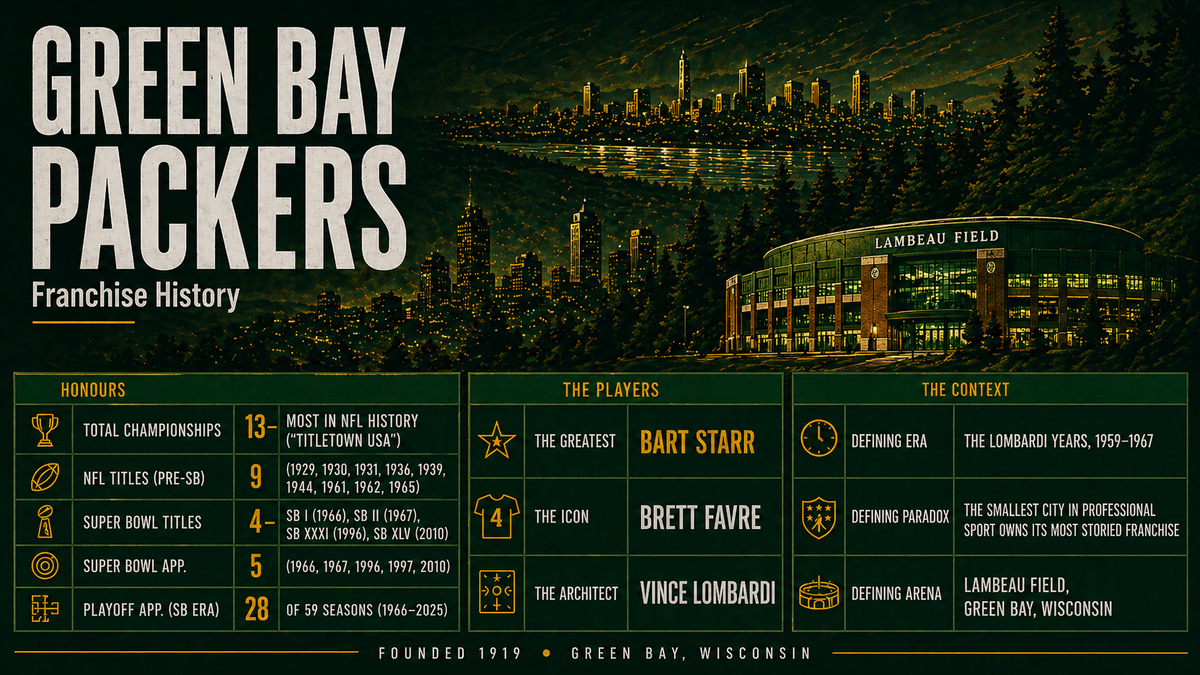
Opened in 1957, expanded repeatedly, and now holding 81,441 people — the second-largest stadium in the NFL — Lambeau Field is the Packers' exclusive home. The stadium is owned by the city of Green Bay. It generates revenue for the surrounding community. On game days, the population of Brown County effectively doubles. It is the longest continuously-occupied stadium in the NFL, and the only one built originally and exclusively for a single professional football team. Every other NFL stadium of the 1957 era was either shared with a baseball franchise or has since been replaced. Lambeau has been renovated. It has not been replaced. The Packers will not replace it. The stadium and the franchise are now structurally inseparable.
The waiting list for season tickets contains approximately 148,000 names — more than the entire population of Green Bay itself. The average wait time, based on current turnover rates, is measured in decades. One BBC documentary captured a family placing their week-old baby on the list; the child took spot 117,957. Those tickets may become available in the 2080s. There are people on that list who will not live to see their tickets come through. Their children are already on the list behind them.
For a European reader accustomed to the idea that a sports club belongs to its community, none of this requires explanation. For an American reader accustomed to the NFL's franchise mobility — the Raiders leaving Oakland, the Colts leaving Baltimore in the middle of the night, the Chargers abandoning San Diego — Green Bay represents something the league would prefer to believe is universal but is actually singular.
Frozen Tundra: A Stadium That Became a Brand
The phrase "Frozen Tundra" was first used by NFL Films narrator John Facenda in his coverage of the Ice Bowl, in the rolling, biblical baritone that defined sports broadcasting for a generation. "It is the frozen tundra of Lambeau Field," he intoned, over images of breath crystallizing in subzero air. The phrase stuck. It became, over the next half-century, something close to a registered trademark — a phrase that meant cold, but more than cold; weather as a competitive advantage; a stadium whose conditions were inseparable from the teams that played there.
The Frozen Tundra mythology rests on a real and durable home-field advantage. From 1957 through 2002, the Packers were undefeated in postseason home games — a 13-0 streak that lasted forty-five years before the Atlanta Falcons broke it on January 4, 2003. The 2007 NFC Championship Game against the New York Giants was played in temperatures of -4°F with a wind chill of -24°F — the third-coldest game in NFL postseason history. (The Packers lost in overtime; the cold worked against them that night, the way the cold occasionally does.) The visual language of late-season Packers football is itself a piece of cultural property: the snow blowing horizontally across the field lights, the breath of linemen rising in clouds at the line of scrimmage, the bare hands of receivers clapping for warmth between plays. The NFL has tried to replicate this atmosphere in other markets and has never succeeded. It cannot be replicated. It is local.
Frozen Tundra is also a marketing phenomenon. The Packers Pro Shop sells Frozen Tundra-branded merchandise. NFL Films archives Frozen Tundra footage as its own visual category. Opposing teams discuss preparing for Frozen Tundra games as if the stadium itself were an opponent. None of this happens at any other NFL venue. There is no "frozen" anywhere else that means what it means in Green Bay. The cold is real; the mythology around it is real; the competitive advantage it produces is real. All of this rests on the simple structural fact that the Packers play their home games in a city where the average January high temperature is 27°F, and have done so without interruption since 1957.
The Lambeau Leap: A Touchdown Celebration That Became a Tradition
On December 26, 1993, in a regular-season game against the Oakland Raiders, Packers safety LeRoy Butler scored a touchdown after picking up a Reggie White-forced fumble — and instead of spiking the ball, he turned and jumped backwards into the south end zone stands, where the fans caught him. The image was unrepeated for two seasons, then revived by wide receiver Robert Brooks in 1995 after he scored a touchdown. Brooks had told Butler he was going to do it. Brooks made it a habit. By 1996, every Packers player who scored at home was leaping into the stands. The Packers' subsequent Super Bowl run made the celebration nationally recognizable. The NFL has since institutionalized it: Lambeau Leap exemptions exist within the league's rules against excessive celebration. Every other NFL team's celebrations are taxonomized and regulated. The Lambeau Leap is recognized as a categorically different thing — a cultural inheritance rather than a celebration.
The structural significance of the Leap, like nearly everything that distinguishes the Packers from other franchises, comes from the ownership model. Green Bay's fans are also the team's owners. When a player jumps into the stands, he is jumping into a crowd of people who, in a literal corporate sense, employ him. No other major American sports celebration has this property. The catch is mutual. The institution is collective. The most American moment in American sports — the touchdown — has been, in Green Bay, transformed into a moment of physical and symbolic communion between players and the community that owns them.
Every NFL franchise has touchdown celebrations. Green Bay has a touchdown ritual. The difference is structural. The fans below are not spectators paying for entertainment. They are shareholders welcoming home an employee. The Lambeau Leap looks like joy because that's what it is — but it is also a small weekly enactment of what makes this franchise different.
Wisconsin: The Region That Made the Franchise Possible
Green Bay is a city of 106,000 people on the southern shore of Green Bay, an inlet of Lake Michigan. It was founded in 1634 by French explorers — making it the oldest European settlement in Wisconsin — and was a fur trading post for more than two centuries before becoming a paper-and-meatpacking industrial center in the late nineteenth century. Its population is heavily of German, Belgian, and Polish descent, reflecting the late-nineteenth-century immigration patterns of the upper Midwest. Curly Lambeau himself was Belgian — the son of immigrants from the same Walloon-speaking region of southern Belgium that supplied much of the area's early labor force.
The cultural attributes that have come to define Packers fandom — the cheeseheads (foam wedges of cheese worn as hats, originally a 1987 invention by Milwaukee Brewers fan Ralph Bruno, adopted by the Packers' supporters by the early 1990s), the polka music in the parking lots before games, the bratwurst-and-beer tailgate culture, the absolute disregard for inclement weather — are not generic American sports culture. They are Wisconsin culture, transferred essentially without modification onto the Packers' game-day environment. The Packers are not a Wisconsin team that happens to play in Green Bay. They are an organic expression of the Wisconsin region — its dairy economy, its German-Belgian immigrant heritage, its Northern European tolerance for cold, its deeply communal civic temperament — translated into the language of professional football.
This is what makes Green Bay structurally inimitable. Other NFL franchises have passionate fan bases. None of them are inseparable from the regional culture in the way the Packers are. A Cowboys fan in Houston is still a Cowboys fan. A Patriots fan in Florida is still a Patriots fan. There are Packers fans everywhere — Wisconsin diaspora, NFL Sunday Ticket subscribers, the grandchildren of dairy farmers who left for the coasts and never came back — but the cultural center of gravity remains Green Bay, Wisconsin, and the surrounding farms and small towns of the Fox River Valley. Other franchises have built loyalty. Green Bay has built identity. The distinction is not subtle, and it cannot be reverse-engineered.
There is no "Wisconsin Packers." There is no "Milwaukee Packers." There is no "Lake Michigan Region Packers." There is the Green Bay Packers — a city of 106,000 people that did not even rank in Wisconsin's six largest cities at the moment the franchise was founded — and that is the whole point.
What Could Have Been: Three Packers Counterfactuals
If the NFL had forced Green Bay out in 1927. When the league contracted dramatically — cutting from 22 teams to 12 in a single offseason — Green Bay survived by a margin that, in retrospect, looks impossibly thin. The Hungry Five had only just stabilized the finances. A different league vote removes the Packers entirely. No Lambeau championships. No Lombardi. No Ice Bowl. No Favre, no Rodgers. The most storied franchise in NFL history does not exist. The trophy bearing Lombardi's name is awarded each year, and nobody in Green Bay knows why.
If Ron Wolf had not traded for Favre in 1992. Favre was a second-round pick sitting unused on Atlanta's roster. Wolf, newly arrived as Green Bay's general manager, surrendered a first-round selection to acquire him — a gamble that most of his peers thought excessive. The pick Atlanta used became Tony Smith, a running back who played three forgettable seasons. The player Green Bay received won three consecutive MVP awards and took the franchise to two Super Bowls. Without Wolf's conviction in that specific moment, in February 1992, Green Bay's QB succession goes elsewhere entirely. The 1990s look like the 1970s.
If Rodgers had not been drafted in 2005. Rodgers was available at the 24th pick. The Packers moved up two spots to take him at 26. Had they passed, Rodgers goes to another franchise — likely one without Favre blocking his path — and develops on a different timeline. Green Bay finds a different succession plan, with unknown results. The point is not that Rodgers was irreplaceable, but that the specific sequence — Favre-to-Rodgers, with a three-year apprenticeship — produced something that organizational planning cannot guarantee and blind luck cannot replicate.
The Current State: Love's Window, and What Comes Next
Jordan Love's 2025 season was, by most measures, the best of his career. He completed 291 of 439 passes for 3,381 yards, 23 touchdowns and 6 interceptions — a passer rating that ranked fifth in the NFL — before a concussion in Week 16 forced him out of the final two regular-season games. He played through a left shoulder injury sustained in Week 11, missed nothing, and returned to start the Wild Card game against Chicago. The Packers finished 9–7–1, earned the seventh seed in the NFC, and lost to the Bears 31–27 in a game that was there to be won.
The numbers are solid. The problem is what lies beneath them. Under pressure, Love ranked 37th among 44 qualified quarterbacks in completion percentage, 38th in yards per attempt, and tied for last with zero touchdown passes. Green Bay has been a 7th seed in each of Love's three playoff seasons — competitive enough to make the bracket, not good enough to advance. His cap number rises to $36.1 million in 2026 and $44 million in 2027. The inexpensive years are over. The results must now match the investment.
In August 2025, the Packers executed the most significant in-season trade in franchise history: edge rusher Micah Parsons from the Dallas Cowboys, in exchange for two first-round picks (2026 and 2027) and three-time Pro Bowl defensive tackle Kenny Clark. Parsons signed a four-year, $188 million extension on the day of the trade — at $47 million per year, the highest-paid non-quarterback in NFL history. He delivered immediately: 12.5 sacks in 14 games, including a sack on Dak Prescott when the Packers visited Dallas in Week 4. Then he tore his ACL in December. His status for the start of 2026 is uncertain. The trade announced what the front office believes about its window — that it is open now, not in three years, and worth two first-round picks plus an established starter to accelerate. Love has the supporting cast: Jayden Reed, Matthew Golden, Tucker Kraft, a competent offensive line. What he does not have is a playoff win. In Green Bay, across sixty-five years of franchise quarterback continuity, that remains the only standard that ultimately counts.
The Packers have had a franchise quarterback for sixty-three of the last sixty-five years. The line will hold — or it won't. Green Bay has been here before.
Legacy Players: Where the Giants Ended Up
Bart Starr spent his post-playing years in Green Bay, returned as head coach in 1974, managed eight losing seasons, and was fired in 1983. He remained connected to the franchise until his death on May 26, 2019, at the age of 85. He was present for Ice Bowl anniversaries, present for Super Bowl XLV, present for the ceremonies that marked each new era. He never left. He was what he had always been: the embodiment of an era the franchise built its identity around, and a quiet reminder that being a great player requires no relationship at all to being a great coach.
Brett Favre's post-career legacy is complicated in ways that have nothing to do with football. A Mississippi welfare fraud investigation revealed that Favre had received approximately $1.1 million in state welfare funds — money intended for the state's poorest residents — that was redirected toward a volleyball facility at the University of Southern Mississippi, his alma mater. Civil proceedings are ongoing. The man who once represented everything elemental about the love of football — the gunslinger who couldn't stop playing, who played through a broken thumb in the 2003 Monday Night game the night after his father died, who gave everything he had on every snap — became a case study in how reputations built over decades can be complicated by decisions made off the field. His relationship with the Packers Hall of Fame was temporarily suspended pending legal resolution. Green Bay's feelings about Favre are genuinely mixed: the affection for what he was on the field sits alongside the disappointment of what he turned out to be away from it. Both are real.
Aaron Rodgers, as of April 2026, has not retired. He is 42 years old. He played for the Jets and won five games in two seasons. He played for the Steelers and won an AFC North title, then lost in the Wild Card round. He has told Pittsburgh he wants to return for a 22nd season. He has not signed. He has not retired. He has not decided. The man who spent years signaling to Green Bay that he was ready to move on has now spent three years moving on and apparently finding that nowhere else is quite right either. The parallel with Favre — who also spent his post-Packers years looking for something the next franchise could not provide — is not subtle. Both men left Green Bay convinced they were bigger than the institution. Both discovered, at some point, that the institution was larger than they had understood.
Green Bay moved on. Both of them are still looking.
Further Reading: Books, Documentaries, and Series — With Editorial Notes
The Green Bay Packers have generated more written and filmed material than any other professional football franchise. The selections below have been curated for quality, factual reliability, and analytical depth. Material of mixed reliability is included where it has cultural significance, with editorial notes flagging its limitations.
BOOKS
David Maraniss, When Pride Still Mattered: A Life of Vince Lombardi (Simon & Schuster, 1999). The single most authoritative account of Lombardi's life, written by a Pulitzer Prize–winning journalist who grew up in Wisconsin during the Lombardi years. Built on hundreds of interviews and exhaustive primary research. Covers Lombardi's Brooklyn upbringing, his years at Fordham and West Point, his Giants assistant tenure, and the nine Green Bay seasons in equivalent depth. Essential. Cliff Christl, the Packers' official team historian, has cited it as the book against which all other Lombardi accounts should be measured.
Jeff Pearlman, Gunslinger: The Remarkable, Improbable, Iconic Life of Brett Favre (Houghton Mifflin Harcourt, 2016). The definitive Favre biography. Pearlman conducted approximately 500 interviews; Favre himself declined to cooperate. The book is more candid about Favre's painkiller addiction, his marital infidelities, and his extended retirement saga than any work that preceded it. Pearlman's reporting standards are high enough that subsequent Favre coverage — including the Mississippi welfare-funds reporting — has used Gunslinger as its baseline reference for the man's character.
Jerry Kramer and Dick Schaap, Instant Replay: The Green Bay Diary of Jerry Kramer (World Publishing, 1968). A first-person diary of the 1967 Packers season, kept by guard Jerry Kramer and edited by sportswriter Dick Schaap. Published immediately after Super Bowl II, before Lombardi had been mythologised. The book is widely considered one of the great works of American sports literature — the first sustained inside account of professional football, written when player confessionals were rare and frank ones rarer still. Kramer's portrait of Lombardi is more nuanced than the public image that came later.
Vince Lombardi and W.C. Heinz, Run to Daylight! (Prentice-Hall, 1963). Lombardi's own coaching memoir, written in collaboration with the legendary sportswriter W.C. Heinz. Structured as a week in the life of an NFL head coach during the 1962 season. The book is the closest existing record of how Lombardi actually thought about football — the Power Sweep, blocking schemes, quarterback decision-making, the management of personality. It is also a primary historical document for understanding the small-college, pre-television NFL of the early 1960s. Heinz's prose elevates what could have been a routine coaching book into literature.
Don Gulbrandsen, Green Bay Packers: The Complete Illustrated History (MVP Books, 3rd edition 2011). The most comprehensive single-volume franchise history, updated through Super Bowl XLV. Includes more than 200 photographs, chalkboard diagrams of key plays, and profiles of every significant player from Curly Lambeau through Aaron Rodgers. Written for general readers, but the research holds up. Particularly strong on the pre-Lombardi era, which most Packers literature treats as preamble.
Michael Bauman, Ron Wolf and the Green Bay Packers: Mike Holmgren, Brett Favre, Reggie White, and the Pack's Return to Glory in the 1990s (St. Martin's Press, 2018). The most thorough account of the Wolf-Holmgren-Favre rebuild. Bauman, a longtime Milwaukee Journal Sentinel columnist, draws on direct access to Wolf and contemporaneous reporting. Particularly useful for understanding the structural decisions — the Bob Harlan front-office reorganisation, the Favre trade, the White signing — that produced the 1996 championship.
DOCUMENTARIES & SERIES
America's Game: The Super Bowl Champions — Green Bay Packers editions (NFL Films, 2006–2011). NFL Films's flagship documentary series, with separate episodes covering each of Green Bay's four Super Bowl–winning seasons (1966, 1967, 1996, 2010). Each episode draws on extensive sideline footage from the NFL Films archive and interviews with the principal participants. The 1966 and 1967 episodes are the most comprehensive Lombardi-era documentary content currently available. The 1996 and 2010 episodes are the standard reference works for the Favre and Rodgers Super Bowl runs respectively.
Lombardi (HBO / NFL Films, 2010). Feature-length documentary built around interviews with Lombardi's surviving players, family members, and contemporaries. Directed by Keith Cossrow. The film's strength is its access to figures — Paul Hornung, Jerry Kramer, Bart Starr, Marie Lombardi — who had not previously sat for sustained on-camera reflection. The film is sympathetic to Lombardi but does not entirely sanitise him; the contradictions between his discipline and his warmth, his Catholic conservatism and his progressive racial politics, are explored rather than smoothed over.
The Complete History of the Green Bay Packers (NFL Films, 2003). Two-disc documentary set covering the franchise from 1919 to the early 2000s. The first disc is a 58-minute narrative history; the second is the NFL Films reconstruction of the Ice Bowl, assembled from thousands of feet of archival footage because the original network broadcast was never preserved. The Ice Bowl reconstruction is the single most thorough visual account of the game in existence and the closest approximation to watching the contest as broadcast.
Timeline: The Ice Bowl (NFL Films, 2017). One-hour documentary released for the 50th anniversary of the 1967 NFL Championship Game. Narrated and co-produced by filmmaker Michael Meredith, son of Cowboys quarterback Don Meredith — which gives the film an unusual perspective, leaning more sympathetic to Dallas than most NFL Films productions of the game. The episode incorporates new interviews with surviving players from both teams and is the most analytically thoughtful Ice Bowl documentary currently available.
A Football Life: Brett Favre / Vince Lombardi / Reggie White (NFL Films, various dates 2011–2020). The A Football Life series produces hour-long biographical documentaries on individual football figures. The Favre, Lombardi, and White episodes are each the standard biographical film treatment of their subject. The Reggie White episode is particularly valuable because comparatively little long-form journalism exists on White's life beyond his football career — his ministry, his views on race in 1990s America, his early death — and the film treats those aspects with care.
PODCASTS & ONGOING REPORTING
Cliff Christl's Packers History columns at Packers.com (2014–present). Christl, the franchise's official team historian since 2014, has produced a substantial body of weekly historical journalism on Packers.com. His standards for accuracy are unusual among team-employed writers; his work is the primary reason multiple long-standing Packers myths (the Hungry Five composition, the Lambeau-Calhoun founding meeting, various early-era statistical claims) have been corrected in the public record over the past decade. Required reading for serious students of the franchise.
Pro Football Hall of Fame archives (profootballhof.com). The Hall of Fame maintains detailed biographical records and primary-source materials on its inductees, including the twenty-eight Packers in the Hall as of 2026. The archives are particularly useful for verifying career statistics and contemporaneous reporting on players from the Lambeau and Lombardi eras whose records are otherwise scattered across multiple secondary sources.
The Green Bay Packers have won 13 championships from a city smaller than Bochum. They have produced the coach whose name is on the sport's ultimate trophy, three Hall of Fame quarterbacks across six decades, and a fourth who is still writing his story. They have done all of this under an ownership structure that every other franchise's owners have declined to replicate — because it works for Green Bay precisely because it cannot be monetized the way a private owner would demand.
Two of those quarterbacks eventually tried to take the franchise hostage on their way out. The franchise survived both of them, as institutions tend to outlast the individuals who briefly defined them.
The Vince Lombardi Trophy is awarded every February to the Super Bowl champion. It carries the name of a coach who worked in Green Bay for nine years and died at 57. His name goes everywhere the trophy goes — Dallas, New England, San Francisco, Kansas City, Pittsburgh. Every year, the trophy travels to a new city. Every year, it carries the name of a man who never left Green Bay.