FRANCHISE HISTORY: LOS ANGELES LAKERS
FRANCHISE HISTORY SERIES - #1 The Glamour Team And The Lakes That Aren't There.
They Didn't Start in Minneapolis. They Started Worse Than That
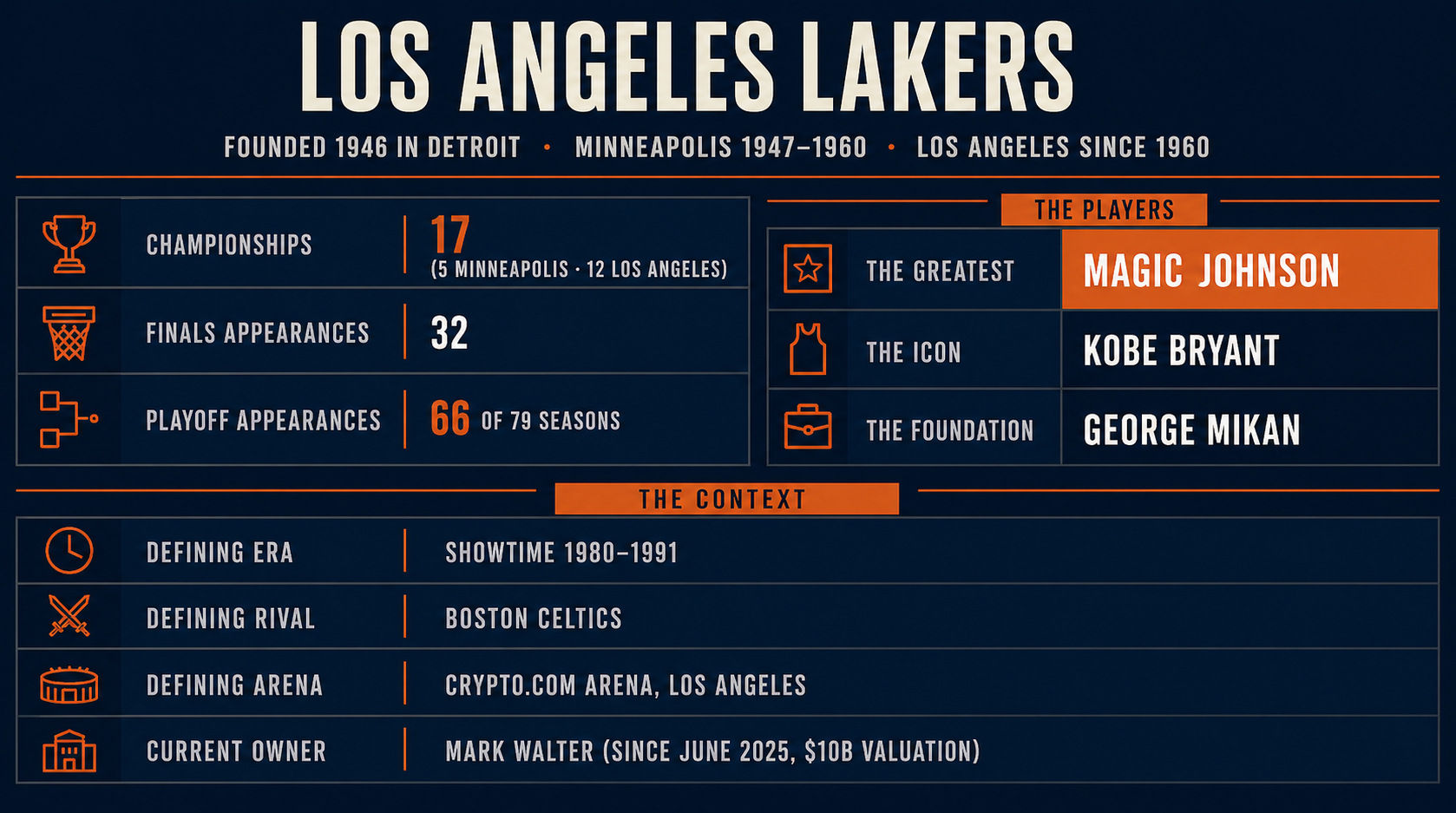
Alongside the Boston Celtics, the Los Angeles Lakers are the most decorated franchise in NBA history — and by most measures the more valuable one. The Celtics hold 18 championships to the Lakers’ 17, one title ahead after 79 seasons of competition between the two most successful clubs the sport has produced. The Lakers were sold in June 2025 for a $10 billion valuation, the highest control-sale price in the history of team sports anywhere in the world, and a global brand that no basketball franchise — and few sports organisations of any kind — can match. Championships measure one thing. What the Los Angeles Lakers have built measures something considerably larger.
In 1946, in Detroit, a businessman named Maurice Winston founded the Detroit Gems and watched them go 4–40 in the National Basketball League — the worst team in professional basketball that season, possibly the worst in any season. He sold them at a loss to a group of Minneapolis investors for $15,000. They moved the franchise north, renamed it for Minnesota’s 10,000 lakes, and used the dispersal-draft pick they had inherited from the Gems’ collapse to select George Mikan.
Seventy-nine years later, that same franchise is owned by Mark Walter — the financial-services billionaire who also owns the Los Angeles Dodgers, holds a stake in Chelsea FC, and paid $10 billion for control of an organisation that began with a $15,000 fire-sale and a 4–40 record. Between those two facts lies the entirety of professional basketball as a commercial enterprise.
The Lakers are not a franchise. They are an argument, running continuously since 1946 — commercially, culturally, and competitively. Mikan proved that one player could define a league. Magic Johnson proved that one player could save one. Kobe Bryant proved that a career could be a global cultural project. LeBron James proved that an athlete could build an entertainment industry while still playing. Luka Dončić is the next chapter, written in the same city, under the same impossible name.
The argument has never been interrupted. It shows no sign of ending.
Minneapolis 1947–60: Mikan & the Dynasty That Built the League
The Mikan-era Minneapolis Lakers won five championships in six seasons between 1949 and 1954 — a sustained dominance that has only ever been bettered, in NBA history, by the Bill Russell Celtics of the 1960s. The casual modern fan, asked to name great Lakers eras, will say Showtime, then Shaq-and-Kobe, then perhaps the LeBron championship of 2020. Almost nobody starts with Mikan. This is one of basketball’s most consistent historical errors.
George Mikan was 6-foot-10, 245 pounds, and wore thick glasses on the court. He had been cut from his high school freshman team in Joliet, Illinois, because the coach considered tall players too awkward to learn the game. At DePaul University, under coach Ray Meyer, he developed the footwork drill that still bears his name — the Mikan Drill, performed in every gym on Earth where serious basketball is taught: a big man stands directly under the rim, shoots a layup with the right hand, catches the ball, shoots with the left, repeats until the motion becomes mechanical. The drill is so foundational that most players who do it have no idea it was invented for one specific person’s career.
Mikan’s NBA dominance was so complete that the league changed its rules to constrain him. In 1951, after his second consecutive scoring title and third championship, the NBA widened the painted lane from six feet to twelve feet — a rule change still officially called the Mikan Rule. The change was a direct attempt to push him further from the basket. It reduced his scoring slightly but did not stop him from winning two more championships in 1952 and 1953. Then, on November 22, 1950, the Fort Wayne Pistons defeated Minneapolis 19–18 in the lowest-scoring game in NBA history — the Pistons stalling possession after possession to keep the ball away from Mikan, who scored 15 of his team’s 18 points. That game catalysed the introduction of the 24-second shot clock four years later. Two of the most fundamental rules in basketball — the lane width and the shot clock — exist because one centre on one franchise was too dominant to play against under the previous rules.
The lane was widened in 1951 to move George Mikan further from the basket. The shot clock was created in 1954 to prevent teams from stalling against him. Two of the most foundational rules in modern basketball were written specifically to constrain a single player on a single franchise. He won championships under both old rules and new ones.
Mikan was professional basketball’s first genuine superstar. The marquee at Madison Square Garden once read simply: ‘Geo Mikan vs. Knicks.’ He was on the cover of every major American magazine. Edward R. Murrow interviewed him on national television. His teammate Slater Martin recalled: ‘When George came to town, it was an event.’ Bud Grant — Mikan’s teammate before becoming the Hall of Fame coach of the Minnesota Vikings — said: ‘George Mikan is the greatest competitor I’ve ever seen or been around in any sport.’
He retired in 1954, attempted a brief unsuccessful comeback in 1955–56, and stepped away permanently with 11,764 career NBA points and seven championships across the NBL, BAA, and NBA — a total no other player of his era approached. He later became the first commissioner of the American Basketball Association in 1967, where he proposed the red-white-and-blue ABA basketball that became the league’s most enduring visual signature. He died in 2005. A nine-foot bronze statue of him stands outside Target Center in Minneapolis — the home of the city’s replacement franchise, the Timberwolves, which arrived in 1989, three decades after the Lakers had abandoned the city Mikan made famous.
The Mikan era established the franchise’s most durable organisational philosophy: find the most dominant centre available in any given generation, build everything around him, repeat. The pattern would be honoured by Wilt Chamberlain in 1968, Kareem Abdul-Jabbar in 1975, and Shaquille O’Neal in 1996. Each of them won championships in Los Angeles. Each of them was selected, traded for, or signed because the franchise had absorbed the lesson of 1947: without a dominant centre, the Lakers do not function.
From Minneapolis to Los Angeles: The Move That Made a Market
The franchise that would become the Lakers was born in Detroit in 1946 as the Detroit Gems. The Gems finished 4–40 in the NBL, dead last, before their owners sold them at a loss to Minneapolis businessmen Ben Berger and Morris Chalfen for $15,000. The new owners had no players, no fanbase, and no obvious future. What they had was the first pick in a dispersal draft.
They selected Mikan. Five championships followed in six seasons. Then Mikan retired, attendance collapsed, and the franchise’s competitive identity dissolved. Bob Short bought the team in 1958 and watched it lose money in a city where the Minneapolis Auditorium ice hockey crowds were larger than the basketball ones. The Brooklyn Dodgers had moved to Los Angeles in 1958 and become an immediate financial success. Short noticed. After considering Chicago and San Francisco, he relocated the franchise to Los Angeles before the 1960–61 season, making the Lakers the NBA’s first West Coast team.
The name ‘Lakers’ was practical and literal: Minnesota called itself the Land of Ten Thousand Lakes, and the team wanted a name rooted in its region. Nobody considered what would happen when the franchise moved 2,800 kilometres west to a city built on concrete and desert. The answer, it turned out, was that nobody cared. The name stayed because the franchise had already become the name.
The relocation of a professional sports team is, in European football terms, unthinkable. AC Milan does not move to Turin because Milanese attendance figures disappoint. Bayern München does not consider Hamburg because Munich’s ice hockey crowds are larger. The club is the city. The idea of separating them violates something foundational about European sports culture.
The NBA in 1960 operated under entirely different logic. Bob Short moved the Lakers with the practicality of a man relocating his dry-cleaning business. What the move produced was something even he could not have fully anticipated: Los Angeles did not just absorb the Lakers — it amplified them. The city’s relationship with celebrity, entertainment, and performance gave the franchise an audience Minneapolis could never have provided. By the time Jerry Buss bought the team for $67.5 million in 1979 — the largest transaction in American sports history at that moment — the Lakers were already Hollywood’s basketball team. Buss turned that cultural adjacency into a business model, and the rest was Showtime.
Elgin Baylor and James Worthy: The Men the Trophy Case Forgot
Before Magic and Kareem, before Showtime, before Hollywood courtside — there was Elgin Baylor. He arrived in Minneapolis in 1958 as the first overall pick from Seattle University, and he saved the franchise from financial collapse as surely as Mikan had saved it from competitive irrelevance a decade earlier. Owner Bob Short, describing his situation before Baylor arrived, was not exaggerating: ‘If he had turned me down, I’d have been out of business. The club would have been bankrupt.’
What Baylor gave the Lakers — and the sport — was something that had no precedent and no name. He played in the air before the air was understood as a basketball dimension. Julius Erving has said it. Michael Jordan has said it. Baylor invented the aerial game in an era without television replays to capture it, without analytics to quantify it, and without a language to describe it. He averaged 38.3 points per game in the 1961–62 season while playing only 48 of 80 games, because he was fulfilling his military service obligations and could only play on weekend passes. Only Wilt Chamberlain scored more points that year. In 48 games. On a weekend pass.
Nine games into the 1971–72 season, Elgin Baylor retired. Nine days later, the Los Angeles Lakers began a 33-game winning streak. The franchise he had sustained for fourteen years won its first Los Angeles championship without him on the roster.
Baylor led the Lakers to eight Finals appearances. He lost all eight — six to the Celtics, one to the Knicks, one to the Celtics again. The franchise’s rivalry with Boston defined and defeated his entire career. As his knees deteriorated through the late 1960s, his playing time shrank and his body betrayed everything his mind still understood. Nine games into the 1971–72 season, at age 37, he retired.
Baylor died in March 2021. His statue stands outside Crypto.com Arena. His career statistics — 27.4 points and 13.5 rebounds per game — belong to a player who should be spoken of in the same breath as the greatest who ever played, and who is instead the subject of occasional retrospectives that begin by noting how many people have forgotten him. The aerial style that Jordan made iconic, that Erving made beautiful, that every wing player in the modern NBA attempts — it traces directly to Elgin Baylor, playing on weekend passes in the early 1960s with no cameras to record it. The patent was never filed.
James Worthy occupies the opposite end of the forgotten-legacy spectrum: not a tragic figure but an underestimated one. He was selected first overall in 1982 — in a year when the Lakers had just won the championship — because Jerry West and Jerry Buss looked at a team that had everything and decided it needed the best player in the draft regardless. That decision reveals more about the organisation’s competitive philosophy than any other single transaction in its history. They had won. They drafted anyway. The coin flip that gave them the Cleveland pick was fortune. The decision to use it on Worthy rather than trade it was character.
Worthy’s twelve seasons in Los Angeles produced three championships, a Finals MVP in 1988, and a career that modern analytics confirm was severely underrated by the award structures of his era. He averaged 17.6 points per game in the regular season and 21.1 in the playoffs — the elevation indicates a player who intensified in proportion to the stakes. His nickname, ‘Big Game James,’ was not promotional. In Game 7 of the 1988 NBA Finals against Detroit, he produced the only triple-double of his career: 36 points, 16 rebounds, 10 assists. His career playoff field-goal percentage was .523 — higher than his regular-season mark and among the best for a forward of his era. He was not named to All-NBA First Team once.
The reason Worthy is underremembered is the same reason Baylor is underremembered: proximity to giants distorts perspective. When you play alongside Magic Johnson and Kareem Abdul-Jabbar, your contributions are processed as supportive rather than essential. They were essential. Worthy was the player who made the Showtime system function at its highest level in the most consequential moments. Without him, the back-to-back titles of 1987 and 1988 are not certain. With him, they were.
Showtime: The Era That Redefined What a Basketball Team Could Be
Across the 1980s, the Los Angeles Lakers won five championships and reached nine of their twelve Finals appearances during the decade and its immediate aftermath — 1980, 1982, 1985, 1987, and 1988. Two further Finals appearances, in 1989 and 1991, extended the Showtime story into defeat: the sweep by Detroit that ended Kareem Abdul-Jabbar’s career, and the loss to Jordan’s Bulls that ended Magic’s. The architecture of Showtime was built on a fact that American sports media has historically under-reported: Magic Johnson was the most important player on this team. He was not merely the face. He was the engine, the architect, and the cultural interpreter of everything the Lakers represented.
Magic’s 1980 rookie Finals performance — 42 points, 15 rebounds, and 7 assists at centre in Game 6 against Philadelphia, filling in for the injured Kareem Abdul-Jabbar, at age twenty — remains one of the most startling individual performances in sports history. He averaged 19.5 points, 11.2 assists, and 7.2 rebounds over his career — statistics that understate his impact because they capture the outcomes of his decisions rather than the quality of the decisions themselves. In thirteen seasons with the Lakers, he appeared in the Finals nine times. He ran this franchise. As Pearlman’s Showtime documents from nearly 300 interviews: Magic could get whatever he wanted. He knew every staff member’s name. He organised the player campaign that ended Paul Westhead’s coaching tenure mid-season in 1981–82.
Earvin Johnson did not merely play for the Lakers. He was the Lakers.
Pat Riley vs. Phil Jackson: The Coach the Lakers Loved, the Coach They Respected
The Lakers have had two championship-coaching geniuses in their modern history. Pat Riley, who won four titles between 1982 and 1988. Phil Jackson, who won five between 2000 and 2010. Together: nine of the franchise’s twelve Los Angeles championships. They are the two most successful coaches in NBA history by ring count — Jackson’s eleven (six in Chicago, five in Los Angeles) and Riley’s five (four in Los Angeles, one in Miami). They share the franchise’s coaching pantheon equally on paper. They occupy fundamentally different places in its emotional architecture.
Pat Riley is loved. Phil Jackson is respected. The distinction is real, it is consistent across every generation of Lakers fans, and it explains something important about how the franchise relates to authority figures.
Riley arrived in Los Angeles in 1979 as a broadcaster. He had been a journeyman guard who won a championship as a Lakers reserve in 1972 alongside Wilt Chamberlain and Jerry West. He became an assistant coach under Paul Westhead in 1979–80 — the rookie season of Magic Johnson — and inherited the head coaching position eleven games into the 1981–82 season after Magic publicly demanded a trade and Jerry Buss fired Westhead in response. Riley was not the franchise’s first choice. He was, briefly, named co-coach with Jerry West — a structure neither man wanted — before West backed away and Riley assumed sole responsibility.
What he produced over the next eight years was the most charismatic coaching tenure in franchise history. Riley’s Lakers played at pace, in colour, with absolute conviction in their own theatricality. He combined offensive freedom with defensive discipline that commentators consistently underestimated. His teams won 533 games against 194 losses — a 73.3% winning percentage that remains the franchise’s all-time best. They won four championships and reached the Finals seven times in nine seasons. The 1986–87 team won 65 games, the second-most in franchise history at the time, and Riley publicly guaranteed a repeat in his championship speech. Then they delivered it.
Riley was beloved because he was ‘one of them’ — a former Lakers player who had earned his championship credentials wearing the same jersey, who had grown into the head coaching role through proximity rather than parachuted in from another franchise. He was Hollywood-handsome, immaculately groomed, and willing to absorb personal hostility in service of the team. Magic Johnson said of him after the 1985 ‘Memorial Day Massacre’ — a 148–114 Game 1 loss to Boston — that Riley had gone harder on Kareem in the postgame meeting than on any other player. ‘If he went in on Kareem, what am I gonna get next?’ Magic recalled. The team responded by winning the next four games and the championship.
Phil Jackson arrived twenty years later, having already won six championships with the Chicago Bulls. He arrived not as a saviour but as a calculated acquisition — a coach whose public musings about coaching the Lakers, published in ESPN The Magazine while Del Harris was still employed, had infuriated the front office and delighted the city’s media. Jerry West, the GM who hired him, was ejected from the team’s own locker room by Jackson within the first season. Jackson barked at him to leave. West did, and never returned. Their relationship never recovered.
Jackson’s system rested on two foundations that appeared contradictory: Tex Winter’s triangle offence, which demanded collective selflessness from players whose entire identity was built around individual dominance; and a philosophy drawn from Zen Buddhism and Native American spirituality that gave him an approach to ego management no other coach in the sport’s history had developed. He delegated. He let conflicts play out without intervening. Shaquille O’Neal would later describe him on Mike Bibby’s podcast: ‘Phil was more of a let-you-figure-it-out type of guy. When me and Kobe were going through a rift, you never heard Phil say anything. He’d call a timeout in the Sacramento series, and he’d be like, “I’m not bailing you guys out. Figure it out.” So we’d have to figure it out.’
Pat was ‘Do this, do that.’ So he was more of a dictator. — Shaquille O’Neal, comparing the two coaches who together won him four championships.
The contrast is structural. Riley was hands-on; Jackson was hands-off. Riley shouted; Jackson read books on the bus. Riley sweated through his suit jackets; Jackson observed the chaos with the calm of a man who had seen it before. Both methods worked. Riley’s method produced affection. Jackson’s method produced reverence. The Lakers loved Riley because he absorbed their pain. They respected Jackson because he transcended it.
Both men left the franchise in difficult circumstances. Riley resigned in 1990 after a second-round playoff loss to Phoenix — the relationship with Jerry Buss had cooled, the players had grown weary of his intensity, and he understood that his shelf life as a head coach in any single locker room was finite. He went to New York, then Miami, where he won another championship in 2006 and remained as president into his eighties. Jackson left in 2011 after a sweep by Dallas, retired briefly, returned to coach for one final season in 2010–11, and walked away with his eleven rings and his Zen books and the abiding sense that he had managed the most difficult locker rooms in the sport’s history more effectively than anyone before or since.
Riley would later describe their relationship publicly as a ‘friendly rivalry rooted in respect.’ The truth is more textured. They were not friends. They were the two most accomplished coaches of their generation, in the same franchise’s history, separated by twenty years and by every coaching method available. They never directly coached against each other in a Finals — Riley’s Knicks lost to Jackson’s Bulls in 1993 and 1994 conference rounds, but the Lakers themselves never produced a Riley-Jackson final. Both men shaped what Los Angeles basketball means. Only one of them is loved.
The Throne in the Paint: Four Generations, One Franchise
No franchise in NBA history has maintained elite centre play across as many distinct eras as the Los Angeles Lakers. This is not coincidence. It is organisational philosophy expressed across seven decades — the consistent identification, acquisition, and construction around the most dominant big man available in each generation.
George Mikan made the centre position the most important in basketball. When he retired in 1956, the franchise lost its competitive identity and nearly its financial existence. The lesson was clear: without a dominant centre, the Lakers are not the Lakers.
Wilt Chamberlain arrived in 1968, already the most statistically dominant player the game had produced. In 1971–72 he posted a field-goal percentage of .649 while anchoring a team that went 69–13 — the best regular-season record in NBA history until the 1995–96 Bulls. He was 35 years old. His presence gave Jerry West the supporting cast to win the only championship of his playing career.
Kareem Abdul-Jabbar was acquired from Milwaukee in 1975 — four players for the man who would anchor Showtime. He led the Lakers in scoring for eleven consecutive seasons, won three of his six MVP awards in Los Angeles, and appeared in the Finals eight times in purple and gold. His sky hook — a right-handed sweeping shot released at the apex of a 7-foot-2 frame, described by Bill Walton as the most unstoppable shot in the history of the sport — was genuinely unguardable for twenty-one NBA seasons.
Shaquille O’Neal arrived in 1996 as the most physically dominant player since Chamberlain — 7-foot-1, 325 pounds, faster in a straight line than most shooting guards in the league. He won three consecutive Finals MVPs from 2000 to 2002. His field-goal percentage across those three championship seasons averaged above .570.
Magic, Kareem, Kobe, and the Players Who Connected Them
Magic Johnson is the greatest Laker — not by raw scoring totals, but by every measure that captures what a franchise player actually is. The argument against Kareem or Kobe requires precision: Kareem produced 14,211 of his career points in Milwaukee before arriving in Los Angeles. Kobe Bryant scored 33,643 points as a Laker — the franchise record at this specific team — and his case is strong on pure volume. But Magic Johnson built this franchise, saved this league, and defined what it meant to be a Los Angeles Laker in every era that followed. Thirteen seasons. Five championships as the primary engine. Three Finals MVPs. Twelve All-Star selections. Nine Finals appearances.
His HIV announcement in November 1991 — one of the most significant individual moments in American sports history — and the manner in which he returned for the 1992 Olympics, played briefly in 1995–96, and became a franchise icon in retirement reflects something about his character that his basketball statistics cannot fully contain.
Kareem Abdul-Jabbar is the most statistically productive player ever to wear purple and gold across a full career, and the most underappreciated dominant player in NBA history by public recognition standards. His sky hook was unguardable for twenty-one seasons. He scored 38,387 career points — a record he held for 38 years until LeBron James broke it in February 2023. With the Lakers he won five championships and three MVP awards, led the team in scoring for eleven consecutive seasons, and appeared in the Finals eight times. In retirement, he has become something rarer — a public intellectual whose written work on culture and race has given him a platform that outlasts his playing career.
Kobe Bryant is the franchise’s defining icon for the generation that matters most to TEP’s audience. He played twenty seasons in Los Angeles, won five championships, an MVP, two Finals MVPs, and an Oscar for his short film Dear Basketball. He scored 33,643 points as a Laker — the franchise record. He scored 81 in a single game against Toronto on January 22, 2006. His death in a helicopter crash in January 2020, with his daughter Gianna, produced a public grief unlike anything a sports figure’s death had generated before. The Mamba Mentality — the obsessive competitiveness, the rejection of anything less than maximum effort — resonated globally across cultural and geographic lines that basketball excellence alone would not have crossed.
Jerry West connects the pre-Showtime era to everything that followed. He scored 25.1 points per game for his career, made fourteen All-Star teams, and was so definitionally clutch that his silhouette became the NBA logo. His seven Finals appearances ended in six losses to the Celtics — among the most unfair records in sports history. After retiring, West returned as general manager, assembled the Showtime championship rosters, and constructed the Shaquille O’Neal–Kobe Bryant combination that won three straight titles. His autobiography, West by West, reveals a man whose public composure masked severe depression, childhood trauma, and a perfectionism that made him simultaneously the most effective executive in franchise history and the most personally tormented. He died in June 2024.
Shaq vs. Kobe: How Hatred Built a Dynasty and Then Destroyed It
In the history of modern professional sport, there have been very few high-level partnerships between teammates who disliked each other as intensely as Shaquille O’Neal and Kobe Bryant disliked each other. From the moment both signed with the Lakers in 1996 — two powerhouses with fundamentally incompatible personalities and identical needs to be the franchise centrepiece — the tension was structural rather than incidental.
O’Neal was a 7-foot-1 extrovert who wanted teammates to love him and acknowledge his centrality. Bryant was a singularly focused 18-year-old with no interest in social relationships and a competitive drive that expressed itself most naturally by outperforming everyone around him — including his own team. Jerry West, who constructed the partnership, observed it early: ‘He had a showboat style and a bottomless reservoir of drive that fuelled him; he wasn’t content just to beat people, he had to embarrass them, even players on his own team.’
The three consecutive championships from 2000 to 2002 were produced despite this dynamic, not because of it. Phil Jackson’s triangle offence created a structure within which their incompatibility was manageable. The dynasty ended not with a defeat but with a decision. The 2004 Finals loss to Detroit — a team whose defensive coherence exposed the Lakers’ individual limitations — was the fracture point. Kobe demanded Shaq be traded. Shaq demanded Kobe be traded. Jerry Buss chose Kobe. O’Neal went to Miami and won another championship. Kobe won two more titles in 2009 and 2010 with Pau Gasol beside him.
From a European perspective, the Shaq–Kobe dynamic is recognisable as the defining paradox of elite team sport: the best partnerships are often between people who cannot stand each other, because competition between them generates an intensity that friendship dilutes. Senna and Prost. The dynamic that produces championships is not harmony — it is controlled tension managed by a framework strong enough to contain it. Phil Jackson provided that framework. When he left, the tension had no container, and the partnership collapsed. The cause was not the hatred. It was the removal of the architecture.
Chick Hearn: The Voice That Gave the Sport Its Vocabulary
From November 21, 1965 through December 16, 2001 — a span of thirty-six years — Francis Dayle ‘Chick’ Hearn called 3,338 consecutive Los Angeles Lakers games. He missed his first game in that span only because aortic-valve surgery made it impossible. The streak is not a sports broadcasting record. It is a category of human commitment for which sports broadcasting does not provide an adequate frame of reference.
Hearn invented the language of basketball as a televised sport. Slam dunk. Air ball. Finger roll. Give and go. No harm, no foul. Triple-double. Garbage time. These are not stylistic flourishes — they are the working vocabulary of every basketball broadcaster, every coach, every player, every analyst on the planet. They were coined by one man, sitting at a microphone in the Forum and later the Staples Center, calling the action so rapidly that the language of the sport had to expand to keep up with him.
‘Slam dunk’ was his first universal contribution. ‘Air ball’ followed. ‘Triple-double’ was a Chickism that the league eventually adopted as an official statistical category. He coined dozens of more idiosyncratic phrases that never crossed over into universal usage but that defined what it sounded like to watch a Lakers game on local television — the ‘mustard’s off the hot dog’ when a player blew an easy shot showing off; the ‘popcorn machine’ when a defender leapt for a head fake and the offensive player blew past him; ‘the game is in the refrigerator: the door is closed, the lights are out, the eggs are cooling, the butter’s getting hard, and the Jell-O’s jigglin’’ when a Lakers victory was secure. The phrase ‘refrigerator’ is now used by basketball broadcasters who have never heard of him.
Slam dunk. Air ball. Finger roll. Triple-double. Garbage time. The vocabulary of basketball as a televised sport was invented by one man calling Lakers games for thirty-six years. He has a star on the Hollywood Walk of Fame and a statue outside Crypto.com Arena — the only non-player to whom the franchise has given that honour.
Hearn’s personal life across those thirty-six years contained the kind of accumulated tragedy that the on-air voice never reflected. His son Gary died of a drug overdose in 1972. His daughter Samantha died of complications from anorexia in 1991. He worked through both losses without missing games. He was inducted into the Naismith Memorial Basketball Hall of Fame in 2003, the year after his death. A bronze statue of him sits outside Crypto.com Arena — the only non-player honoured with one. His name hangs in the rafters alongside Jerry West’s, Wilt Chamberlain’s, and Magic Johnson’s.
He died on August 5, 2002, after a fall at his Encino home that left him in a coma surgeons could not reverse. He was 85 years old. The Lakers’ 2002 championship parade — their third consecutive title — had been seven weeks earlier. Photographs from the parade show him on the lead bus, hair dyed purple, drenched in champagne, exhausted. He had called nine Lakers championships across thirty-six years of consecutive games. He died before the streak’s broader meaning had fully settled. Cardinal Roger Mahoney, at the funeral, said: ‘I am going to go outside and look up in the sky, because I think for the last time we will see the meteor go by and we will wave so long.’
For European basketball fans, Hearn occupies a position that has no obvious analogue. He is closer to football commentators of the Kenneth Wolstenholme or Herbert Zimmermann tradition — voices so embedded in the sport’s emotional architecture that the games sound wrong when called by anyone else — than to the modern American sports broadcasting model. The Lakers existed for thirty-six years as a team that Chick Hearn told you about. When he stopped, the franchise had to learn how to be heard differently.
Jerry Buss and the Business of Making Basketball Look Easy
Jerry Buss bought the Lakers in 1979 for $67.5 million — a package deal with the Forum and the Los Angeles Kings — and recognised immediately that the entertainment value of professional basketball was dramatically underpriced relative to its potential. He held a doctorate in physical chemistry and had learned, through real estate development, how to read markets that other investors were undervaluing. What he constructed was the template for the modern NBA franchise as entertainment company.
The Forum Club’s celebrity integration, the deliberate entertainment packaging of the game-day experience, the courtside premium product that made Lakers tickets the most aspirational in American sport — all of it was his design. More fundamentally, the decision to build rosters around transcendent personalities rather than efficient role players was his philosophy expressed in personnel. Find the biggest star. Build around them. Maintain the spectacle. That philosophy won ten championships during his ownership.
The comparison to European ownership models is instructive. The closest parallel is Silvio Berlusconi’s AC Milan — a showman-owner who understood that the stadium experience and the brand were as important as the trophies. Both men won a lot. Both built institutions that outlasted their ownership in ways that continue to define the clubs.
Buss died in February 2013 at age 80 from kidney failure, leaving ownership of the Lakers in a trust controlled equally by his six children: Jeanie, Jim, Johnny, Janie, Joey, and Jesse. What followed was the longest-running family power struggle in modern American sports.
The Buss Family: Six Siblings, One Trust, and the $10 Billion Sale That Ended an Era
Jerry Buss had six children from two marriages. The first marriage to JoAnn Mueller produced four: Johnny (born 1956), Jim (1959), Jeanie (1961), and Janie (1963). The second relationship produced two more: Joey (1986) and Jesse (1988). When Buss died, all six were named equal beneficiaries of the trust controlling the Lakers. None of them held majority operational authority. The structure was designed to keep the franchise in family hands. It was also designed, perhaps unintentionally, to produce conflict.
The first significant fracture came in February 2017. Jeanie Buss, who had been managing the business operations of the Lakers since the 1990s and had served as governor of the franchise after her father’s death, fired her older brother Jim from his role as executive vice president of basketball operations. The Lakers under Jim’s management had missed the playoffs for four consecutive seasons — the first such drought in franchise history since the 1970s — and had compiled a losing record in five of the previous five years. Jeanie’s decision was business-rational. It was also a public family event.
Days later, Jim and Johnny Buss called for a board meeting that Jeanie interpreted as an attempted coup. She went to court. The dispute resolved in 2017 with a formal agreement designating Jeanie as controlling owner. Jim and Johnny retained their trust shares but lost meaningful operational authority. The arrangement held for eight years.
In late 2024, the youngest siblings — Joey and Jesse Buss, both in their thirties — began circulating proposals to monetise a portion of the family’s 66% stake at a roughly $10 billion valuation, allowing siblings to retain control of basketball operations while pocketing approximately $50–150 million each. Their plan involved selling perhaps half the family’s stake. The older siblings — Jeanie, Jim, Johnny, Janie — considered the proposal and, according to ESPN’s January 2026 reconstruction by Ramona Shelburne, used it as the basis for a more comprehensive sale to Mark Walter.
‘This sounds like collusion,’ Jesse told Jeanie and her two senior advisors, after learning the family had voted to sell to Walter at the valuation he and Joey had originally proposed for a half-sale. The denial — ‘No, no, no, we did not negotiate. This was an offer’ — did not satisfy him. — Reconstructed by ESPN, January 2026.
The vote took place on June 18, 2025. Four siblings — Jeanie, Jim, Johnny, Janie — voted yes. Two — Joey and Jesse — voted no. The motion carried 4–2. Each sibling received approximately $930 million pre-tax. The sale closed in late October 2025 after NBA Board of Governors approval. Mark Walter — the chairman of TWG Global, owner of the Los Angeles Dodgers, stakeholder in Chelsea FC — became the controlling owner of the Lakers at a $10 billion valuation, the highest control-sale price in the history of professional sports.
The Buss family retained a minority stake of approximately 17%, just over the 15% threshold required by NBA rules for Jeanie to remain governor. As part of the agreement, Jeanie continues as governor for at least five years pending Board approval. Joey and Jesse Buss were terminated from their executive basketball-operations roles in November 2025 — the team had started 11–4 and the season was going well, and the dismissal happened anyway. For the first time since 1979, no Buss sibling held basketball-operations authority over the franchise. Jesse Buss publicly told The Athletic that his sister had ‘fired everyone.’
There is one further piece of the Buss family story that conventional reporting tends to handle delicately. Jeanie Buss was, for several years through the 2000s and into the 2010s, in a romantic relationship with Phil Jackson. The relationship overlapped with his coaching tenure of the Lakers, and ended around the time he left the franchise. The two became engaged in 2012 and never married. The relationship was an open secret in basketball circles and a structural complication in the franchise’s management for as long as it lasted. It is also one of the few examples in modern American sport of a franchise governor and head coach being personally involved while running the same organisation. Whether it affected business decisions is a question their respective autobiographies leave deliberately understated.
The $10 billion valuation, in retrospect, is not merely a record sale price. It is the price paid for ending forty-six years of family ownership. The Buss era ran from 1979 to 2025 and produced eleven championships — the most by any owner in NBA history during their tenure. The Walter era is just beginning. What he inherits is a franchise whose family ownership ended not because the family ran out of money or interest, but because the family ran out of patience with each other.
Hollywood Doesn’t Just Watch: Why Los Angeles Is a Recruitment Weapon
The conventional understanding of the Lakers’ relationship with Hollywood is atmospheric: celebrities sit courtside, the entertainment industry provides glamour, the franchise benefits from the association. This understanding is accurate but incomplete. The precise analysis is structural: the Los Angeles entertainment economy gives Lakers players access to brand-building infrastructure that no other NBA city can match, and that infrastructure has become a primary recruitment tool in the modern era.
Jerry Buss understood this first. He built the Forum Club as a space where the boundary between entertainment and sport dissolved — where players, agents, studio executives, and musicians occupied the same room and the same conversation. The Showtime era’s courtside celebrity culture was not incidental. It was part of the product Buss was selling, and players understood that the Lakers placed them inside a social ecosystem unavailable elsewhere.
The Lakers do not recruit with money alone — every contender can pay maximum contracts. They recruit with the promise of becoming something larger than a basketball player.
Kobe Bryant extended this logic more deliberately. His partnership with Italian fashion, his Zen-philosophy framing, his post-career venture into animation and storytelling — all of it was built on a foundation only Los Angeles could have provided. When Dear Basketball won an Oscar in 2018, it was not a basketball event. It was confirmation that Kobe had executed a transition from athlete to creative figure that no player in any other market could have managed as credibly.
LeBron James took the model to its logical conclusion. SpringHill Company — the production and media enterprise James built with Maverick Carter, valued at $725 million by 2021 after investment from RedBird, Nike, Epic Games, and Fenway Sports Group — was operating before James signed with the Lakers in 2018. His arrival in Los Angeles placed him in the same city as his production infrastructure. SpringHill has secured deals with Netflix, Disney, and Amazon’s Audible. It is a legitimate entertainment company, not a vanity project — and it could not exist in the form it does if James had spent his prime years in Cleveland or Boston.
The implication for recruitment is direct. When Luka Dončić signed his three-year, $165 million extension with the Lakers in August 2025, he was not simply choosing a basketball organisation. He was choosing an ecosystem. A Slovenian who grew up in Ljubljana, learned basketball in Madrid, and became one of the most commercially recognisable athletes in Europe now plays in a city where the infrastructure to build a global personal brand is embedded in the franchise’s DNA.
The Three Wildernesses: How a Franchise This Large Has Lost Its Way Three Times
Every great franchise has its wilderness periods. The Lakers have had three distinct ones. Each ended with the acquisition of a generational player. The pattern is so consistent that the franchise’s organisational philosophy might be summarised: build until the talent expires, then collapse until the next transcendent player arrives. Repeat.
The first wilderness arrived after Mikan’s retirement in 1956. The franchise lost four consecutive Western Division Finals to the Minneapolis-area Hawks of St. Louis between 1957 and 1961, won no championships between 1955 and 1971, and survived the move from Minneapolis to Los Angeles primarily because of Elgin Baylor’s 1958 arrival. The wilderness ended definitively with the 1968 Wilt Chamberlain trade and the 1971–72 championship that followed.
The second wilderness was shorter and is consistently underestimated. From the 1972 championship through 1979, the Lakers reached the Finals once (in 1973, losing to New York) and missed the playoffs in 1974–75 and 1975–76 — the first consecutive playoff misses in franchise history. They were rescued by the 1979 first overall pick (Magic Johnson) and Jerry Buss’s purchase of the franchise in the same year. The wilderness was real. It was simply overshadowed by the dynasty that followed.
The third wilderness is the most recent and the most painful for fans who lived through it. After the 2010 championship — the second of Phil Jackson’s second three-peat with Kobe and Pau Gasol — the franchise descended into a period of sustained dysfunction that lasted from approximately 2013 through 2019.
The causes were structural and traceable. Kobe Bryant, playing through an Achilles tendon rupture suffered in April 2013, signed a two-year extension worth $48.5 million in November 2013 — a contract that was both a reward for loyalty and an organisational decision that damaged roster flexibility for years. The signings of Steve Nash and Dwight Howard in 2012 failed to produce a contender and cost the franchise the draft picks that rebuilding teams require. Mike D’Antoni and Byron Scott served as head coaches for teams that had no business competing. Jerry Buss died in February 2013 at the precise moment when the franchise needed his commercial and competitive instincts most. His son Jim Buss assumed authority over basketball operations; his decisions, including the Nash and Howard acquisitions that Jerry West publicly characterised as ill-conceived, cost the franchise six years.
The Lakers missed the playoffs in five consecutive seasons between 2013–14 and 2017–18 — the longest playoff drought in franchise history. They had records of 27–55, 21–61, 17–65, 26–56, and 35–47. Twenty-one wins in 2014–15 was the worst single-season record in franchise history. They drafted Julius Randle, Larry Nance Jr., D’Angelo Russell, Brandon Ingram, and Lonzo Ball with high lottery picks; none of them developed into franchise cornerstones in Los Angeles. Magic Johnson took over basketball operations in 2017 and resigned abruptly in 2019 in a press conference that Jeanie Buss watched in confusion. The fans who had grown up on Showtime and Three-peat were watching a Lakers team genuinely irrelevant to the league’s competitive structure for the first time in their lives.
The third wilderness ended with the LeBron James signing in July 2018, the Anthony Davis trade in June 2019, and the 2020 NBA Bubble championship that followed. The pattern held: the franchise descended into mediocrity, accumulated assets, and rescued itself with a transcendent acquisition. The cycle is so reliable that it functions as the franchise’s natural rhythm rather than as crisis.
The Championships That Slipped Away
A franchise with 17 championships does not need sympathy for near-misses. The Lakers are not a sympathetic case in this regard. And yet a complete accounting requires acknowledging the windows that closed without a title.
The 1960s represent the most sustained excellence without reward in franchise history: six Finals in ten seasons, six losses to the Celtics. The Baylor–West teams were legitimately great, and their era is consistently undervalued because the scoreboard never reflected it. West’s 1969 Finals MVP, awarded to a player on the losing team, is the only time that has happened in NBA history.
The 1984 Finals loss to Boston — in seven games, after the Lakers led 2–1 — is the more personally resonant near-miss. Magic Johnson has called it the worst loss of his career. The 1985 title was direct revenge. The 1987 and 1988 titles were confirmation. But 1984 is the moment the rivalry’s outcome could have been decided differently.
The Shaq–Kobe window’s 2004 Finals loss to Detroit represents the unresolved question of what might have been preserved had the relationship survived. The answer, in retrospect, is probably one more title.
How the Lakers Build: The Philosophy Behind Seventeen Banners
The Lakers’ roster-building philosophy has never been subtle. They identify the best player available and acquire him. The method — draft, trade, or free agency — is secondary. This has produced a franchise that has rarely built through patient development and frequently built through bold, disruptive reconstruction. The pattern is consistent: find the biggest star; build everything around them; when that era ends, find the next one.
The best draft decisions: Magic Johnson first overall in 1979. James Worthy first overall in 1982 — a pick acquired from Cleveland whose protection terms accidentally produced a lottery selection. Elgin Baylor first overall in 1958. The most consequential trade decisions: Kareem Abdul-Jabbar from Milwaukee in 1975. Kobe Bryant via draft-night trade from Charlotte for Vlade Divac in 1996. Luka Dončić in February 2025 for Anthony Davis.
The Lakers do not rebuild. When they lose a superstar, they acquire another one. This has worked seventeen times at the championship level.
Two Timelines, Three Injuries, and the Summer That Defines a Decade
The 2025–26 Los Angeles Lakers are in the first round of the Western Conference Playoffs, leading the Houston Rockets 3–0 — without Luka Dončić, who suffered a Grade 2 left hamstring strain on 2 April in Oklahoma City, and without Austin Reaves, who strained an oblique in the same game. LeBron James, at 41, is leading the team with 29 points, 13 rebounds, and 6 assists in Game 3. Marcus Smart has contributed 21 points and 10 assists. Luke Kennard, acquired at the deadline, has provided the offensive creation the injured starters cannot.
The injury context is important but not the core story. The core story is what comes next. Dončić finished the regular season averaging 33.5 points, 8.3 assists, and 7.7 rebounds; Reaves finished with 23.3 points, 5.5 assists, and 4.7 rebounds. Combined: 56.8 points, 13.8 assists, and 12.4 rebounds per game. Their partnership is the most promising offensive foundation the Lakers have constructed since the Shaq–Kobe era.
The summer of 2026 is the franchise’s most consequential roster decision point since the summer of 2018. LeBron James is a free agent. The Lakers will enter the offseason with approximately $51 million in projected cap space and three first-round picks available to trade. The organisation’s stated preference is to welcome LeBron back for a 24th season. His stated preference is genuinely uncertain.
The larger strategic question: who comes after LeBron? And more specifically — consistent with seven decades of franchise philosophy — who is the next transformative centre? The names circulating: Giannis Antetokounmpo, Bam Adebayo, Jalen Duren. The Lakers are searching for a transformative centre. They are not certain one exists at the level the franchise has historically demanded.
What Happens After: The Lakers Alumni and Their Afterlives
The Los Angeles Lakers produce a specific post-career story, because the franchise’s relationship with celebrity and platform does not end when players retire.
Kareem Abdul-Jabbar has become, in retirement, one of American sports’ more unexpected public intellectuals — producing journalism, cultural criticism, and social commentary with a directness his playing career always hinted at. His Substack newsletter covers topics from media literacy to racial justice. He is in his late seventies and maintains a larger written platform than most active sportswriters. The sky hook is immortal. The voice after it turns out to be equally durable.
Magic Johnson’s post-career trajectory is the most commercially instructive. He built a business empire that made him one of the wealthiest former athletes in American history. His brief stint as the Lakers’ president of basketball operations from 2017 to 2019 was the most public failure of his business career. His return to life as franchise ambassador has been characteristically composed. He was, notably, one of the most prominent public voices supporting the 2025 sale to Mark Walter — a longstanding business partner of his.
Kobe Bryant’s posthumous cultural presence — the Mamba Mentality as a global self-help framework, the Oscar-winning animation, the advocacy work his wife Vanessa continues through the Mamba and Mambacita Sports Foundation — has made him more culturally present than many active athletes.
Jerry West’s post-Lakers career — advisory roles with Memphis, Golden State, the Clippers, and Charlotte — confirmed that his talent for roster evaluation was not specific to the franchise that made him famous. He died in June 2024.
In 1947, a group of Minneapolis businessmen bought the worst team in professional basketball and used a dispersal-draft pick to select a 6-foot-10 centre from DePaul. In 2025, a Slovenian point guard who learned basketball in a Real Madrid academy signed a three-year extension with the same franchise. Between those two facts: George Mikan rewriting the rules of basketball through dominance, Elgin Baylor playing on weekend military passes and scoring 38 points per game that no camera recorded, Magic Johnson saving a league that was tape-delaying its own Finals, Pat Riley promising and delivering, Phil Jackson reading Zen texts on the team bus while Shaq and Kobe refused to speak to each other, Kobe Bryant winning an Oscar, LeBron James building a $725 million media company while playing in his twenty-third season, and Chick Hearn calling 3,338 consecutive games until his body would not let him call a 3,339th.
The Buss family ran the franchise for forty-six years, won eleven championships, fought each other publicly for control, and sold to Mark Walter in 2025 for $10 billion when the family had finally exhausted its capacity for shared ownership. Mark Walter inherits the most valuable basketball franchise in the world and an argument that has been running, without interruption, since 1947.
The lake never moved. Minnesota still has its ten thousand, and Los Angeles has never needed a single one. What Los Angeles has is a franchise that arrived in 1960 with a mismatched name and built an empire precisely because it never felt compelled to explain itself.
Further Reading: Books, Documentaries, and Series — With Editorial Notes
The Los Angeles Lakers have generated more written and filmed material than any other professional basketball franchise. The selections below have been curated for quality, factual reliability, and analytical depth. Sensationalist material is included where it has cultural significance, with editorial notes flagging its limitations.
BOOKS
Jeff Pearlman, Showtime: Magic, Kareem, Riley, and the Los Angeles Lakers Dynasty of the 1980s (Gotham Books, 2014). The single most authoritative account of the Showtime era. Built on nearly 300 interviews. Pearlman’s reporting is comprehensive enough that nearly every subsequent piece of Showtime-era content — including the HBO series Winning Time — draws directly from this book. Essential.
Jeff Pearlman, Three-Ring Circus: Kobe, Shaq, Phil, and the Crazy Years of the Lakers Dynasty (Houghton Mifflin Harcourt, 2020). The companion to Showtime, covering the 1996–2004 Shaq-Kobe-Phil dynasty in equivalent depth. Particularly strong on the personal hostility between O’Neal and Bryant and on Phil Jackson’s ego-management methodology.
Phil Jackson and Hugh Delehanty, Eleven Rings: The Soul of Success (Penguin Press, 2013). Jackson’s own account of his coaching philosophy across both championship runs. Self-serving in places — inevitable in any coach’s memoir — but the chapters on triangle-offence implementation and Native American spirituality’s application to NBA coaching are intellectually honest in ways Jackson is rarely given credit for.
Jerry West and Jonathan Coleman, West by West: My Charmed, Tormented Life (Little, Brown, 2011). The most psychologically revealing autobiography by any major basketball figure. West’s clinical depression, childhood abuse, and lifelong perfectionism are documented with a candour that subsequent sports memoirs have rarely matched. Painful and essential.
Kareem Abdul-Jabbar and Peter Knobler, Giant Steps (Bantam, 1983). Kareem’s first autobiography, written shortly before the peak of Showtime. His political and intellectual development, his conversion to Islam, and his early-career frustration with American sports culture are all here. Subsequent Kareem books — there are many — are more polished but less raw.
Kareem Abdul-Jabbar, On the Shoulders of Giants: My Journey Through the Harlem Renaissance (Simon & Schuster, 2007). Kareem’s most ambitious cultural work — a meditation on the Harlem Renaissance and its influence on his own intellectual formation. Demonstrates the range of his post-playing identity. He has also written novels, including Mycroft Holmes (Titan Books, 2015), a Sherlock Holmes prequel narrated by Sherlock’s older brother. The book is genuinely competent literary fiction; that an NBA legend wrote it remains the more interesting fact.
Roland Lazenby, The Show: The Inside Story of the Spectacular Los Angeles Lakers in the Words of Those Who Lived It (McGraw-Hill, 2006). Oral history of the franchise from Mikan through the Shaq-Kobe era. Comprehensive across all eras in ways that more focused books cannot match.
Roland Lazenby, Mindgames: Phil Jackson’s Long Strange Journey (Contemporary, 2001). The best biography of Jackson, written before his second Lakers stint. Lazenby’s research on Jackson’s philosophical influences — from Tex Winter to Native American spirituality — is more thorough than Jackson’s own books on the same topic.
Stew Thornley, Basketball’s Original Dynasty: The History of the Lakers (Nodin Press, 1989). The definitive account of the Mikan-era Minneapolis Lakers. Out of print but worth tracking down for anyone interested in the period that current Lakers fans typically skip over.
DOCUMENTARIES & SERIES
Legacy: The True Story of the LA Lakers (Hulu, 2022). Ten-part documentary produced with the cooperation of the Buss family. The most comprehensive franchise documentary ever produced. Strong on Showtime and the Buss family business model. Light on the Phil Jackson era and on the post-2010 wilderness, presumably because the Buss family’s editorial control limited critical perspectives. Essential despite the limitations.
Winning Time: The Rise of the Lakers Dynasty (HBO, 2022–2023). Two-season scripted dramatisation of the Showtime era, based loosely on Jeff Pearlman’s book. Adrien Brody plays Pat Riley, John C. Reilly plays Jerry Buss, Quincy Isaiah plays Magic Johnson.
EDITORIAL NOTE: Winning Time is dramatised entertainment, not journalism. Multiple Lakers figures — including Magic Johnson, Kareem Abdul-Jabbar, and Jerry West’s estate — publicly disputed the show’s portrayals of real people, with West’s family threatening legal action. Jerry Buss’s personal life and management decisions are stylised and amplified for narrative effect. The series is highly enjoyable as television and largely accurate on the broad outlines of events. It is unreliable on character, motive, and dialogue. Recommended viewing with the caveat that Pearlman’s book is the source material and the more reliable record.
The Last Dance (ESPN/Netflix, 2020). Strictly speaking a Chicago Bulls documentary, but Phil Jackson’s coaching philosophy, the triangle offence, and the conditions that produced both his Bulls and Lakers championship runs are documented in ways that no Lakers-specific film has matched. Required viewing for anyone studying his coaching method.
Kobe Bryant’s Muse (Showtime, 2015). Documentary directed by and produced with Kobe’s cooperation, covering his rehabilitation from his 2013 Achilles injury and his career-long reflections on competitive obsession. Self-curated and therefore limited as journalism, but as a primary-source document of how Kobe wanted to be understood, it is invaluable.
Dear Basketball (2017, dir. Glen Keane). The five-minute animated short film based on Kobe’s retirement letter. Won the Academy Award for Best Animated Short Film in 2018. The artistic culmination of his transition from athlete to creative figure.
PODCASTS & ONGOING REPORTING
Mind the Game (Spring Hill Productions, 2024–present). Podcast hosted by LeBron James and JJ Redick. Granular tactical analysis of NBA basketball, with regular Lakers-specific content. Redick’s subsequent appointment as Lakers head coach in 2024 makes the early episodes a primary source for understanding his coaching philosophy.
Ramona Shelburne’s ESPN coverage (2010s–present). Shelburne’s longform reporting on the Lakers — including the January 2026 reconstruction of the Buss family sale — is the highest-quality ongoing journalism on the franchise. Her work is the closest current equivalent to what Pearlman produced for the Showtime era.