FRANCHISE HISTORY: UTAH JAZZ
FRANCHISE HISTORY SERIES — #2 Salt Lake City Never Asked for Jazz Music. It Got Stockton, Malone And Fifteen Years of Greatness Instead.
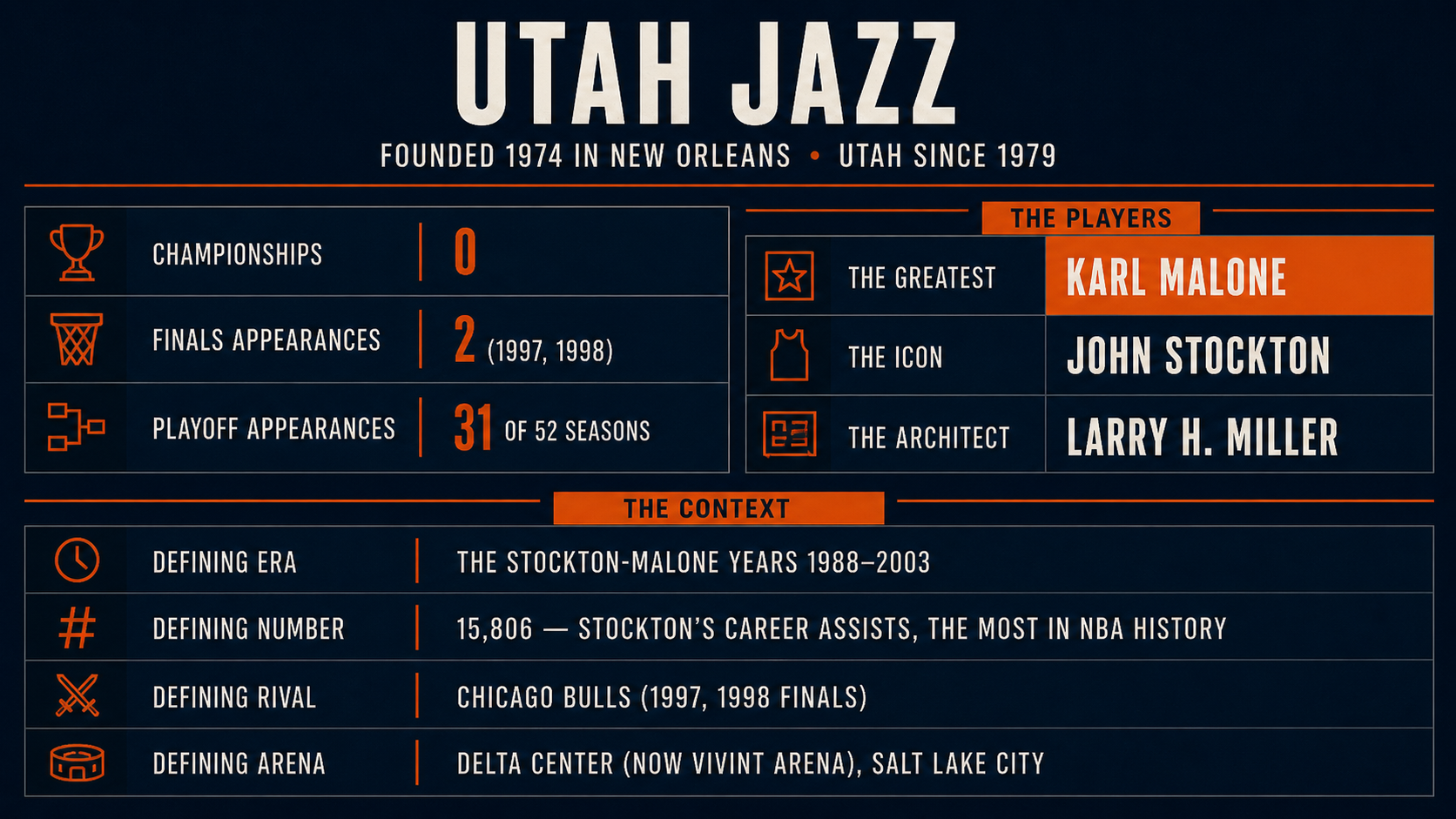
15,806.
That is the number of career assists John Stockton accumulated across nineteen seasons with the Utah Jazz — the most in NBA history by a margin so vast that statistical analysts describe the record as one of the least-breakable in professional sports. The three players closest to him on the all-time list are Chris Paul with 12,552, Jason Kidd with 12,091, and LeBron James with 12,016. The gap between Stockton and Paul — the current second-place holder — is 3,254 assists. More career assists than most starting point guards accumulate in a decade of play. Kidd is long retired, Paul retired during the 2025-26 season. LeBron James is 41 years old. He would have to play five more seasons, alwys playing all 82 regular season games and averaging more than nine assists per game in order to get close to and ultimately catch Stockton's number. Quite simply put: He is not catching Stockton.
The 16th pick in the 1984 NBA Draft was a 6-foot-1 point guard from Gonzaga University that twelve teams had already passed on. The 13th pick in the 1985 NBA Draft was a 6-foot-9 power forward from Louisiana Tech that twelve teams had already passed on. Neither player was considered a franchise-defining talent. Neither player was recruited to Utah from elsewhere as an established star. Both became Hall of Famers. Together, they built the most sustained competitive run in the history of a small-market franchise that had no business competing with the glamour clubs of the NBA.
That is the Utah Jazz story, before it is anything else. Not the impossible name. Not the wrong city. Not the two Finals appearances without a ring. The story is this: two players who scratched and clawed their way from overlooked draft picks to all-time greatness, in a desert city that nobody chose voluntarily, under a coach who ran the same play for twenty-three years, against opponents who had more money, more stars, and more cultural cachet. They built it themselves. That is rarer than a championship.
John Stockton and Karl Malone never won a ring. Michael Jordan saw to that. What they built instead — what the Utah Jazz built instead — is the proof of concept that has always been more interesting than the trophy: that a franchise in the smallest market, under an impossible name, can develop its own superstars through patience and system and trust, and compete at the highest level for two decades on the strength of what it made rather than what it bought.
A Tribute to a City They Were Already Leaving
The New Orleans Jazz entered the NBA in 1974 as the league’s 18th franchise. The name was both obvious and sincere: New Orleans was the birthplace of jazz music, and an expansion team joining a city deserved to carry its identity. ‘Jazz’ was not a marketing construction. It was an act of local pride.
The franchise’s first major move was also its most consequential mistake. Before their first season began, the Jazz traded two first-round draft picks, three second-rounders, and a third-round pick to Atlanta for Pete Maravich — the LSU legend who had averaged 44.2 points per game in college without a three-point line, a figure so extraordinary it remains essentially incomprehensible by modern standards. Maravich was a local hero, raised ninety miles from New Orleans, and the logic was straightforward: build attendance around a star, grow the fanbase, establish the franchise.
Maravich won the NBA scoring title in 1976–77 at 31.1 points per game, made three All-Star teams in New Orleans, and never led the Jazz to a winning record. The team’s best record in Louisiana was 39–43. They missed the playoffs every year they played in New Orleans. The deeper problem was structural: New Orleans was not a basketball city, the Superdome made NBA attendance figures catastrophic in a 69,000-seat arena designed for football, and financial pressure accumulated until it became existential. In 1979, the franchise was sold to Salt Lake City businessmen who relocated it before the upcoming season — too quickly to rebrand. The Utah Jazz were born not from design but from deadline.
Pete Maravich: The First Tragedy, the Forgotten Blueprint
Before Stockton and Malone, before Sloan, before any of it — there was Pistol Pete. Maravich is the most fascinating player in Jazz history and the one that the franchise’s mythology has most thoroughly erased, partly because his greatest years predated the Utah era, and partly because his story ends in a way that is difficult to incorporate into any clean narrative.
He averaged 44.2 points per game in college at LSU — again, without a three-point line, meaning every basket counted two. He dribbled behind his back, through his legs, off his elbow, in an era when that kind of showmanship was not yet coded as legitimate NBA skill. He was the first basketball player whose physical vocabulary — the handles, the no-look passes, the shots created from nothing — prefigured what the modern guard would become. He was doing in 1970 what players receive highlight packages for today.
With the Jazz he averaged 31.1 points per game in 1976–77, scoring champion in a league that also contained Kareem Abdul-Jabbar, Julius Erving, and David Thompson. He played through the relocation to Utah, averaging 17.1 points in 1979–80 on a franchise that was losing interest in veteran contracts as it rebuilt toward the future. He retired in 1980 at age 32, his body broken by years of playing on a knee that should have ended his career earlier.
He died on January 5, 1988, in Pasadena, California — of a congenital heart defect that he had never known he had, while playing pickup basketball in a church gymnasium. He was 40 years old. Three weeks before his death, he had told a reporter he felt the best he ever had. An autopsy revealed he had been born with a single coronary artery where most people have two. The heart that had powered one of the most extraordinary athletic careers in basketball history had been running on less than half its normal blood supply for forty years. He had no idea.
The Trade That Gave Away a Dynasty Before It Started
The relocation story is interesting. The trade story is devastating. Before leaving New Orleans, the Jazz had traded the rights to Moses Malone — a future Hall of Famer, three-time MVP, one-time champion — to recover picks used in the original Maravich trade. Then, in 1976, Gail Goodrich — a veteran guard from the Los Angeles Lakers — signed with the Jazz as a free agent. Under NBA rules of the era, the Jazz were required to compensate the Lakers for signing their veteran free agent. That compensation included future first-round picks, among them the pick that became the first overall selection in 1979. Goodrich was 32 years old when he arrived in New Orleans, played three ineffective, injury-limited seasons, and retired in 1979.
The pick they traded became the first overall selection in the 1979 NBA Draft. The Lakers used it to select Magic Johnson. The Jazz had surrendered Moses Malone, then surrendered the asset received for Moses Malone, and that asset became one of the two or three greatest players in NBA history. It is one of the most catastrophically lopsided chains of transactions the league has ever produced, spanning three franchises across five years.
Larry H. Miller: The Car Dealer Who Saved a Franchise Twice
In the spring of 1985, a letter was sent to 40 Utah business leaders asking them to invest in the Jazz to keep the franchise in Salt Lake City. Most declined. Larry H. Miller — a Toyota dealership owner from Murray, Utah, with a net worth of approximately $4 million and no prior involvement in professional sports — did not merely accept. He called the owner of the franchise and offered to buy half of it.
Miller had seven minutes before the deadline imposed by Jazz owner Sam Battistone expired. He assembled a consortium of six local banks to loan him $8 million for a 50% stake in a franchise that had lost $17 million across eleven years of existence. The NBA nearly rejected the purchase because Miller’s net worth was insufficient by their standards. The league approved it on May 10, 1985. Miller became a co-owner of the Utah Jazz at 40 years old, with borrowed money, in a sport he had never operated in professionally.
Fourteen months later, he faced a second decision. Battistone had found a buyer for his remaining 50% stake — a transaction that would have resulted in the team relocating to Minnesota. Miller was offered the opportunity to sell his own half for $14 million: a tidy $6 million profit on a 14-month investment, double his entire net worth at the time. According to those present, he picked up a pen to sign the sale agreement, paused for a long moment, and tossed it back on the table. He then bought Battistone’s half for $17.3 million instead, taking on a total debt of approximately $22 million for a basketball franchise in the NBA’s smallest market.
Miller considered the Jazz his ‘gift to Utah.’ He borrowed $22 million for a franchise that had lost $17 million across its history, in a market that nobody else wanted, at a moment when he could have walked away with a profit that doubled his net worth. He tossed the pen on the table and bought the whole thing instead. That decision is the single most consequential moment in Utah Jazz history.
Miller then did something no franchise owner in the modern NBA has done before or since on this scale: he privately financed the construction of the team’s arena. Ground was broken on May 22, 1990 for a $66 million facility on the west side of downtown Salt Lake City. The Delta Center opened on October 4, 1991, completed on budget and on schedule, financed entirely through Miller’s own credit. No public money. No city subsidies. No naming-rights deal imposed by a corporate investor. He built it himself, added it to his debt load, and watched the Stockton-Malone dynasty play there for twelve championship-contending seasons.
Larry H. Miller was born in Salt Lake City in 1944, the son of a mechanic. He graduated from West High School in 1962, worked in auto parts, became a Toyota dealer, and grew his dealerships into one of the largest privately held automobile groups in the American West. He was, in every respect, a self-made Utah businessman of the specific kind that the state’s LDS-influenced culture produced in the post-war decades: hard-working, community-oriented, financially conservative in most respects, and willing to take enormous risks when he believed in something.
He died on February 20, 2009, at age 64, from complications of type 2 diabetes. He had undergone bilateral leg amputations six weeks before his death after diabetic ulcers led to infections that could not be treated otherwise. His wife Gail took control of the franchise, then their son Greg. When Greg Miller sold the franchise to Ryan Smith in October 2020 for $1.66 billion, he executed the largest single family liquidity event in Utah business history. The franchise Larry H. Miller borrowed $22 million to save in 1986 sold for $1.66 billion thirty-four years later. That arithmetic is the most complete single expression of what a professional basketball franchise can become when the right ownership makes the right decisions at the right moment.
The NBA retired his jersey number during a ceremony at the Delta Center in April 2010 — a gesture normally reserved for players, extended to an owner who had, by consensus of the basketball community in Utah, done more for the franchise than most players ever could.
The Delta Center: The Arena That Made Salt Lake City Loud
The Delta Center opened in 1991 and became, over the following decade, one of the most hostile venues in the NBA for visiting teams. The arena held 19,911 fans — a small number by major-market standards — in a configuration that placed the crowd close to the floor and generated a noise level disproportionate to the capacity. During the 1990s Finals years, the Delta Center was consistently ranked among the three loudest arenas in the league, driven by a fanbase that had spent the previous decade watching Stockton and Malone develop from overlooked draft picks into the best player-coach combination the franchise had ever produced.
The specific moment that the Delta Center entered NBA cultural memory came on May 29, 1997, in Game 6 of the Western Conference Finals against the Houston Rockets. The Jazz trailed 3–2 in the series and were facing elimination at home. With 2.5 seconds remaining in overtime, John Stockton — who was not known for his three-point shooting in the way that later guards would be — caught a pass on the left wing with Charles Barkley contesting and hit a three-pointer over Barkley’s outstretched arm to win the game 103–100 and advance the Jazz to the NBA Finals for the first time in franchise history. The Delta Center’s reaction to that shot — 19,911 people simultaneously understanding that something they had been building toward for thirteen years had just arrived — is the most complete single expression of what small-market basketball can produce when the right franchise, the right players, and the right city find each other.
The arena was renamed EnergySolutions Arena in 2006 after a naming-rights deal with a nuclear waste management company — a branding decision widely considered among the less inspired in American sports history — and subsequently Vivint Smart Home Arena after a home security company acquired those rights. The original name has never fully departed from the franchise’s cultural memory. When Jazz fans of the Stockton-Malone generation speak of the arena, they call it the Delta Center. The arena was renovated for $125 million in 2017, the year it hosted the NBA All-Star Game. In 2024, Ryan Smith’s Delta Center development project broke ground on a new arena adjacent to the existing facility.
Ten Years Without a Playoff, and the Two Picks That Changed Everything
The Jazz’s wilderness years span a decade — ten seasons without a playoff appearance, split between two cities that could not quite accommodate them. The first playoff appearance came in 1984, the franchise’s sixth season in Utah, first with a winning record at 45–37. That same draft class produced John Stockton with the 16th pick. The 1985 class produced Karl Malone with the 13th pick.
Stockton was passed over fifteen times. Malone was passed over twelve times. Both were available to every franchise in the league. Twelve organisations looked at Karl Malone — a 6-foot-9 power forward with 256 pounds of muscle, elite athleticism, and a work ethic that his college coaches described as extraordinary — and decided someone else was a better use of a draft pick. Twelve organisations looked at John Stockton — a point guard who had averaged 20.9 points and 7.2 assists at Gonzaga as a senior — and saw an undersized guard from an obscure conference. Utah saw something different.
The franchise’s worst draft decision within the Utah era came in 2009: Hasheem Thabeet with the second overall pick, in the same draft as Stephen Curry (seventh), James Harden (third to Oklahoma City), and Ricky Rubio (fifth). Thabeet played four NBA seasons and averaged 2.6 points per game. Curry won six championships and became one of the three greatest players the sport has produced. The decision to select Thabeet over Curry is the canonical Jazz draft failure — a single choice that reveals how badly the organisation misread both the individual talent and the direction the sport was heading.
John Stockton: The Most Private Superstar in NBA History
John Stockton was born in Spokane, Washington, on March 26, 1962, and grew up in a Catholic household in a city that professional basketball had never touched. His father Jack ran a bar called Jack and Dan’s Tavern. His grandfather was a minor local sports celebrity. His family was, by every available account, grounded, private, and resolutely unglamorous. He played at Gonzaga University — a Jesuit institution in the Spokane suburbs whose basketball program was obscure enough in 1984 that his draft candidacy was considered marginal despite his extraordinary production. The Jazz selected him with the 16th pick. He never left.
What Stockton produced across nineteen seasons is, statistically, the most dominant single-position performance in NBA history. He is the all-time leader in assists with 15,806 — a record he held when he retired and that, as of 2026, remains intact. He is the all-time leader in steals with 3,265. He led the league in assists for nine consecutive seasons from 1987 to 1996 — a record of sustained positional dominance that has no equivalent at any position in any major professional sport. His single-season record of 1,164 assists in 82 games, set in 1990–91, has never been seriously challenged.
He played 82 games in a season seventeen times across his career — meaning he missed a total of one regular-season game across seventeen full seasons, an availability record for a point guard whose primary defensive responsibility required physical engagement on every possession. His career ended not with injury or age-related decline but with a decision: in May 2003, at age 40, he retired after nineteen seasons because he felt he could no longer play at the level he demanded of himself. He left money on the table. He left years of playing time on the table. He left because he was John Stockton and John Stockton did not play below his standard.
The off-court Stockton is as consistent as the on-court one. No agent. No entourage. No social media presence. No basketball camp empire. No broadcasting career. No endorsement portfolio beyond basic sponsorships. When he retired, he returned to Spokane, where he has lived in relative anonymity in the city where he grew up and where his children attended school. He gave relatively few interviews in his playing career and fewer since retiring. The most public version of John Stockton is his statue outside Vivint Arena in Salt Lake City, frozen in a dribbling posture, which he sees less frequently than most of his former fans.
In 2021, Stockton emerged briefly and disruptively into public consciousness by making statements questioning COVID-19 vaccine safety and disputing official statistics about vaccine-related harm. The statements — which contradicted the scientific consensus and generated significant national media attention — cost him a speaking appearance at Gonzaga and produced the closest thing to a public controversy his post-retirement life has contained. He did not apologise. He did not clarify. He returned to Spokane. Both the statements and the response to them were entirely consistent with everything Stockton has always been: a person who forms his own views, holds them without requiring external validation, and declines to perform reconsideration he does not feel.
Stockton led the NBA in assists for nine consecutive seasons. He led the NBA in steals twice. He accumulated 15,806 assists across nineteen seasons. He has given perhaps thirty substantive media interviews since retiring. Both the record and the silence are characteristic of the same person.
Karl Malone: The Mailman Who Always Delivered, and the Complication That Never Goes Away
Karl Malone’s nickname was The Mailman because, as teammates and coaches described it, he always delivered. The phrase captured something real: in eighteen seasons with the Utah Jazz, he averaged 25.0 points and 10.1 rebounds per game — numbers that, sustained across that many seasons, represent one of the most consistent individual performances the sport has produced. He made the All-NBA First Team eleven consecutive seasons from 1989 to 1999, a record that has never been matched. He won two MVP awards, was named to the Dream Team twice, and finished his career second all-time in NBA scoring with 36,928 points, behind only Kareem Abdul-Jabbar.
Malone’s body was his primary instrument and he treated it accordingly. His off-season conditioning regime was documented by teammates and journalists alike as extreme: he ran, lifted, and practised through summers while most NBA players rested, returning to training camp each year in condition that players half his age found difficult to match. He missed fewer than thirty games in his first seventeen seasons with the Jazz. He was available, game after game, at a level of intensity that the pick-and-roll system Sloan built depended on absolutely. The Stockton-to-Malone sequence worked because Malone arrived at the correct position, at the correct speed, at the correct moment, in the fifty-third game of the season as precisely as he had in the first.
He left Utah in 2003 for the Los Angeles Lakers, signing for the veteran’s minimum at age 39 in pursuit of the championship ring that Jerry Sloan’s system had never provided. The Lakers lost to the Detroit Pistons in the 2004 Finals. Malone suffered a knee injury in the Western Conference Finals and was limited throughout the championship series. He retired having scored more points than anyone except Kareem Abdul-Jabbar, without a ring, without a Finals win, without the one thing his career statistically deserved. His relationship with Utah in retirement has been warm but less publicly visible than most Hall of Famers’ connections to their franchises.
There is a passage in Malone’s biography that serious journalism requires acknowledging and that the franchise has never fully incorporated into its official narrative. In the early 1980s, before his NBA career began, Malone fathered a child with a thirteen-year-old girl. The child — a son named Demetrius Bell, who later played professional football — was born when Malone was in his late teens. The relationship was not publicly documented until 2019, when Bell spoke to the media about it. Malone has not addressed the matter in substantive public statements. The Jazz’s official franchise history does not include it. The basketball community’s relationship with this information has been, characteristically for American professional sports, to note its existence and then proceed to discuss points and rebounds.
This is a piece of writing about a basketball franchise and its greatest players, not a court of law. What can be stated: the relationship existed, the child exists, and the manner in which professional sports culture has historically processed the personal lives of its stars — celebrating the productivity while minimising the accountability — applies as clearly to Malone’s case as to any other. The Mailman always delivered on the court. The complication is part of the complete record.
Michael Jordan and the Two Finals That Defined a Franchise Forever
The Utah Jazz do not have a natural geographic rival. Salt Lake City has no nearby NBA city to generate organic antagonism. What the Jazz have instead is a historical antagonist: the team that twice denied them the championship they had spent a decade building toward.
Michael Jordan’s Chicago Bulls appeared in the 1997 and 1998 NBA Finals against Utah, and both series are remembered by Jazz fans primarily as two of the greatest individual performances in sports history — performances that happened to the Jazz rather than by them. In 1997, Jordan scored 38 points while visibly ill in Game 5 — the ‘Flu Game’ — to give Chicago a 3–2 series lead they would not relinquish. In 1998, Jordan stripped Karl Malone of the ball with 18 seconds remaining in Game 6, then hit the pull-up jumper over Bryon Russell with 5.2 seconds left to give the Bulls an 87–86 lead they preserved for the championship.
Karl Malone had made two free throws with 17 seconds left to put the Jazz ahead by one. Jordan stripped him on the next possession. Then came The Shot. Some losses define a franchise not by what they reveal about its weakness — but by the quality of what beat it.
From a European perspective, losing to a dynasty is not shameful. Ajax lost to Milan. Liverpool lost to Real Madrid. The circumstance of losing to an opponent who may have been the greatest team ever assembled does not diminish the loser’s achievement. The Jazz won 64 games in 1996–97 and 62 in 1997–98. The problem was not that they were bad. The problem was that Michael Jordan existed.
The secondary rivalry with the Houston Rockets — who eliminated the Jazz in the Western Conference in 1995 and contested Western supremacy annually — is consistently underappreciated. Stockton’s buzzer-beating three-pointer over Charles Barkley in Game 6 of the 1997 Western Conference Finals, which sent Utah to the Finals for the first time, is the most celebrated moment in franchise history.
Jerry Sloan: The Coach the NBA Never Gave Enough Credit
Jerry Sloan arrived as a player in the NBA in 1965, drafted by the Baltimore Bullets out of Evansville, Indiana. He was a 6-foot-5 guard who was not gifted with exceptional athleticism or shooting range. What he possessed was the specific combination of physical toughness and defensive intensity that made him, across eleven seasons with the Chicago Bulls, one of the most effective perimeter defenders in the sport. His jersey number 4 hangs in the United Center rafters — the only player the Bulls have retired from the pre-Jordan era.
He came to Utah as head coach in December 1988, replacing Frank Layden seventeen games into the season, and he ran the franchise for twenty-three years. His record of 1,127–682 is the standard against which every subsequent Jazz coach has been measured and found wanting. His system was not designed to be innovative. It was designed to be correct: defence, rebounding, the Stockton-Malone pick-and-roll, and a physical style of play that punished teams who approached the game with less commitment than his own.
Sloan grew up on a farm in McLeansboro, Illinois, one of ten children. His father died when he was four years old. He worked the farm from childhood, played high school basketball without an audience of scouts, and earned a scholarship to Evansville University through sheer production rather than recruiting attention. The farming background was not incidental to his coaching philosophy: he believed in showing up, doing the work, and not complaining about the difficulty. He expected the same from his players. When they did not deliver it, he told them directly. When they disagreed, he told them again.
His relationship with players was not warm in the manner of Pat Riley’s or Phil Jackson’s. It was demanding in the manner of a coach who knew exactly what the system required and had no patience for deviation from it. Karl Malone, who played for Sloan for eighteen years, described the relationship as one of the most important of his professional life while also acknowledging that their arguments were genuine and sometimes extended. Stockton, who was constitutionally aligned with Sloan’s philosophy, had fewer conflicts. The coach and the point guard were, in temperament, essentially the same person operating at different positions.
Sloan’s resignation in February 2011 was his own decision, made after Deron Williams — his point guard since 2005 — had publicly questioned his play-calling during a game and the relationship between them had deteriorated to a point Sloan judged unworkable. He did not wait to be fired. He walked into the general manager’s office and resigned. Two weeks later, Williams was traded to the New Jersey Nets. The Jazz lost their head coach and their best player in three weeks because of a conflict between a twenty-six-year-old All-Star and a sixty-eight-year-old coach who had been running the same system for twenty-three years and was not going to change it.
He was inducted into the Naismith Basketball Hall of Fame in 2009, in the same class as Stockton. He died in May 2020. The tributes that followed were warm but insufficient for what the record demanded. Twenty-three years, 1,127 wins, two Finals appearances, and a system so effective that it made two mid-round picks into all-time record holders. That record belongs in the conversation about the greatest coaches in NBA history, regardless of the absence of a championship ring. The ring was not absent because the system failed. It was absent because Michael Jordan made two pull-up jumpers.
The Stockton-Malone Era: What Homegrown Greatness Actually Looks Like
Between 1988 and 2003, the Utah Jazz made the playoffs every season. They won 50 or more games twelve times. They reached the Western Conference Finals five times in seven years and the NBA Finals twice. They did all of it in the NBA’s smallest market, under a coach who ran the same offensive system for twenty-three years, with two players who had been available to everyone in the league and taken by almost no one.
The specific mechanics of the Stockton-Malone pick-and-roll — the play that defined the franchise more completely than any other single tactical element — are worth understanding in their precision. Malone would set the screen on Stockton’s defender, then roll toward the basket as Stockton drove the right side of the lane. The play’s effectiveness was not based on its unpredictability: opposing coaches, scouts, and players knew exactly what was coming. Its effectiveness was based on the precision and timing with which it was executed — Stockton’s footwork creating the optimal angle, Malone’s reading of the defence determining whether to roll to the basket or pop to the elbow, the two players having run the same action thousands of times until the decision-making was pre-verbal. Defences knew what was coming. They could not stop it. Jerry Sloan ran it for twenty-three years. He ran it because it worked.
John Stockton retired in 2003 as the NBA’s all-time leader in assists with 15,806 and in steals with 3,265. Karl Malone finished his career second all-time in NBA scoring with 36,928 points. Together, their combined career regular-season totals represent the most productive two-player partnership at the same franchise in professional basketball history. The franchise spent a combined $0 in free agency to recruit them. They were drafted 16th and 13th, respectively, in consecutive drafts, and developed within the system that Larry H. Miller’s ownership stabilised and Jerry Sloan’s coaching refined.
The 16th pick and the 13th pick. Passed over by twelve franchises each. Both became Hall of Famers. Both became all-time record holders. Both stayed in Utah for their entire careers. The Jazz did not buy greatness. They built it — slowly, without fanfare, in a market nobody else wanted.
Why Nobody Chooses Salt Lake City: The Structural Problem No Championship Can Solve
There is an honest conversation that the Utah Jazz franchise has never fully had with itself, and that the NBA’s polite institutional culture rarely permits in public. Salt Lake City is not a free agent destination. It has never been one. It will not become one in the foreseeable future, regardless of how many draft picks the organisation accumulates or how many winning seasons it strings together.
The reasons are specific and overlapping. Salt Lake City is the most religiously homogeneous major American city — approximately 60% LDS in the metro area, with a social and cultural infrastructure built around that identity. For the 75%+ of NBA players who are Black, and for the many more who come from urban backgrounds in Atlanta, Los Angeles, Chicago, or New York, this represents a cultural distance that is not irrational to weigh in a free agency decision. There is no nightlife infrastructure, no urban entertainment scene, no community that resembles the background of most NBA players. The winters are long and cold. The nearest major city is three hours by car.
Karl Malone articulated this directly when he left for the Lakers in 2003. Donovan Mitchell was transparent when he signalled his desire to leave: he wanted a market that matched his personality and his ambitions off the court, not just his basketball aspirations. These are not complaints or criticisms of Utah as a place to live. They are rational assessments by mobile professionals with choices, and they reflect a structural disadvantage that no amount of organisational excellence can fully overcome.
The contrast with the Los Angeles Lakers is instructive. The Lakers recruit with the promise of becoming something larger than a basketball player — a media figure, an entertainment brand, a global cultural presence. Utah offers none of that. What Utah offers is a well-run organisation, a loyal fanbase, and a market small enough that a player who performs well will own it completely. For some players, that is enough. For the players who can choose between Utah and Los Angeles, it rarely is.
The Jazz have built two generations of greatness from players who were not recruited to Utah — they were developed there. Stockton was the 16th pick. Malone was the 13th. Neither had options. The current rebuild is attempting to prove that the same model works when the players involved do have options. That is a significantly harder test.
Donovan Mitchell, Rudy Gobert, and the Coalition That Almost Became a Dynasty
Donovan Mitchell was selected 13th overall in the 2017 NBA Draft from Louisville — the same draft position Karl Malone had occupied thirty-two years earlier. The numerical coincidence is either meaningful or a curiosity, depending on your tolerance for franchise mythology. What is not a curiosity: Mitchell became, within two seasons, the most exciting Jazz player since Stockton and Malone in their prime.
In the 2020 NBA Bubble playoff series against the Denver Nuggets, Mitchell scored 57 points in Game 1 — the third-highest single-game scoring total in NBA playoff history at the time, behind only Michael Jordan and Elgin Baylor. He followed it with 51 points in Game 4 of the same series. He became only the third player in NBA history to score 50 or more points twice in the same playoff round — after Michael Jordan and Allen Iverson. The Jazz lost the series in seven games after leading 3–1. The collapse is one of the more stunning in recent NBA playoff history. It did not diminish what Mitchell had produced: he had averaged 36.4 points per game across seven games at 50%+ shooting and his team had still lost, because Jamal Murray had matched him point for point at the other end.
Mitchell’s partnership with Rudy Gobert was the franchise’s most consequential relationship of the modern era, and it broke apart before it produced a championship. The fault line appeared early: on March 11, 2020, Gobert tested positive for COVID-19 minutes before tip-off of a Jazz-Thunder game in Oklahoma City, triggering the NBA’s suspension of the season and making the Jazz the public face of the pandemic’s arrival in American professional sports. Days before his positive test, at a media availability, Gobert had touched all the microphones and tape recorders on the table in an apparent joke about the virus. He later called it careless and apologised publicly. Mitchell, who also tested positive, was initially angry at Gobert for the exposure. The two said publicly they had moved past it. The relationship never fully recovered.
Quin Snyder’s coaching staff attempted to repair the Mitchell-Gobert partnership through dedicated two-man workouts, film sessions conducted in the Stockton Room and the Malone Room adjacent to each other in the team facility — rooms decorated with photographs of the franchise’s previous great partnership, a constant reminder of what the current one was supposed to become. The partnership produced two top-seeded regular seasons (2020–21, winning the best record in the NBA) and two first-round playoff exits as those top seeds. The gap between regular-season excellence and postseason production was never resolved.
In September 2022, the Jazz traded Mitchell to the Cleveland Cavaliers for Lauri Markkanen, Collin Sexton, Ochai Agbaji, three first-round picks, and two pick swaps. One month earlier, they had traded Gobert to the Minnesota Timberwolves for five players, four first-round picks, and a pick swap. Within sixty days, the franchise had dismantled its entire star core and accumulated approximately eight first-round picks for the rebuild that followed. The decisions were organisationally correct and personally painful for a fanbase that had watched Mitchell develop from a 13th pick into a genuine star. Mitchell went on to score 71 points for Cleveland in January 2023 — a franchise record for the Cavaliers. Gobert won his fourth Defensive Player of the Year award in Minnesota in 2024.
Rudy Gobert: The Most Misunderstood Great Player of His Generation
Rudy Gobert is the only player in Jazz history to win the Defensive Player of the Year award, and he won it three times while in Utah (2018, 2019, 2021). He subsequently won it a fourth time in Minnesota in 2024, tying the all-time record held by Dikembe Mutombo and Ben Wallace. He is, by this measure, the greatest defensive player of his generation and one of the ten greatest defensive players in NBA history.
The public narrative around Gobert during his Utah years was frequently unkind and often analytically incomplete. He was framed, after two consecutive first-round exits as the top seed in 2021 and 2022, as the limitation preventing the Jazz from converting regular-season excellence into postseason success — a player whose inability to defend pick-and-roll coverage at the perimeter exposed the team’s defensive system in playoff conditions. This critique was not entirely without basis: elite modern offences did target Gobert in specific coverages. It was also incomplete: Gobert’s presence made the Jazz the best defensive team in the league in the regular season, and the postseason failures were functions of multiple organisational factors, not one player’s limitations.
The trade to Minnesota vindicated Gobert’s individual value and complicated the Jazz’s rebuild simultaneously. Minnesota gave up four first-round picks and five players for him — the most draft capital ever exchanged for a single player in NBA history at the time. The trade was widely mocked when the Timberwolves struggled in his first season. It was widely praised when, in 2024, Minnesota’s defence became the best in the league and Gobert won his fourth DPOY. The franchise that developed him between 2013 and 2022 received draft capital that became the basis for the current rebuild. The player who was traded away became a record-tying DPOY winner. Both things can be simultaneously true.
For European basketball fans, Gobert’s significance extends beyond his Jazz years. He is French, from Saint-Quentin in northern France, and developed through the French basketball system before being selected 27th overall in the 2013 draft. He is the most decorated European centre in NBA history by DPOY award count and one of the most significant international players of his generation alongside Jokić, Doncic, and Giannis. His career is the most complete argument available that French basketball development — which produced Parker, Batum, Diaw, and Gobert across two decades — has been the most consistently productive international pipeline in NBA history.
Quin Snyder and the Modern Era: The Coach Who Made Analytics Beautiful
Quin Snyder coached the Utah Jazz from July 2014 through June 2022 — eight seasons in which the franchise went from 25–57 (the season before his arrival) to 52–20 in the pandemic-shortened Bubble season and 49–23 in the following full season. He is the most successful Jazz coach since Jerry Sloan by winning percentage and the most analytically sophisticated coach in franchise history by any measure.
Snyder’s background is distinctly international for an American head coach. He played at Duke for Mike Krzyzewski, then worked as an assistant under Gregg Popovich in San Antonio, spent time as head coach at Missouri, and worked as an assistant with the Atlanta Hawks and in European basketball before taking the Jazz job. His coaching style reflects this breadth: he emphasised spacing and three-point shooting before the analytics revolution had fully converted the rest of the league, built one of the most sophisticated offensive systems in the Western Conference, and produced a team that won 50 games five times in seven full seasons — a Jazz record in terms of sustained competitive excellence.
His relationship with Rudy Gobert was the coaching partnership that most defined his tenure: he believed in Gobert’s defensive value before the public narrative caught up with it, built the team’s identity around it, and spent considerable coaching energy protecting Gobert from media criticism that occasionally spilled into the locker room. His relationship with Donovan Mitchell was equally important: he gave Mitchell the primary offensive role and the freedom to develop his isolation game while building the team’s collective defensive structure around Gobert. The two players were not friends. Snyder managed the space between them.
He resigned in June 2022, weeks after the season’s end, without a stated reason that the public fully accepted as complete. The resignation came as the franchise’s ownership was transitioning, its star core was being evaluated for trade, and the direction of the organisation was unclear. He subsequently became head coach of the Atlanta Hawks. His departure from Utah was the franchise’s most significant coaching loss since Sloan’s resignation, and the rebuild that followed has been conducted without a coach of comparable analytical sophistication at the helm.
The Thirteen Lost Years: From Stockton’s Retirement to Mitchell’s Arrival
Between 2003 and 2016, the Utah Jazz existed in a basketball purgatory that the franchise’s official narrative tends to skip quickly. Thirteen years of competitive mediocrity that were neither bad enough to generate the high draft picks that rebuild franchises, nor good enough to compete for a championship. It is the least interesting period in Jazz history, and therefore the most instructive.
Deron Williams, selected third overall in 2005, was the closest thing to a true star the franchise produced in those years. He was an elite point guard by 2007, when he led Utah back to the Western Conference Finals — the Jazz’s deepest playoff run since the Finals years. His relationship with Jerry Sloan deteriorated over four seasons as Williams lobbied for more control of the offensive system, and in February 2011 Sloan resigned rather than continue managing the conflict. Two weeks later, Williams was traded to the New Jersey Nets. The Jazz lost their best coach and their best player in the span of three weeks.
What followed was six years of rebuilding that never quite rebuilt. Carlos Boozer had left for the Chicago Bulls in 2010. Al Jefferson, Paul Millsap, and Gordon Hayward were competent NBA players who could not anchor a championship contender. The franchise made the playoffs in 2012 and 2017 but without the foundational star quality that serious postseason runs require. The arrival of Mitchell with the 13th pick in 2017 ended the grey period.
Lauri Markkanen, Gobert, and Jazz Basketball’s Deep European Roots
The Utah Jazz’s European connections are more historically significant than the current roster’s composition suggests. Mehmet Okur — the Turkish centre acquired in 2004 — was the franchise’s first significant European contributor of the modern era, providing the floor-spacing from the five position that predated the three-point centre revolution by a decade. He averaged 15.4 points per game across six seasons in Utah and made an All-Star Game appearance in 2007 that was, at the time, one of the highest-profile achievements by a Turkish player in NBA history.
Gobert’s nine seasons with the franchise cemented the European connection at its most structurally important position. He was the first Jazz player since Stockton to win a major individual NBA award. His development from a raw 27th overall pick in 2013 into a four-time DPOY winner reflects the same organisational patience with European players that the franchise has applied to underdrafted Americans: identify the potential, build the system around the strength, and wait for the development curve to arrive.
Lauri Markkanen, the Finnish forward acquired in the Donovan Mitchell trade, is the franchise’s current European centrepiece. He was born in Vantaa, Finland, and raised in Jyväskylä, where he played junior basketball for BC Jyväskylä before moving to Helsinki. He played one season at Arizona before being selected seventh overall in 2017, and developed through three organisations before arriving in Utah. His combination of floor-spacing and post scoring makes him the most complete European forward the Jazz have possessed since Okur. He was named an All-Star for the first time in 2023 and averaged 26.7 points in 2025–26 before a hip impingement sidelined him from February through the season’s end.
For TEP’s German-speaking audience: John Stockton’s daughter Laura played professional basketball in Germany, including for Hannover, who won the German women’s basketball cup with her as a contributor. The connection between the all-time NBA assists leader and the German women’s basketball league is the most personally resonant footnote in franchise history for European fans. It is also entirely characteristic of who John Stockton is: his daughter played basketball in Germany and nobody wrote a major feature about it. He would not have wanted them to.
The Jazz Model: Why Homegrown Is More Sustainable Than Imported
Here is the argument that the Utah Jazz’s history makes, and that the NBA’s glamour-franchise narrative consistently obscures: the Jazz model — develop overlooked players, build a coherent system, stay patient, compete structurally rather than spectacularly — is more sustainable for small-market franchises than any alternative. Not more exciting. Not more championship-productive. More sustainable.
The San Antonio Spurs won four championships between 1999 and 2014 with a similar philosophy, but their foundation was Tim Duncan — a generational centre selected first overall who chose to remain in a small market because of his personal values. The Jazz never had that. Stockton and Malone chose Utah because Utah chose them first, not because they had alternatives. Their loyalty was not tested by competing offers until it was too late for those offers to matter.
The Denver Nuggets won a championship in 2023 with Nikola Jokić, a 41st pick who became the most complete player in the league. The pattern across Utah, Oklahoma City, and Denver is the same: find a player who is undervalued by the market, develop him within a coherent system, maintain organisational patience across multiple losing seasons, and compete when the development curve reaches its peak. What the Jazz proved, more completely than any of those franchises except possibly Denver, is that this model can produce Hall of Fame-level excellence without importing an established star.
Four Years of Deliberate Losing and the Fans Who Stayed Anyway
The 2022 rebuild was correct in diagnosis. It was genuinely painful to watch. Over four consecutive seasons, the Utah Jazz intentionally fielded non-competitive teams, ran the NBA’s most transparent tanking operation, and asked a fanbase that had supported the franchise through the Stockton-Malone years to sit through records of 37–45, 31–51, and 22–60.
The NBA fined the Jazz $500,000 in 2025 for sitting healthy players — a public acknowledgment that the tanking was visible enough to constitute a violation of league competitive standards. That fine is a business expense when weighed against the value of a top-five lottery pick. It is also an organisational statement: we are willing to lose games in a way that requires institutional discipline to enforce.
Ryan Smith, the Qualtrics founder who purchased the Jazz from the Miller family in October 2020 for $1.66 billion, represents a new type of sports owner in the NBA’s modern era: a technology-industry billionaire with a data-driven approach to franchise management, a willingness to execute a multi-year rebuild with organisational patience, and a belief that the draft-capital accumulation strategy would eventually produce the assets necessary to compete. Smith also purchased an NHL expansion franchise — the Utah Hockey Club — in 2024, making the Delta Center complex a dual-sport venue and providing revenue diversification that reduced the franchise’s dependence on the Jazz’s competitive performance in any single season.
22 Wins, Eight Draft Picks, and the Riskiest Bet in the Western Conference
The 2025–26 Utah Jazz finished 22–60 — missing the playoffs for the fourth consecutive year. Lauri Markkanen, the franchise’s best player at 26.7 points per game, was sidelined from February with a hip impingement. Jaren Jackson Jr., acquired from Memphis at the trade deadline as the intended second star, played three games before knee surgery ended his season. The season’s competitive value was effectively zero. Its developmental value was real: Keyonte George took a meaningful leap, Ace Bailey averaged 13.8 points as a rookie and improved visibly in the second half, and Cody Williams showed enough after a disastrous first year to remain in the long-term plans.
The organisational expectation, stated or implied by everyone from Ryan Smith to Will Hardy to Lauri Markkanen, is that the 2026–27 Jazz make the playoffs. After four years of deliberate losing, the minimum acceptable outcome is approximately fifteen more wins than the franchise managed in 2025–26. Whether Markkanen and Jackson — two players who have not yet played a full season together — can form the two-way star foundation the rebuild has been designed around is the question that the next season must begin to answer.
The franchise is valued at approximately $3.75 billion, more than double the $1.66 billion Ryan Smith paid in 2020, driven by the NBA’s new media rights agreements. Smith’s expansion into the Utah Hockey Club has made the Delta Center a multi-sport hub that generates revenue independent of the Jazz’s competitive performance. The business is healthy. The basketball is, carefully, being rebuilt.
The structural challenge remains unchanged from the Stockton-Malone era: the Jazz play in the NBA’s smallest market, in a city that is not a free agent destination, in a cultural environment that requires players to choose Utah rather than choose between Utah and somewhere else. The franchise has solved this problem exactly once, with exactly two players, across exactly eighteen seasons. It is attempting to solve it again, with a Finnish All-Star and a former Defensive Player of the Year who has never played a full game together with him. The history says this is possible. The history also says it is rare.
After Utah: Loyalty, Legacy, and a Daughter in the German Bundesliga
Karl Malone left for the Los Angeles Lakers in 2003, signing for the veteran’s minimum at age 39 in pursuit of the championship ring the Jazz had never provided. The Lakers lost to the Detroit Pistons in the 2004 Finals. Malone suffered a knee injury in the Western Conference Finals and was limited in the championship series. He retired having scored more points than anyone except Kareem Abdul-Jabbar, without a ring, without a Finals win, without the one thing his career statistically deserved. He has been largely absent from public life since.
John Stockton retired in 2003 with every assists record the sport had produced. He returned to Spokane, Washington, and has remained private in retirement to an extent unusual for a player of his historical significance. He has given relatively few interviews, attended relatively few public events, and has declined most of the celebrity-culture obligations that retired stars typically accept. He is, in this as in everything else during his career, the most consistent version of himself: unglamorous, precise, loyal to his own values.
Jerry Sloan was inducted into the Naismith Basketball Hall of Fame in 2009, in the same class as Stockton. He died in May 2020. The tributes that followed acknowledged what his twenty-three-year record had always demonstrated: that he was one of the finest coaches the sport has produced, that his absence of a championship ring reflects the absence of a Finals opponent weaker than Michael Jordan’s Bulls, and that the system he built will not be replicated.
The name was always wrong. Jazz does not live in the desert. It does not run the pick-and-roll with the mechanical precision of a Sloan-coached team in the final two minutes of a playoff game. It does not develop its stars through years of unglamorous work in a city that nobody chooses voluntarily.
What the Utah Jazz actually play — what they have always played, at their best — is the oldest story in sport: two players who were passed over, who worked harder than anyone expected, who built themselves into greatness through discipline and system and time. A car dealer from Murray, Utah, who borrowed $22 million to keep a basketball franchise in a city that nobody else wanted. A coach from McLeansboro, Illinois, who ran the same play for twenty-three years and never apologised for it. A French centre from Saint-Quentin who became a four-time DPOY winner in a league that drafted him 27th. A Finnish forward who came back from three organisations to become an All-Star in the NBA’s smallest market.
15,806. The number of assists John Stockton accumulated in a career nobody expected him to have. The number that nobody has approached in the twenty-three years since he retired. The number that the Delta Center put on a banner and hung next to his retired jersey and the retired jerseys of the franchise’s other great players.
Further Reading: Books, Documentaries, and Reporting — With Editorial Notes
The Utah Jazz have generated less written and filmed material than the franchise’s competitive history warrants. The selections below represent what’s available and where to find depth.
BOOKS
Jack McCallum, Dream Team: How Michael, Magic, Larry, Charles, and the Greatest Team of All Time Conquered the World and Changed the Game of Basketball Forever (Ballantine Books, 2012). Stockton and Malone were both members of the 1992 Dream Team. McCallum’s account of how those two months in Barcelona shaped both players’ understanding of their place in the sport’s hierarchy is the most interesting external perspective on both men in any published work.
Roland Lazenby, Michael Jordan: The Life (Little, Brown, 2014). The definitive Jordan biography contains the most thorough account of the 1997 and 1998 Finals from the Bulls’ perspective, including the game-level preparation that produced The Flu Game and The Shot. Essential reading for understanding what the Jazz were beaten by.
Jerry Sloan with Doug Robinson, Jerry Sloan: A Basketball Life (Deseret Book, 2011). Sloan’s memoir is less revealing than West by West or Jackson’s Eleven Rings, because Sloan is constitutionally less inclined toward self-examination than those coaches. It is, however, the most complete available account of his coaching philosophy, his farming background, and his approach to building a team culture. The chapters on the pick-and-roll’s development and his relationship with Stockton are the most analytically useful.
Harvey Araton, Crashing the Borders: How Basketball Won the World and Lost Its Soul at Home (Free Press, 2005). Araton’s examination of basketball’s global expansion uses the Jazz’s market constraints and Stockton-Malone’s domestic obscurity as a case study in how the NBA’s star-manufacturing machine consistently overlooked players who didn’t fit the commercial template. Dated in some respects but analytically sharp on the franchise’s relationship with the league’s promotional infrastructure.
DOCUMENTARIES
Pistol: The Life of Pete Maravich (dir. Kirk Marcantel, 2011). The most thorough documentary available on Pete Maravich, covering his college years, his Jazz career in New Orleans, and the extraordinary circumstances of his death. Essential for understanding the franchise’s pre-Stockton era and the specific tragedy that began and ended with the most gifted scorer the organisation ever had.
The Last Dance (ESPN/Netflix, 2020). Strictly speaking a Chicago Bulls documentary, but Episodes 9 and 10 contain the most detailed reconstruction of the 1997 and 1998 Finals available in filmed form, including Jordan’s account of The Shot and Malone’s of being stripped. The Jazz perspective is represented primarily as the obstacle Jordan had to overcome rather than as a subject in its own right. This is accurate to the documentary’s brief and illuminating as a reminder of how easily the same history can be framed from different vantage points.
1992 Dream Team — various archival footage (YouTube). The footage of Stockton and Malone’s interactions with Magic Johnson, Michael Jordan, and Larry Bird during the Dream Team’s preparation and competition in Barcelona is the most complete record of how the two Jazz players were perceived by their peers at the peak of the franchise’s competitive power. Stockton’s discomfort with the spectacle and Malone’s evident joy in competing at that level are both characteristic.
ONGOING REPORTING
Eric Walden, Deseret News (2000s–present). The most consistent long-form coverage of the Jazz’s front-office decisions, ownership transitions, and organisational culture is in the Deseret News, the LDS-affiliated daily in Salt Lake City. Walden’s coverage of the Ryan Smith era and the rebuild has been the most analytically serious Utah Jazz journalism currently published.
SLC Dunk (SB Nation blog). The most engaged analytical community for Jazz basketball. The coverage of Gobert’s defensive impact metrics and Mitchell’s development curve in the 2018–22 period is superior to most national media coverage of the same topics.