NBA Draft Lottery - At First Blush
The Lottery Gave Us What We Expected — And That's Exactly the Problem
Washington. Utah. Memphis. Chicago.
Four franchises. A combined well over 200 losses in the 2025–26 regular season. And now, collectively, the right to choose from the deepest top of a draft class the NBA has seen in years. Sunday's lottery in Chicago did exactly what the math said it would: it rewarded failure. Efficiently. Predictably. Without apology. Not for all teams — Indiana found out the hard way — but for most of the tankers, the system delivered.
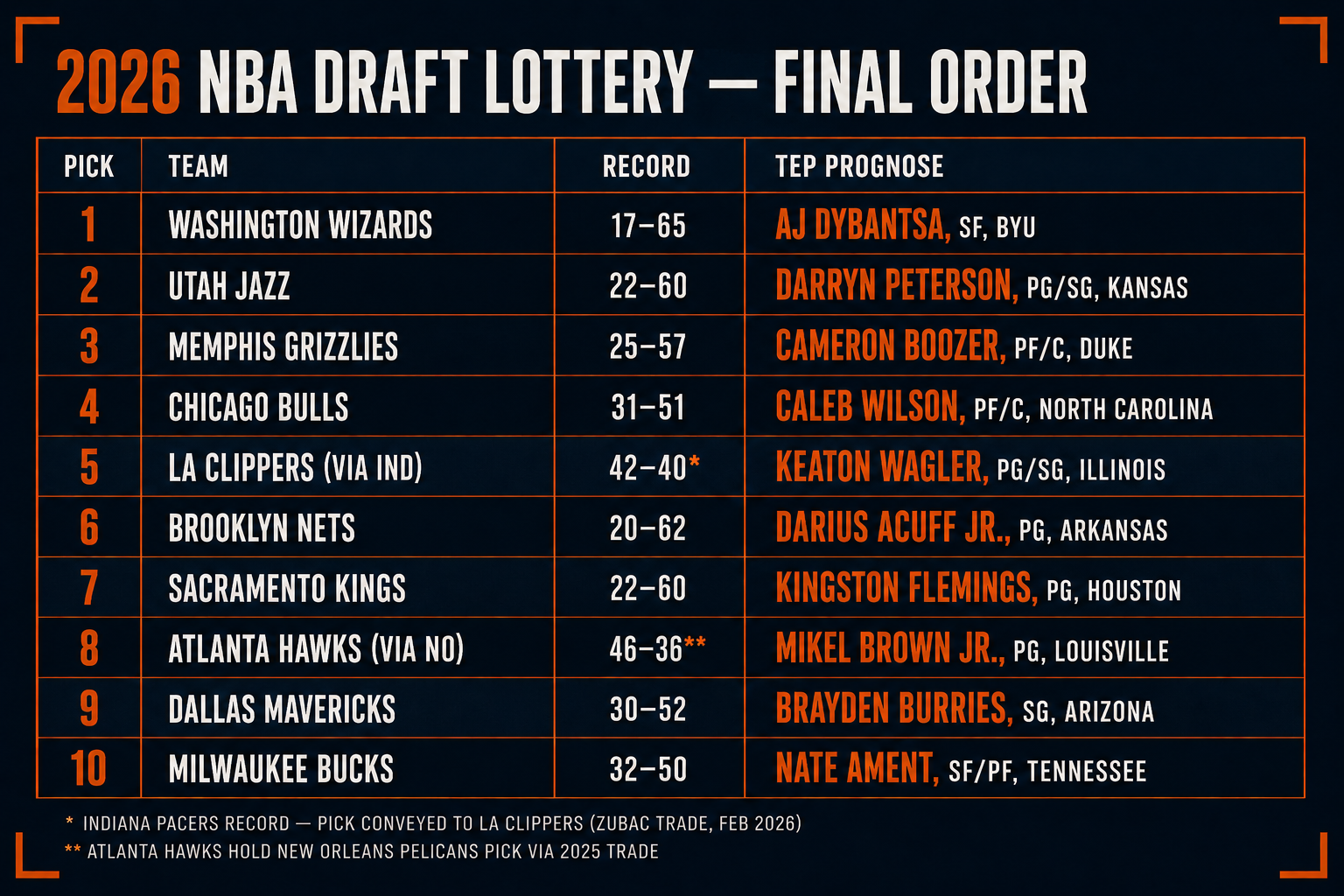
The Wizards — 17-65, the worst record in the league — won the No. 1 pick outright. The Jazz, Grizzlies and Bulls filled out the top four. The Indiana Pacers, who tanked aggressively enough to finish 19-63 while Tyrese Haliburton sat out most of the season, landed at No. 5. Their pick immediately transferred to the LA Clippers, a consequence of the Ivica Zubac trade from February.
Meanwhile, Oklahoma City — currently 7-0 in the playoffs, arguably the best-run franchise in professional basketball — got Pick 12, the same pick number that gave them Jalen Williams in 2022. The Thunder played the game right. The lottery responded with a shrug.
This draft class is deep enough to produce stars at No. 12. But the system still handed its best prizes to its worst teams — and that tension doesn't disappear just because the class is good.
The Top Five: What the Numbers Say
This is, by consensus, one of the most talented top-five groups of any draft in the past decade. Four prospects — AJ Dybantsa, Darryn Peterson, Cameron Boozer and Caleb Wilson — were all projected as potential No. 1 picks before the lottery. That kind of depth at the very top is genuinely rare.
Pick 1, Washington Wizards: It's Gotta Be AJ
The Wizards hold the right to choose first, and the current market consensus points to BYU's AJ Dybantsa. At 6-foot-9 with a 7-foot-1 wingspan and a scoring versatility that drew early comparisons to Tracy McGrady, Dybantsa's freshman season at BYU confirmed what scouts expected: he's a franchise wing, a player capable of driving winning on both ends at the highest level. The argument for him at No. 1 is simple — he's the lowest-risk choice in a class where risk management matters.
Washington's situation makes the decision both straightforward and consequential. The Wizards already possess Anthony Davis and Trae Young — a frontcourt anchor and a point guard who needs firepower around him. A 6-foot-9 wing scorer who can function off the ball alongside Young, and develop into a primary option as Davis ages, fits the blueprint. Dybantsa to Washington makes basketball sense, and that's before accounting for the symbolic weight: a franchise that hasn't picked No. 1 since John Wall in 2010, who was himself on stage Sunday as the lottery representative.
Pick 2, Utah Jazz: The Most Interesting Decision in the Draft
No team has more to think about than Utah — and no team enters the draft in a more genuinely complicated position. The Jazz already made their most aggressive move of the rebuild in February, acquiring Jaren Jackson Jr. from Memphis in an eight-player blockbuster. JJJ joins Lauri Markkanen and Keyonte George as the core Utah is building around. Pick No. 2 now has a specific function: find the guard or wing who completes that frontcourt, not rebuild it from scratch.
That context changes the calculus significantly. Darryn Peterson — the consensus No. 1 coming out of high school — remains the most commonly projected pick at No. 2. At Kansas, a full-body cramping episode derailed his freshman year; he never fully returned to form, though he still averaged 20.2 points in 29 minutes on 38.2% from three. He's the most gifted pure scorer in the class, a three-level threat with real playmaking capacity. With JJJ anchoring the defence and Markkanen spacing the floor, Peterson's ball-dominant tendencies have room to breathe. The question Utah must answer is whether it's buying the ceiling or the medical report.
Cameron Boozer is the alternative — but the fit is murkier with JJJ already in the building. Two big, non-explosive forwards on the same roster creates redundancy Utah doesn't need. Boozer's floor remains the highest in the draft: Naismith Award, AP Player of the Year, a 17.1 box plus-minus leading all of college basketball, 39.1% from three at 6-foot-9. He produces winning. Whether that translates to a Utah system that now has two frontcourt cornerstones is the honest question. There's an additional layer: Jazz scout Carlos Boozer — Cameron's father — has the No. 2 pick in his building. The front office will handle that optics question one way or another by June 23.
And then there's Caleb Wilson from North Carolina. At 6-foot-10 with genuine upside as a perimeter creator, he might actually be the best fit with Utah's rebuilt frontcourt — a long, versatile wing who doesn't duplicate what Jackson or Markkanen do. Hand injuries cut his freshman season short at 19.8 points and 9.4 rebounds per game, and the postseason look scouts were hoping for never came. He enters June as the most intriguing unknown. Utah picking Wilson would be the most aggressive choice — and, given their existing roster, possibly the most logical one.
Picks 3 and 4: Memphis and Chicago Got Lucky — and Earned It
Memphis had a 9% chance of landing in the top four. Chicago had roughly 4.5%. Both jumped.
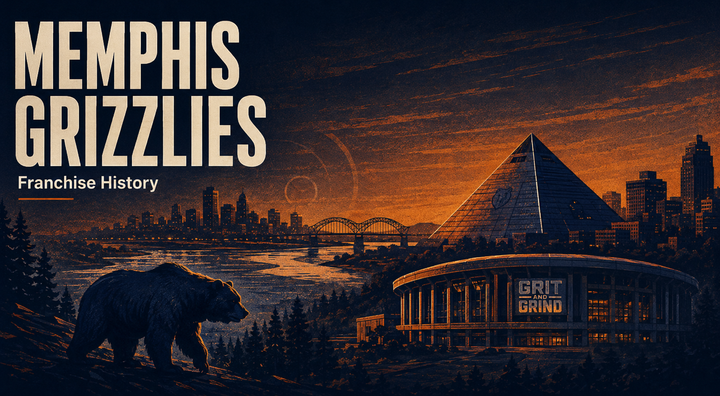
For the Grizzlies, Pick 3 is a franchise-altering development — and the full weight of that word 'franchise-altering' only makes sense if you understand what Memphis did to get here. At the trade deadline on February 3, the Grizzlies were 19-29, still nominally three games behind the final Play-In spot. They surveyed the situation, looked at a loaded draft class, and chose the draft. They traded Jaren Jackson Jr. — their Defensive Player of the Year, franchise cornerstone, the player they'd just signed to a five-year, $205 million extension the previous summer — to Utah in an eight-player blockbuster. In return: three first-round picks, two young players, and a clear signal that the Ja Morant era, too, was probably over.
What followed was one of the more aggressive second-half tank jobs in recent memory. Memphis went 6-28 over the final 34 games after the JJJ trade, bottoming out at 25-57. It was deliberate, it was visible, and it was effective. The Grizzlies now hold 12 first-round picks over the next seven years — tied with OKC and Brooklyn for the most in the league — plus Pick 3 in the deepest draft class in a decade. Whatever the moral calculus of strategic losing, the asset position Memphis has built in 18 months is genuinely impressive.
Pick 3 now lands on a roster that is, by design, a blank slate. No JJJ. Likely no Ja. A collection of young players — Cedric Coward, Walter Clayton Jr., Taylor Hendricks — and a coaching staff under Tuomas Iisalo that has been asked to develop, not win. Whoever Memphis selects will not walk into an established system. They will become the system.
Chicago at No. 4 is the purest upside scenario. The Bulls have had minimal lottery luck in their rebuild. Whoever falls to them — Wilson, Peterson if Utah goes in a different direction, a prospect from the second tier — immediately becomes the centrepiece of everything. The lottery gave them a gift. The question is whether the front office can convert it.
Pick 5, LA Clippers: The Trade That Keeps Paying
The Pacers finished with the league's second-worst record. They had a 52.1% chance of landing in the top four. They landed at No. 5 — and their pick immediately transferred to the Clippers as the consequence of the Zubac trade.
Los Angeles acquired a potentially top-four pick in February for a starting center. That is, by most measures, one of the best single-trade outcomes of the calendar year. Pick 5 in a class this deep is not a consolation prize. Keaton Wagler, Darius Acuff Jr., Kingston Flemings and others represent real value in that range. The Clippers, attempting to build around a young core post-Kawhi, needed this.
For Indiana, the mathematics were always honest about what was likely. The Pacers knew the risk. They made a bet on the draft's depth, accepted the asymmetric downside, and ran out of luck. That's the structure of the system — not an injustice, but a reminder that tanking as strategy has an inherent cost when the ball doesn't bounce your way.
Pick 12, OKC: Rich Get Richer. Again.
Oklahoma City is currently 7-0 in the playoffs. They are the defending champions, the favourites to repeat, and the consensus best-run organisation in the league. They will also pick 12th in June.
That pick, again via the Paul George trade from 2019, has now produced Shai Gilgeous-Alexander, Jalen Williams, and a generation of assets. The same slot — No. 12 — gave them Williams in 2022. Sam Presti's operation has turned the Clippers trade into a perpetual motion machine.
The Thunder also own Pick 17 via Philadelphia and have a second-round selection from Dallas. Their roster is full. Presti may well package these picks to move up, or trade them into future years. Either way, a franchise playing in the Conference Semifinals while simultaneously drafting in the lottery represents the clearest argument that the draft system, operating as designed, rewards good management — but not necessarily in the ways the system's architects intended.
Tanking gets you in the lottery. Smart drafting keeps you relevant. OKC has been doing the second thing for seven years. Sunday reminded everyone else that those aren't the same skill.
Pick 10, Milwaukee: The Window That Just Closed
The Bucks entered Sunday with 6.7% odds at the No. 1 pick. They left with No. 10 — and, for all practical purposes, confirmation that the Giannis Antetokounmpo era in Milwaukee is approaching its end.
This is not hyperbole. The arithmetic is simply unkind. Milwaukee's roster is thin. Their bench is among the least effective in the league. Crucially, they hold de facto no rights to their own first-round picks for the foreseeable future — years of aggressive asset deployment to win now left the cupboard bare. Giannis is 31. He enters the final year of his contract with a front office that has publicly given him a deadline — a resolution by the draft — on whether he intends to extend or move on.
A top-three pick changes the calculus entirely. It brings a young star into the building, someone who can develop alongside Giannis over the next two or three years, extending the competitive window. It gives Milwaukee something to offer in a potential superstar trade. It gives the franchise a credible argument that the rebuild, if Giannis leaves, has already begun.
Pick 10 does none of that. It may still produce a useful rotation player. But it doesn't solve the franchise's structural problem: a superstar in his early thirties, a depleted asset base, and no clear path back to contention without a radical change.
Owner Jimmy Haslam wants clarity by draft night. With Pick 10 in hand and the roster as it stands, the honest answer Giannis should give himself is this: the window with Milwaukee — the real window, the one that had him in Finals — is closed.
The System Worked. Whether That's Enough Is Another Question.
Washington gets Dybantsa. Utah chooses between three legitimate answers. Memphis and Chicago get a boost they didn't statistically deserve. The Clippers profit from a deal that already looked brilliant in February. OKC adds another asset to an operation that treats pick accumulation as competitive advantage.
The lottery did what lotteries do: it distributed outcomes across a probability range, and the results landed close to the median expectations. No wild upsets. No Cooper Flagg-level 1.8% lightning strikes. Just the mathematics, playing out.
What it also did, quietly, is remind the league of something the draft system was never quite designed to confront: that losing deliberately and losing accidentally produce the same reward, while building genuinely — as OKC has, as Boston did before them — earns you a pick at 12 and applause for the process.
The 2026 NBA Draft is set for 23 June in Brooklyn. By then, we'll know whether Giannis is still a Buck, whether Utah chose upside or certainty, and whether Washington has finally found its cornerstone.
The prospects are ready. Whether their future franchises are — that's the harder question.