On The Record: The NBA Doesn't Have a Load Management Problem. It Has a Courage Problem.
On The Record, Issue 01 — The Future of the Regular Season Length and Format

The 2025-26 regular season ended on April 12. Four of the best players on the planet combined to play 203 of a possible 328 games. Giannis Antetokounmpo played 36. Steph Curry 43. LeBron James 60. Luka Dončić 64 — and Dončić, only after the league granted him a medical exception, was able to qualify for All-NBA and MVP consideration despite falling short of the 65-game threshold.
125 games missed. By four players. In one season.
The NBA called this a load management problem. It was not. It was a schedule problem. And the league has known it for years.
The Number That Has Never Made Sense
The NBA played 82 games per team this season. That number was set in 1968, when the league had 14 teams, no sports science departments, and a desperate need for gate revenue. The league now has 30 teams, a $76 billion television deal with ESPN, NBC, and Amazon, and a sports medicine infrastructure capable of telling you exactly how many minutes any given knee can absorb per week. The number 82 survived none of that progress. It survived one thing: it generates television inventory.
That is not a sporting argument. That is an accounting argument dressed as tradition.
There is a concept in corporate strategy that distinguishes between incremental change and what some call the tiger's leap — a single, deliberate transformation so fundamental that it resets the playing field entirely. Incremental change works in stable environments. You adjust, you optimize, you improve by degrees. But some problems are not solved by degrees. Some problems require absorbing one large, defined pain once — rather than carrying a thousand small ones indefinitely.
The NBA has arrived at exactly that moment. There are very few levers in professional sports that qualify as genuine root causes rather than symptoms. The 82-game schedule is one of them.
Here is the simplest test. If you were founding this league today — 30 teams, 32 teams, whatever the number — would anyone in that room propose 82 games? Not a single person. Some would land on 58. Some on 62, the natural product of every team playing every other team twice in a 32-team league. Some would add a handful of division or conference games on top. But the number in every scenario would be lower. It would always be lower — because no one building from scratch would choose a calendar designed for a 14-team league operating in 1968 and call it optimal for the most athletically demanding version of the sport that has ever existed.
82 is not a sporting number. It never was. It is a historical accident that became a contractual assumption that became an untouchable tradition. The tiger's leap does not preserve untouchable traditions. It replaces them with something that actually works.
The league's response to this structural failure was to legislate availability rather than fix the schedule. The Player Participation Policy, introduced in 2023, fined teams $100,000 for a first violation, $250,000 for a second, and escalating into millions for each subsequent offense — with third and subsequent violations costing $1 million more than the previous penalty. Adam Silver admitted the quiet part out loud at the time: load management had "gotten away from us a bit." His solution was to punish teams for responding rationally to an irrational calendar. The 65-game award eligibility rule followed — a blunt instrument that caught Dončić in its teeth this season despite a legitimate injury, forcing the league into the embarrassment of a medical exception for its most marketable young star.
It did not work. The stars kept sitting. The fines kept coming. The Jazz were fined $100,000 this season for failing to make Lauri Markkanen available against Washington on March 5. The Cavaliers were fined for resting Donovan Mitchell and Evan Mobley in the same game in November. The schedule did not change.
The Body Doesn't Lie
The NBA is faster, more explosive, and more physically demanding than at any point in its history. It is also producing more catastrophic soft-tissue injuries than at any point in its history.
That is not a coincidence.
Achilles tears. Calf ruptures. Hamstring breakdowns that linger across months. The injuries accelerating fastest are precisely the ones sports science understands best: soft-tissue damage accumulated through repeated high-intensity output without adequate recovery. Every back-to-back game is a compounding invoice. Every Tuesday in Memphis after a Sunday in Boston is a withdrawal from a biological account the body keeps whether or not the schedule acknowledges it.
The league's athletes are not getting softer. They are getting more explosive, generating higher forces per movement, at more games per season than any generation before them. The schedule that barely worked for a less athletic league in 1968 is a structural mismatch for the product that exists in 2026. Seventy games is not a concession to player comfort. It is basic product protection. The most valuable assets in this business are the bodies on the floor. A schedule that systematically destroys them is not a business model. It is a liability with a very expensive invoice.
The Schedule That Writes Itself
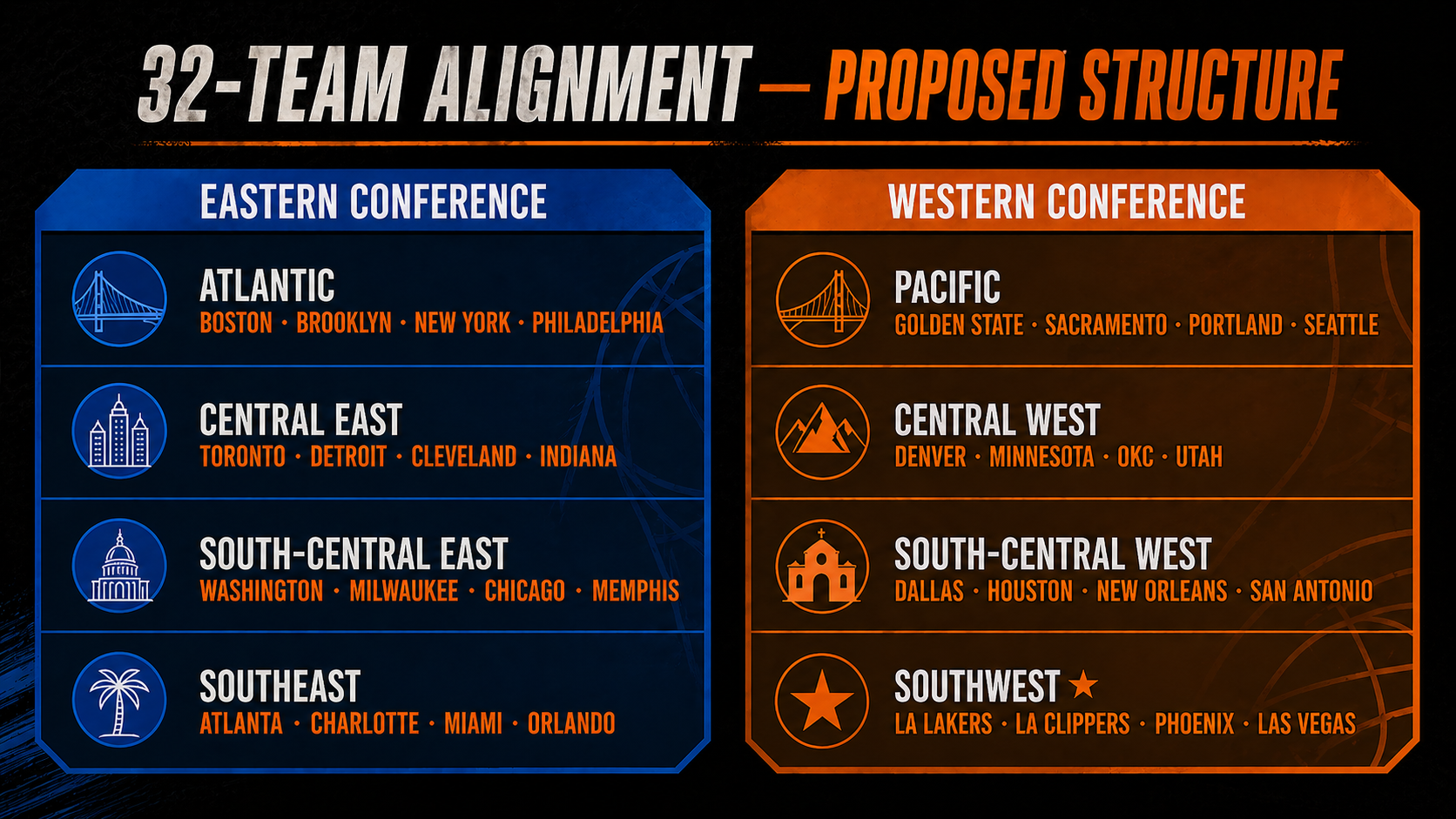
When the NBA expands to 32 teams — and Seattle and Las Vegas are no longer speculation, they are a timeline — the correct schedule emerges from the structure of the league itself.
32 teams. Eight divisions of four. Every team plays every other team twice, home and away. That is 62 games of pure competitive logic. Add four games against your three division rivals. Add four games against your designated rivalry opponent — one team from a rival division within your own conference, rotating every four years through all four teams in that division. Add two games against every other team in your conference. The math produces exactly 70 games.
Not 68. Not 72. 70 — derived from the logic of the league itself, not from a negotiating table in Manhattan.
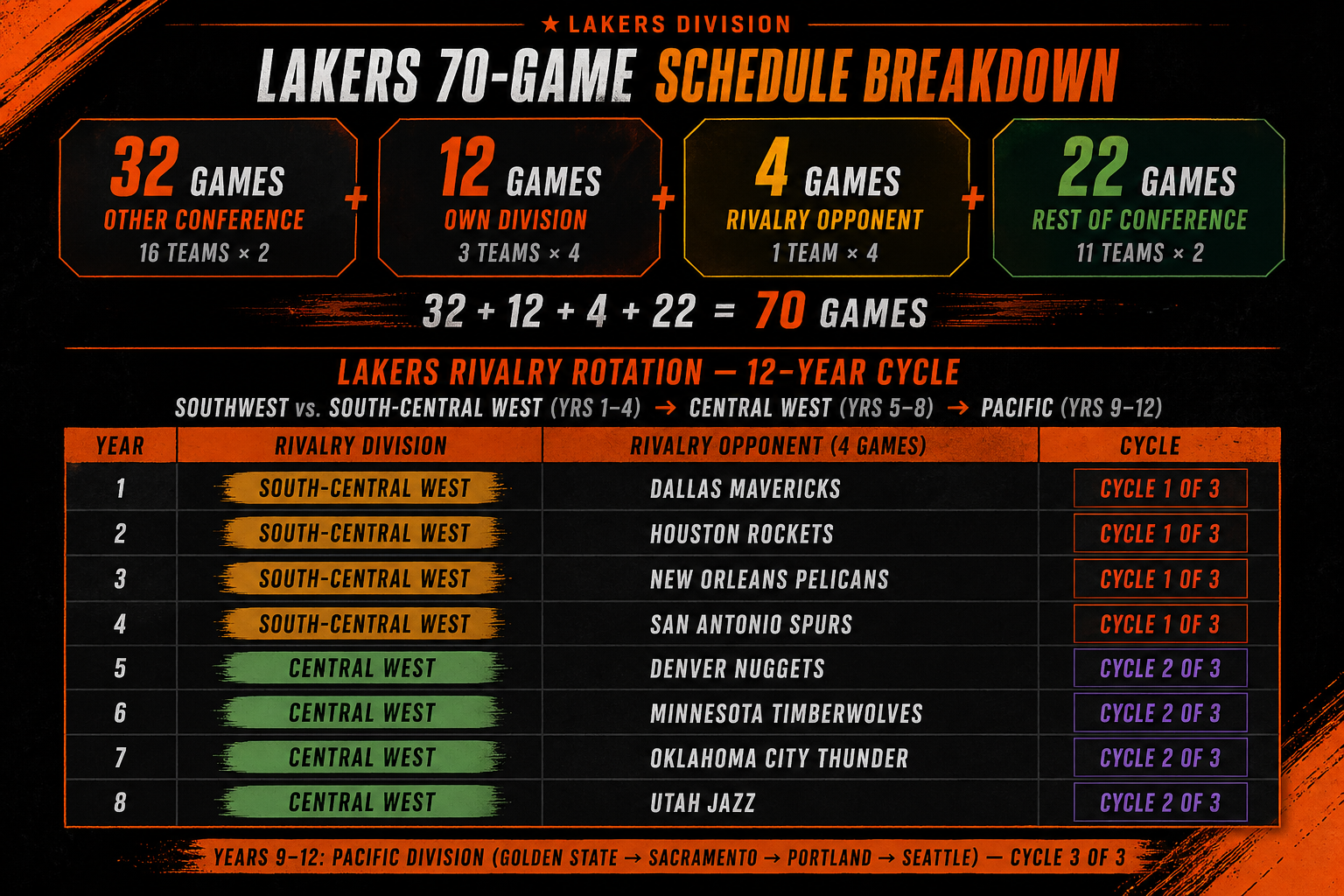
The structure is clean and verifiable. Take the Los Angeles Lakers, sitting in the Southwest Division alongside the Clippers, Phoenix, and Las Vegas. Their 70 games break down as follows: 32 games against the Eastern Conference (16 teams, twice each), 12 games against their three Southwest division rivals (four times each), 4 games against their designated rivalry opponent, and 22 games against the remaining 11 Western Conference teams outside their division (twice each).
The rivalry rotation runs on a 12-year cycle, divided into three chapters of four years each — one chapter per rival division. In years one through four, the Lakers play South-Central West: Dallas in year one, Houston in year two, New Orleans in year three, San Antonio in year four. Years five through eight shift the rivalry to Central West: Denver, Minnesota, Oklahoma City, Utah in sequence. Years nine through twelve bring Pacific: Golden State, Sacramento, Portland, Seattle. Year thirteen: Dallas again. The cycle restarts.
Four years of 2elevated" intensity against the same division. Four opponents, four extra-weighted matchups, one sustained narrative arc that fans and broadcasters can build around. This is not an arbitrary scheduling quirk. It is a structured rivalry format with its own four-year rhythm — the kind of fixture that makes a January game mean something beyond the standings.
Now take those 12 recovered games and do something the current schedule cannot: spread them across the same October-to-April calendar. No new start date. No earlier finish. Just room. Room to eliminate back-to-backs entirely. Room for ten days around the All-Star break instead of four. Room for genuine recovery windows around the NBA Cup knockout rounds in December. Room for players to arrive at January with bodies that still have something left for March.
Twelve fewer games across the same calendar is roughly 20 to 25 fewer playing days. That is not a shorter season. That is a better one.
The League That Already Solved This
The NFL plays 17 games. The NBA played 82. The NFL generates approximately $20 billion in annual revenue. The NBA generates roughly $10 billion — with nearly five times as many games on the schedule.
The owners will say: NFL stadiums hold 70,000 people. NBA arenas hold 18,000. Gate revenue is not comparable. That is true. It is also the wrong conversation. Gate revenue is not where the NBA's future lives. Television rights, global licensing, and international expansion are — and on every one of those fronts, fewer games with higher stakes per game is the superior model.
Which brings us to the argument the league refuses to make to itself.
The World Is Waiting
The NFL moves 53-man rosters, equipment for hundreds of people, and full stadium infrastructure across continents. It plays in London, Frankfurt, Madrid, and São Paulo. It is building permanent international audiences at 100 times the logistical complexity of basketball.
The NBA needs a bus, 15 players, and a parquet floor.
There is no major sport on earth more portable than basketball. And yet the league played roughly two international games this season, called it a global strategy, and wondered why European fans streamed League Pass games illegally at 2am rather than building the tribal loyalty that sustains a market. Two games in Mexico City is not a global strategy. It is a press release.
A 70-game schedule with a loosened calendar creates space for something genuinely different: 20 to 30 international games per season, built around permanent team-market partnerships. Brooklyn in Berlin. Lakers in Paris. Warriors in Tokyo. Knicks in London. Not rotating curiosities — fixed annual commitments that give fans in those cities a team to follow, a fixture to plan around, a reason to subscribe. Yes, some home games disappear for owners. Twelve fewer home dates is real money. It is also the cost of building markets that will generate far more over the next two decades than an extra Tuesday night in November against a team fighting for the eighth seed.
The NFL understood this arithmetic. The NBA is still doing the old math.
The Players' Fear — And Why It's Misdirected
The players' union will resist. The argument will be about money — specifically, that fewer games mean fewer statistical opportunities, fewer chances to chase records, and fewer qualifying games for the supermax contracts tied to individual award thresholds.
It is the most honest objection. It is also the most misdirected.
Players lost money under the current system this season. Zach Collins lost a potential $48 million supermax swing after missing games through injury — not through choice. Dončić needed a league exception just to qualify for awards in a season where he played 64 games and led the NBA in scoring. Three of the four players named in the opening of this article — Giannis, Curry, LeBron — did not reach 65 games. Not because they chose rest. Because 82 games at this level of athleticism is more than human tissue can reliably deliver.
As for records — the league adjusts statistical context constantly. ERA in baseball is measured per nine innings. Efficiency metrics in basketball already account for pace and usage. A player averaging 30 points per game over 70 fully healthy games is more valuable, more marketable, and more likely to still be playing at 35 than one who averaged 28 over 82 games while managing a soft-tissue condition nobody officially acknowledges. The counting records that matter in twenty years will not be raw totals from seasons where the stars played half the schedule at reduced capacity.
Fewer games. Healthier bodies. Higher stakes per night. Bigger international footprint. More stars on the floor.
The Verdict
Load management was the market correcting a structural mistake the league refused to acknowledge. Every star who sat out a Tuesday night this season made a rational decision inside an irrational system. Fining teams for that decision did not fix the system. It taxed the symptom.
Seventy games is the right number — not because it sounds reasonable, but because it is what the logic of a 32-team league produces when you let structure do the math. It is what sports medicine has been recommending, implicitly, every time another Achilles goes in April. It is what international expansion requires if the NBA is serious about being a global league rather than a league with occasional global tourism. It is what the calendar already has room for, if the league is willing to use the space.
The schedule writes itself. The business case makes itself. The medical case makes itself.
The only thing the NBA needs to supply is the one thing it has avoided for twenty years.
The courage to change the number.