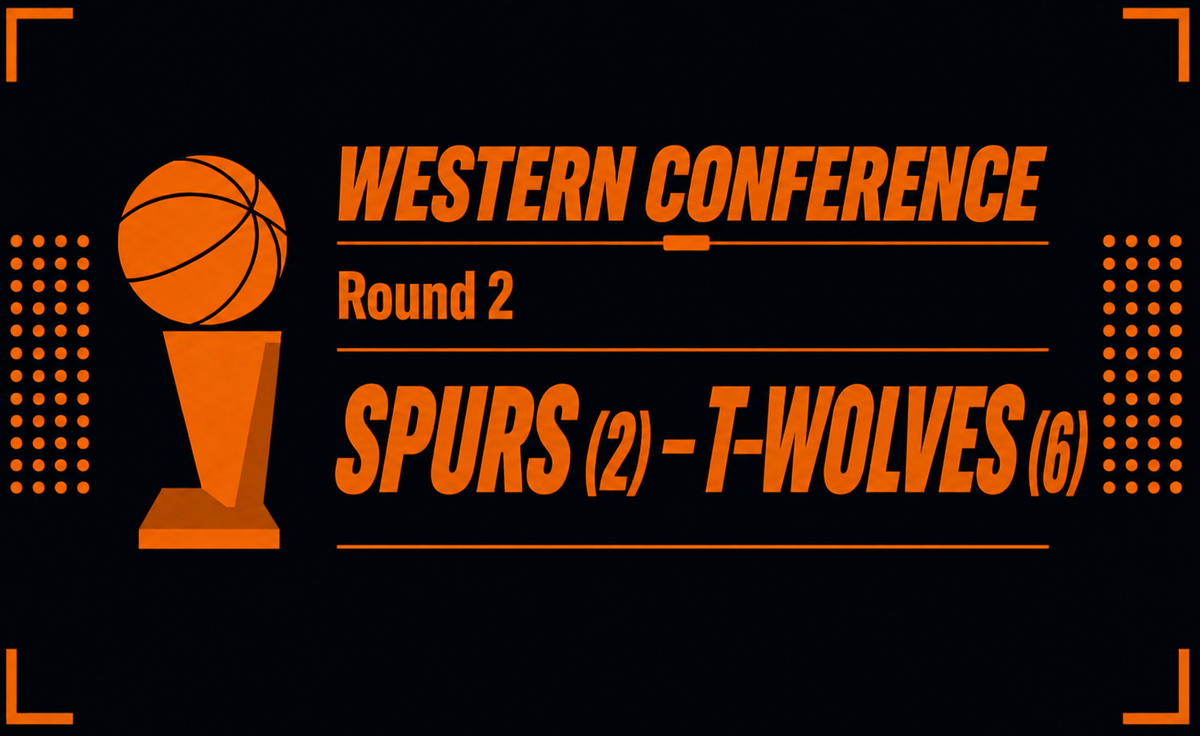
Round #2 - Tracker#2 | SAN vs. MIN
Series tied 2-2
My prediction: Spurs 4-1 · Series tied 2-2 · Game 5: Tbd. in San Antionio
Latest Game:
Game 4: Wembanyama's Ejection Didn't Lose This Game. Minnesota Won It.
Timberwolves 114, Spurs 109 · Series tied 2-2
With 8:39 left in the second quarter, Victor Wembanyama threw an elbow at Naz Reid's jaw and walked off the floor with four points and a Flagrant 2. It was the earliest an All-Star has been ejected from a playoff game in the play-by-play era. Teams are 1-8 in such situations, according to ESPN Research.
San Antonio became the exception.
For three quarters, the Spurs were winning without their 7-foot-4 franchise player. Dylan Harper scored 24 on 8-of-11 shooting. De'Aaron Fox added 24 more. The mid-range clinic was working. Then Anthony Edwards scored 16 of his 36 points in the fourth quarter, and the series reset at 2-2.
This is not a story about Wembanyama's ejection costing the Spurs Game 4. This is a story about what Minnesota found when the pressure was highest.
The Fourth Quarter Is Edwards's Office
Through three quarters without Wembanyama, the Spurs had constructed an eight-point lead. The Wolves had committed six turnovers in a disastrous third quarter. The crowd at Target Center had gone quiet. Minnesota coach Chris Finch later admitted his team "lost our way" offensively in that stretch.
Then Edwards hit a 27-footer to pull the Wolves within three. Then a catch-and-shoot 3 from the wing to put them up 98-97 for the first time since the first half. Then Rudy Gobert — 11 points, 13 rebounds — converted a three-point play off a feed from Julius Randle with 1:56 remaining to push the lead to six.
Edwards finished with 36. He has now logged 40-plus minutes in four consecutive playoff games despite hyperextending his knee 15 days ago.
When asked after the game whether he was thinking about his late mother — today is Mother's Day — Edwards redirected the first press conference question immediately: "I just wanted to win for my Mom. It was that simple."
What the Spurs Built Without Their Star
The more interesting story from Game 4 is the 30 minutes in which San Antonio genuinely competed at full capacity. Harper and Fox each scored 24. Stephon Castle added 20. Three guards who were never supposed to shoulder a playoff series without Wembanyama looked like they could.
San Antonio shot 48% from the field. They were competitive on the offensive glass. They held the lead entering the fourth.
The 23% three-point shooting (6-of-26) will not sustain a deep playoff run. But the question this game raised is different: when Wembanyama returns for Game 5, does San Antonio actually know something about itself that it didn't before Sunday?
The Ejection in Context
Wembanyama was ejected after throwing an elbow at Reid following a physical rebound scramble. Spurs coach Mitch Johnson said officials should do a better job of protecting the 22-year-old from the physicality routinely imposed on him — then acknowledged, without condoning the action, that Wembanyama had reached a limit.
"At some stage, he should be protected," Johnson said. "If not, he's going to have to protect himself."
The league will review the incident for possible supplemental discipline. A Flagrant 2 carries a minimum fine of $2,000. A suspension is possible.
Wembanyama finished with four points — the fewest of his career in any regular season or playoff game. He addressed teammates at halftime from the locker room with the Spurs trailing 60-56.
It helped. For a while.
What the Series Looks Like Now
Game 5 is Wednesday in San Antonio. Wembanyama's status is to be determined by the league.
Minnesota took the first two games at home, San Antonio took Game 3 in Minneapolis, Minnesota won Game 4. The home team has won every game in this series. The Spurs have not yet lost on their own floor.
If the pattern holds, Game 5 is a Spurs win. If Edwards has a say, it won't.
Minnesota took 38 shots at the rim in Game 4 — their second-most in any game under Finch. Thirty-eight came after the ejection. The math is not subtle: San Antonio with Wembanyama is a different problem than San Antonio without him. But the Spurs proved they can stay in a game when he's gone. Minnesota proved they can still win it.
That's what makes Game 5 actually interesting.
Series History:
Preview: Wembanyama's First Real Test
Victor Wembanyama posted 25 points, 11.5 rebounds, and 3.1 blocks per game against Portland. The Trail Blazers had no interior presence capable of challenging him — no one to draw him away from the paint, no one to punish his occasional defensive gambles. Minnesota is different, with one enormous caveat.
Anthony Edwards is not playing. His bone bruise makes him week-to-week, which in playoff terms means Game 1 without him is almost certain, and Games 3 and 4 are genuinely uncertain. Without Edwards, the Timberwolves lack the one player who can create separation off the dribble against elite defenders. Wembanyama is the most elite defender in this bracket.
San Antonio's Blueprint
DeMar DeRozan averaged 24 points in round one, the best basketball of his Spurs career. His mid-range game — pull-up jumpers at the elbow, post-ups against smaller defenders — is perfectly designed to keep Wembanyama occupied without drawing him to the perimeter. When Wembanyama collapses on DeRozan, San Antonio's shooters — Keldon Johnson, Jeremy Sochan, Devin Vassell — punish the closeouts.
The Spurs are the West's second seed for a reason. Their 62-20 record was not a statistical accident. But this is their first genuine contender-level test, and Gregg Popovich's absence from the sideline (Mitch Johnson coaching) creates institutional uncertainty that a deeper postseason run amplifies.
Minnesota's Survival Mode
The T-Wolves beat Denver without their three best perimeter players. That was remarkable. Doing it again against Wembanyama requires something different — a version of Jaden McDaniels and Rudy Gobert's defensive brilliance that somehow neutralizes a 7'4" player who has never faced playoff physicality at this level.
McDaniels guarded Jokic. He cannot guard Wembanyama — no one can, really — but making him uncomfortable in the paint, disrupting his rhythm, and forcing San Antonio's role players to beat you is a viable strategy. Naz Reid at 15 points per game off the bench is the only secondary scorer Minnesota has without Edwards. That is not enough.
Prediction: SA 4-1
If Edwards returns healthy by Game 3, Minnesota competes. Without him — or with a limited version — San Antonio's combination of Wembanyama's two-way dominance, DeRozan's efficiency, and Fox's pace should be decisive. The Timberwolves give San Antonio one dangerous game at Target Center. The Spurs close it out in five.
Game 1: Wemby and Fox Combined for 21 Points. Minnesota Stole One Anyway.
Spurs 104, Timberwolves 102 · T'wolves lead 1-0
Victor Wembanyama and De'Aaron Fox are San Antonio's two most important players — one by talent, one by salary. In Game 1 of the Western Conference Semifinals, they combined for 21 points on 10-of-31 shooting.
Minnesota won 104-102. The Timberwolves stole a game in San Antonio without a single one of their own stars delivering a signature performance. That is the most dangerous kind of road win.
What San Antonio Got Wrong
The Spurs shot 10-of-36 from three (28%). That number is the entire problem — and it is a structural one, not a random variance issue. San Antonio's offense is built on the perimeter-first principles that work beautifully in an 82-game regular season and become exploitable in playoff series where opponents have time to prepare and adjust. When the threes don't fall, the Spurs have no secondary scoring mechanism that doesn't run through Wembanyama in the post.
Wembanyama shot 5-of-17 from the field, 0-of-8 from three, and finished with 11 points. He had 15 rebounds and 12 blocks — a defensive performance of genuine historic quality that kept San Antonio in a game their offense had no business being close in. Fox shot 5-of-14 for 10 points and committed 6 turnovers in 33 minutes. The two players who cost this franchise the most in talent and money delivered a combined box score that, in any competitive series, gets you eliminated by ten.
San Antonio cannot become Boston West — a team that lives and dies entirely by three-point variance. The Spurs have Wembanyama in the paint. That means inside-out is not just an option, it is the only sustainable path: establish Wemby in the post first, collapse the defense, then use the kick-outs to create the threes that the regular season made look automatic. Shooting 10-of-36 without ever forcing the defense to respect the interior is a different problem entirely.
What Minnesota Got Right
Anthony Edwards returned from his left knee bone bruise and played 25 minutes off the bench — 18 points on 8-of-13 shooting, 3 rebounds, quietly efficient without the explosiveness that makes him dangerous at full health. His return changes the series calculus entirely. Minnesota beat Denver without him. With even a 70% version of Edwards, the Timberwolves have a secondary scorer that San Antonio's perimeter defenders cannot contain while also respecting Wembanyama's help zone.
Naz Reid was the best player on the floor in the fourth quarter — 12 points, 9 rebounds, +15 in 30 minutes. Julius Randle had 21 points and 10 rebounds. Mike Conley shot 4-of-7 from three in 24 minutes. None of those are signature performances. All of them together were enough to win in San Antonio by two.
Dylan Harper had 18 points on 7-of-13 shooting for the Spurs — the best individual offensive game of the night on either roster. Stephon Castle added 17. Julian Champagnie scored 17 off the bench. San Antonio's supporting cast did enough. Their two best players didn't.
Why This Series Just Got Interesting
Minnesota needed exactly this: a road game one where nobody had to carry them, where the structure held, and where San Antonio's best players gave them a path to win despite being the underdog. They got it.
The Spurs are still the favorites. Their 62-20 regular season record was not accidental, and a two-point home loss in Game 1 is recoverable. But the lesson from this game is written clearly in the box score — Wembanyama averaging 25 points per game in the first round came against Portland, a team with no interior presence and no defensive scheme capable of disrupting his rhythm. Minnesota has Rudy Gobert, who blocked 3 shots and disrupted a dozen more without making the box score look remarkable.
Game 2 is Thursday, also in San Antonio. The Spurs need Wembanyama inside before outside. They need Fox to attack rather than pull up. And they need to understand that 28% from three on 36 attempts is not a system — it is a habit that gets you eliminated.
The modern NBA rewards three-point volume. It punishes three-point dependence.
San Antonio is not there yet. Game 1 proved it.
Game 2: Minnesota's Worst Postseason Loss in Franchise History. San Antonio's Answer Was Always That Simple.
Spurs 133, Timberwolves 95 · Series tied 1-1
Minnesota's previous largest postseason defeat was by 30 points — against the Los Angeles Lakers on April 29, 2003. San Antonio erased that record by eight, winning 133-95 in a game that was settled so decisively that both teams sent their starters to the bench with ten minutes remaining and the Spurs leading 104-66.
The series is tied 1-1. Anthony Edwards' reaction after the game — "we got blown out, we came out cool and what happened — we got blown out" — was both accurate and insufficient. Game 2 was not a variance problem or a competitive game that got away. It was a statement about what San Antonio looks like when their system functions at full speed.
What San Antonio Fixed From Game 1
Game 1's core problem was three-point dependence without interior establishment — 10-of-36 from three, Wembanyama and Fox combining for 21 points on 10-of-31 shooting. In Game 2, Mitch Johnson's adjustment was visible from the opening possession: the Spurs played through Wembanyama first, created interior pressure, and used the kick-outs to generate the threes they took in Game 1 without earning.
The results were immediate. San Antonio shot 50% from the field and 41% from three (16-of-39). Wembanyama had 19 points, 15 rebounds, and the kind of physical presence that Minnesota's frontcourt — without a reliable Edwards — could not disrupt. Fox added 16 on 5-of-10 shooting and was +24 in 26 minutes. Stephon Castle scored 21 on 6-of-10 shooting, set the physical tone early, and finished +17.
The Spurs scored 58 points in the paint. Minnesota managed 36. San Antonio's fast break points — 29 to Minnesota's 5 — reflected how completely the Timberwolves' defensive structure broke down whenever turnovers created open court.
The Edwards Situation
Anthony Edwards played 24 minutes and scored 12 points on 5-of-13 shooting with a -33 plus-minus. He came off the bench for the second consecutive game as Minnesota continued managing his hyperextended left knee. The coaching staff is protecting him — the right decision for the series, the wrong night for it to visibly limit what he can provide.
Without a healthy, full-capacity Edwards, Minnesota's offense runs through Julius Randle (12 points, 5 turnovers), Jaden McDaniels (12 points, 6 fouls), and a rotation of players who were sufficient against Denver and are insufficient against San Antonio's defensive athleticism. Rudy Gobert had 5 points in 28 minutes and was -23. The Timberwolves shot 30% from three and 52% from the free throw line — numbers that make winning impossible against a team executing at this level.
The Lesson San Antonio Delivered
The inside-out framework that Game 1 exposed as missing was present in every quarter of Game 2. Wembanyama in the post first. Fox in attack mode, not pull-up mode. Castle creating pace. Dylan Harper adding 11 points and 8 assists off the bench. The entire San Antonio system, when operating as designed, produces the kind of scoreline that ends reputations.
Minnesota knew it was coming. The Timberwolves have watched San Antonio's system from the outside all season — 62 wins, Wembanyama's evolution, Fox's impact. Knowing what's coming and being able to stop it are different problems. Game 2 proved the Timberwolves cannot stop it without Edwards at full capacity and without a defensive answer for Wembanyama in pick-and-roll coverage.
Games 3 and 4 are in Minneapolis. Edwards' knee and Minnesota's home court are the two variables that give this series any remaining uncertainty.
San Antonio has already shown what a functioning version of this team looks like. The margin was 38 points. There is no ambiguity in that number.
Game 3: Wembanyama Had 39. Minnesota Had No Answer. Nobody Does.
Timberwolves 108, Spurs 115 · Spurs lead 2-1
Victor Wembanyama scored 39 points, grabbed 15 rebounds, and blocked 5 shots in a road playoff game against a team that had the crowd, the momentum, and Anthony Edwards back at full capacity.
San Antonio won 115-108. The Spurs led for 87% of the game. Their largest lead was 15. Minnesota's was 4.
There is no tactical adjustment Minnesota can make that addresses what Wembanyama is doing in this series. There is no player on their roster capable of guarding him. There is no defensive scheme in the modern NBA that reliably stops a 7'4" player who shoots 13-of-18 from the field, draws fouls at will, and blocks the shots that might otherwise keep the opponent alive.
What This Performance Means
Wembanyama shot 13-of-18 from the field and 10-of-12 from the free throw line. He added 5 blocks and led San Antonio with 87% of the lead time in a hostile arena on the road. When Jaden McDaniels drew his fifth foul with 6:18 remaining and brought Minnesota within 99-98, Wembanyama sat for approximately one minute — coach Mitch Johnson's calculated risk — and the Spurs never trailed in the second half regardless.
His 3-pointer at 3:06 pushed the lead to six. On the next possession, Naz Reid tried a shot near the end of the shot clock and Wembanyama got the rebound. The game ended shortly after. San Antonio has now won two straight in a series they lost in Game 1. Wembanyama is averaging 29.7 points, 14.7 rebounds, and 4.3 blocks across the three games.
These are not numbers. They are a problem with no solution.
The Edwards Return and Why It Wasn't Enough
Anthony Edwards came back from his hyperextended left knee after one week and played 41 minutes — 32 points, 14 rebounds, 6 assists. The physical resilience was genuine. His buzzer-beating 31-footer ended the first quarter and a McDaniels three tied it 51-51 at halftime. Minnesota fought. This was not the passive effort of Game 2.
It still wasn't enough because Edwards' return, while essential for competitiveness, doesn't solve the Wembanyama problem. Minnesota's offense around Edwards produced enough to stay within striking distance. Their defense around Wembanyama did not. McDaniels and Randle shot a combined 8-of-34 from the floor — unable to get short-range and rim-attacking shots against Wembanyama's help presence. Naz Reid had 18 and 9 off the bench. Ayo Dosunmu contributed 11. Those are good numbers from role players in a losing effort.
Rudy Gobert had 13 points, 7 rebounds, and was -6 in 31 minutes. Against Wembanyama's combination of perimeter shooting and interior dominance, Gobert's traditional center game is rendered tactically irrelevant.
The Series in Three Numbers
San Antonio has now outscored Minnesota across three games 350-298 — a 52-point aggregate margin in a series where the Timberwolves won Game 1 by two. The two San Antonio wins have come by 38 and 7 — different in margin, identical in control. The Spurs led for 96% of Game 2 and 87% of Game 3. Minnesota has led for a combined 5% across those two games.
Game 4 is Monday in Minneapolis. A Timberwolves win ties the series. A San Antonio win puts them one game from the Western Conference Finals with home court for Game 5.
Edwards said after the game: "If we make our shots, we win this game."
He's right. He's also playing against a player who makes that conditional irrelevant.
Game 4: Wembanyama's Ejection Didn't Lose This Game. Minnesota Won It.
Timberwolves 114, Spurs 109 · Series tied 2-2
With 8:39 left in the second quarter, Victor Wembanyama threw an elbow at Naz Reid's jaw and walked off the floor with four points and a Flagrant 2. It was the earliest an All-Star has been ejected from a playoff game in the play-by-play era. Teams are 1-8 in such situations, according to ESPN Research.
San Antonio became the exception.
For three quarters, the Spurs were winning without their 7-foot-4 franchise player. Dylan Harper scored 24 on 8-of-11 shooting. De'Aaron Fox added 24 more. The mid-range clinic was working. Then Anthony Edwards scored 16 of his 36 points in the fourth quarter, and the series reset at 2-2.
This is not a story about Wembanyama's ejection costing the Spurs Game 4. This is a story about what Minnesota found when the pressure was highest.
The Fourth Quarter Is Edwards's Office
Through three quarters without Wembanyama, the Spurs had constructed an eight-point lead. The Wolves had committed six turnovers in a disastrous third quarter. The crowd at Target Center had gone quiet. Minnesota coach Chris Finch later admitted his team "lost our way" offensively in that stretch.
Then Edwards hit a 27-footer to pull the Wolves within three. Then a catch-and-shoot 3 from the wing to put them up 98-97 for the first time since the first half. Then Rudy Gobert — 11 points, 13 rebounds — converted a three-point play off a feed from Julius Randle with 1:56 remaining to push the lead to six.
Edwards finished with 36. He has now logged 40-plus minutes in four consecutive playoff games despite hyperextending his knee 15 days ago.
When asked after the game whether he was thinking about his late mother — today is Mother's Day — Edwards redirected the first press conference question immediately: "I just wanted to win for my Mom. It was that simple."
What the Spurs Built Without Their Star
The more interesting story from Game 4 is the 30 minutes in which San Antonio genuinely competed at full capacity. Harper and Fox each scored 24. Stephon Castle added 20. Three guards who were never supposed to shoulder a playoff series without Wembanyama looked like they could.
San Antonio shot 48% from the field. They were competitive on the offensive glass. They held the lead entering the fourth.
The 23% three-point shooting (6-of-26) will not sustain a deep playoff run. But the question this game raised is different: when Wembanyama returns for Game 5, does San Antonio actually know something about itself that it didn't before Sunday?
The Ejection in Context
Wembanyama was ejected after throwing an elbow at Reid following a physical rebound scramble. Spurs coach Mitch Johnson said officials should do a better job of protecting the 22-year-old from the physicality routinely imposed on him — then acknowledged, without condoning the action, that Wembanyama had reached a limit.
"At some stage, he should be protected," Johnson said. "If not, he's going to have to protect himself."
The league will review the incident for possible supplemental discipline. A Flagrant 2 carries a minimum fine of $2,000. A suspension is possible.
Wembanyama finished with four points — the fewest of his career in any regular season or playoff game. He addressed teammates at halftime from the locker room with the Spurs trailing 60-56.
It helped. For a while.
What the Series Looks Like Now
Game 5 is Wednesday in San Antonio. Wembanyama's status is to be determined by the league.
Minnesota took the first two games at home, San Antonio took Game 3 in Minneapolis, Minnesota won Game 4. The home team has won every game in this series. The Spurs have not yet lost on their own floor.
If the pattern holds, Game 5 is a Spurs win. If Edwards has a say, it won't.
Minnesota took 38 shots at the rim in Game 4 — their second-most in any game under Finch. Thirty-eight came after the ejection. The math is not subtle: San Antonio with Wembanyama is a different problem than San Antonio without him. But the Spurs proved they can stay in a game when he's gone. Minnesota proved they can still win it.
That's what makes Game 5 actually interesting.