Round #1 - Tracker#2 | SAN vs. POR
Spurs win Series 4-1
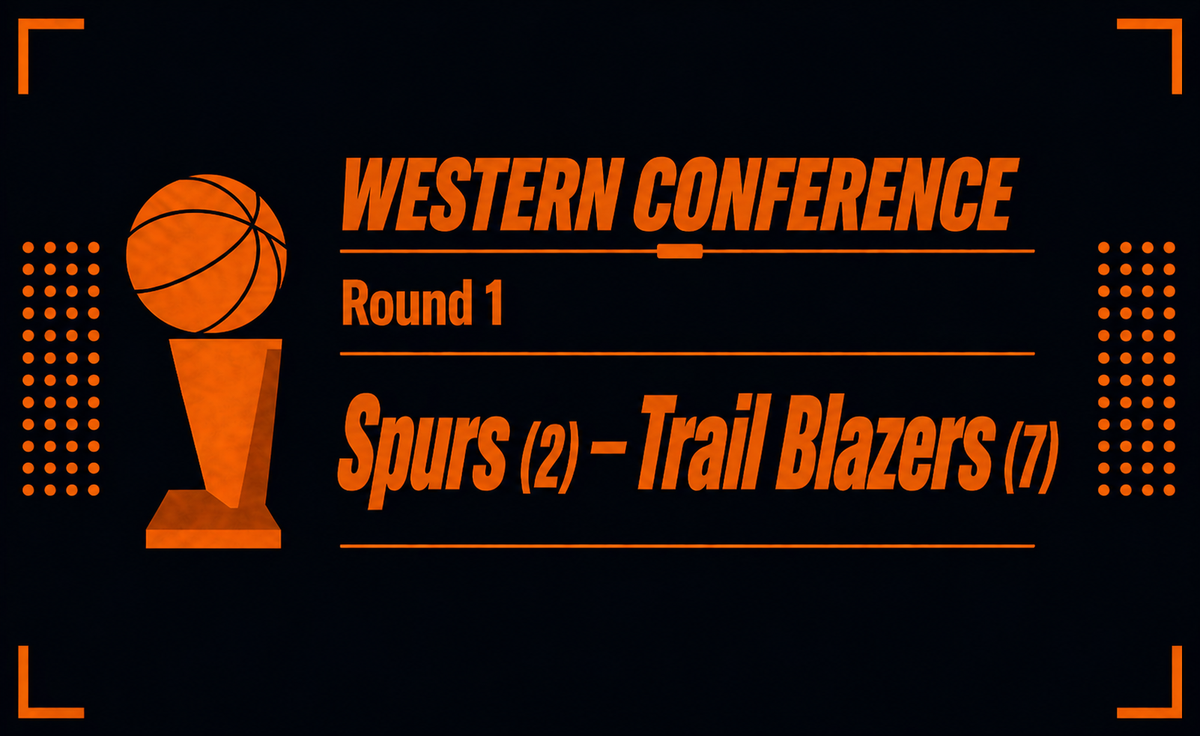
My prediction: Spurs 4-1 · Spurs win Series 4-1
Latest Game:
Game 5: San Antonio Closes the Door
Portland never led. Not for a single second.
The Spurs eliminated the Trail Blazers 114-95 in Game 5 at Frost Bank Center, advancing to the Western Conference Semifinals for the first time since 2017. San Antonio led by as many as 28 points. The win probability line on ESPN never moved — 99% Spurs from the opening tip to the final buzzer. Portland shot 23% from three on 47 attempts. Scoot Henderson scored five points in 17 minutes after a third-quarter skirmish with Dylan Harper carried consequences into Game 5.
The Trail Blazers had a window in this series. Games 3 and 4 in Portland gave them momentum, a crowd, and home court. They won one. San Antonio closed in five.
The Spurs Never Let Portland Back In
Mitch Johnson came into Game 5 with one directive after his team squandered double-digit leads in Games 3 and 4 on the road: start clean, build early, don't let Portland find rhythm. San Antonio charged to a 17-4 start. Julian Champagnie hit back-to-back threes. The Blazers' offense — already limited by Avdija's 1-for-6 shooting from three — had no answer for the pace.
Portland mounted one rally. They cut the deficit to 91-82 with eight minutes remaining on an 11-0 run. San Antonio responded immediately: Vassell blocked Donovan Clingan's dunk attempt, the ball found Luke Kornet at the three-point line — 64-37 swing. The lead was back to double digits within two possessions, and it never came under ten again.
That is what a 62-20 team looks like when it is in control.
Wembanyama Was the Series. Again.
He finished with 17 points, 14 rebounds and 6 blocks in the clincher — efficient, physical, present on both ends. Through the five games he played in this series, Portland shot 5-of-30 on contested shots with Wembanyama as the primary defender. He blocked 10 shots, altered two dozen more, and allowed the Spurs' switching defense to function at a level Portland's offense could not penetrate.
Fox added 21, Champagnie 19, and Dylan Harper — the 19-year-old rookie — contributed 17 points including an and-one late that sealed it. Champagnie finished 5-of-7 from three in Game 5. San Antonio shot 40% from deep as a team. Portland shot 23%.
That gap — 40% to 23% at the three-point line — was not a one-game anomaly. It was the series. Portland never found a consistent answer for San Antonio's length and shot quality, and the Blazers' own perimeter shooting collapsed under playoff pressure.
Portland's Window Opened. They Never Climbed Through.
The Trail Blazers entered this series as the seventh seed against the second seed. They won Game 2 in San Antonio, won Game 3 in Portland on Deni Avdija's 26-point effort, and briefly made this feel like a competitive series. For approximately 48 hours after Game 3, there was a version of events where Portland pushed San Antonio to six or seven games.
Then Game 4 happened. Portland led by 19 at halftime in their own building and lost by 21. Wembanyama returned from his concussion and did not look like a player who had missed a game. The series was effectively over before Game 5 began — because a team that cannot close a 19-point lead at home with a chance to go up 3-1 is not built to close out a series on the road.
Avdija was Portland's best player all series — 22 points in the finale, consistent throughout. He gave the Blazers something to build around. Jrue Holiday, Scoot Henderson, and the rest of the supporting cast did not. Henderson scored five points in Game 5. The backcourt that was supposed to complement Avdija's development never showed up in the moments that mattered.
San Antonio Is in the Second Round. Oklahoma City Is Waiting.
The Spurs advance to face the winner of Minnesota-Denver — a series the Timberwolves lead 3-2 heading into Game 6. San Antonio last reached the Western Conference Semifinals in 2017, the season Kawhi Leonard's ankle injury ended their run against Golden State and accelerated the franchise's descent into the rebuild that produced Wembanyama.
That rebuild is now complete.
Wembanyama is 22 years old, averaging 25 points, 11.5 rebounds and 3.1 blocks in these playoffs. Fox is 28 and playing the best basketball of his career. Castle, Harper, Champagnie and Vassell form a supporting cast that is young, long, and defensively versatile. The Spurs finished 62-20 in the regular season — the Western Conference's second seed — and dispatched a playoff-ready Portland team in five games without ever looking genuinely threatened.
The second round matchup, almost certainly against Oklahoma City, will be the first real test of whether this team is a contender or a very good team that still needs one more year. OKC finished 64-18, owns the league's best offense and defense in these playoffs, and swept their first-round series. The gap between first and second seed in the West is not cosmetic.
What Wembanyama does against Shai Gilgeous-Alexander — two of the three best players in the Western Conference on the same floor — is the most compelling individual matchup of the second round.
San Antonio is ready. The real series starts now.
Series History:
Preview: The Coming-Out Party
This is not a competitive series on paper. San Antonio is deeper, more defensively sophisticated, and operating with the most disruptive defensive presence in the league at the center of everything they do. Portland won their play-in game against Phoenix and earned their spot. They are not equipped for what the Spurs will ask of them.
My prediction: Spurs in five. Victor Wembanyama's postseason debut is the story — not because of what it means for this series, but because of what it signals about the next five years of Western Conference basketball. The Spurs are young, organized, and operating with a second-year head coach who has already demonstrated he knows how to deploy the most unusual talent in basketball.
Three questions that decide the series: First, can Portland find any offensive consistency against Wembanyama's length — specifically, can Deni Avdija establish himself as a threat the Spurs must respect? Second, does Scoot Henderson take a step forward as a playoff point guard or does the stage expose the remaining gaps in his game? Third, can the Spurs close out games cleanly — their youth has occasionally led to late-game lapses, and Portland will need every one of them.
Game 1: The Debut
Spurs 111, Trail Blazers 98 · Spurs lead 1-0
Victor Wembanyama scored 21 points in the first half — the highest scoring output in any player's first career playoff half in the play-by-play era. He finished with 35 points and five three-pointers, becoming only the third player in NBA history to reach that combination in a postseason debut. He also held Portland's shooters scoreless as the primary defender.
The number that matters more than his scoring line: Portland shot 4-of-23 from the field in stretches where Wembanyama was the contesting defender. His length doesn't just block shots — it changes the decision-making process before the shot is even attempted. Shooters who have faced him once now release earlier, flatten their arc, or pass out of situations they would otherwise attack. That adjustment happens at the cost of offensive efficiency, and Portland made it visibly in Game 1.
Deni Avdija led Portland's scorers but the Blazers had only two other players in double figures across three quarters. San Antonio had five.
Question for Game 2: Portland cut a ten-point halftime deficit to two by scoring the first eight points of the second half in Game 1. That run — brief as it was — exposed a tendency in San Antonio's young rotation to lose focus after building a lead. Can the Spurs eliminate that lapse before Portland exploits it for a full quarter?
Game 2: Scoot Carried POR - The Bigger Story Left the Floor in the 2nd. Quarter
Spurs 103, Trail Blazers 106 · Series tied 1-1 · Game 3: Friday in Portland
There are two games inside Portland's 106-103 win over San Antonio on Tuesday night. One of them was Scoot Henderson delivering the best performance of his young career — 31 points, 11-of-17 shooting, 4 assists, composure under pressure that would have been unthinkable a year ago. The other one ended when Victor Wembanyama landed on his chin at 8:57 of the second quarter and walked to the locker room.
Portland came back from 14 down. Scoot led it. The series is tied 1-1.
But Wembanyama is in concussion protocol. And nothing else about this series matters as much.
The Spurs won Game 1 convincingly, 111-98. Wembanyama was everything San Antonio needed him to be in his first playoff game — dominant on defense, creative on offense, already physically imposing in a way that Portland had no real answer for. The ESPN write-up called Game 1 a legitimate "Playoff Wemby" moment. He was 22 years old and looked like the best player in a first-round series.
Then came the fall. A drive to the basket, a contested layup, a hard landing squarely on his chin. He grabbed his jaw, walked to the bench, and didn't return. San Antonio announced concussion protocol immediately.
Without him, Portland mounted the comeback. Scoot Henderson was magnificent — the kind of performance that signals something is genuinely happening with this 21-year-old. His shot off the dribble, his ability to get to the line, and his poise late in games have all evolved. Robert Williams III added 11 points and 6 rebounds in 23 minutes and provided exactly the kind of physical interior presence that challenges Wembanyama's gravity — though none of it matters without Wembanyama on the floor to guard him.
The Spurs, to their credit, fought. De'Aaron Fox had 17 and Devin Vassell contributed 16 with 12 rebounds and 3 steals — a typically underrated Vassell performance that the Spurs will need more of if Wembanyama misses time. Stephon Castle added 18. The depth held together better than expected.
But the depth held together for one game without Wembanyama against a team trailing by 14 at halftime. A full game, in Portland, against a Blazers team that has nothing to lose, with Scoot Henderson in this form — that is a different problem.
Per ESPN's Michael C. Wright, the concussion protocol minimum is 48 hours, and San Antonio has historically been conservative with injury returns. Wembanyama played the entire 2025 playoffs with a torn ligament in his right wrist and delayed surgery until after the championship run. That precedent cuts both ways: it shows his pain tolerance, but it also shows an organization that has been willing to manage him carefully when the situation demands it.
If he misses Game 3 in Portland, this series becomes genuinely open. If he returns, the Spurs are still favored. That uncertainty is the entire story of what happens next in the West.
Game 3: Portland's Window. San Antonio's Answer
Trail Blazers 108, Spurs 120 · Spurs lead 2-1 · Game 4: Sunday in Portland
Portland had everything they needed to make this series interesting again.
Home court. Wembanyama absent. A halftime lead. The kind of moment that defines whether a young, over-achieving team is ready to compete at the level their regular season suggested — or whether the ceiling they hit in April represents their actual limit.
San Antonio won 120-108. The Spurs outscored Portland 61-44 in the second half. SA leads 2-1.
The story of Game 3 is not that Portland lost. It is what the loss revealed. The Blazers are a genuinely positive story of the 2025-26 season — a young, competitive team that finished 42-40 and punched above their weight for months. Jrue Holiday's experience, Deni Avdija's two-way versatility, Scoot Henderson's improving playmaking — these are real pieces. But when a playoff game reached its decisive stretch, Portland couldn't close it. They led at halftime, lost the second half by 18, and were outscored in the fourth quarter alone by double digits.
That is the difference between a good regular-season team and a playoff-hardened one. San Antonio has the latter.
And this is what makes the Spurs genuinely fascinating beyond Wembanyama: Dylan Harper. The rookie was a starter on almost any other team in this league. In San Antonio, he came off the bench — and delivered 27 points on 9-of-12 shooting, plus-25 in his minutes, with the kind of composed late-game execution that rookies almost never produce in playoff situations. This is the Spurs Way operating exactly as designed. The hierarchy is clear, the roles are defined, the culture absorbs star power without letting it disrupt structure. Harper is Manu Ginobili's spiritual successor in the system — a player whose talent is elite and whose ego is managed by something larger.
Stephon Castle added 33 points on 10-of-18. Luke Kornet: 14 points, 10 rebounds, exactly the veteran utility player that a developing team needs and that his contract justifies completely.
De'Aaron Fox: 6 assists in 36 minutes. The Spurs won without their most important piece by connecting every other piece correctly.
Wembanyama's return — expected for Game 4 or 5 at the latest — will change the series calculus entirely. Portland missed an extraordinary opportunity to make this competitive. The window was open. They couldn't walk through it. San Antonio will close this in six, possibly five.
Game 4: Wembanyama Came Back. Portland Collapsed
Trail Blazers 93, Spurs 114 · Spurs lead 3-1 · Game 5: Tue in San Antonio
San Antonio trailed by 19 at halftime. They won by 21.
That 40-point swing is the second-largest second-half differential in NBA playoff history — behind only the Golden State Warriors' 39-point run in Game 6 of the 2018 Western Conference Finals. The Spurs outscored Portland 73-35 in the second half, rallied from a 15-point third-quarter deficit to tie the game on a Wembanyama tip dunk at the buzzer of the third, and then outscored the Trail Blazers 40-19 in the fourth. The final score is 114-93. The series is 3-1.
This was not a comeback. This was an annihilation — and it started the moment Victor Wembanyama decided the game was his.
Portland Led by 19 and Forgot to Close
The Trail Blazers played their best first half of the series. They moved the ball, attacked the paint, and held San Antonio's offense to 41 points through two quarters. Deni Avdija was excellent — 26 points and 7 rebounds. Jrue Holiday added 20. Portland's crowd at Moda Center was alive in a way it hadn't been all series.
Then the second half began.
San Antonio opened with a 13-0 run in three minutes and 54 seconds. Devin Vassell scored nine points in the third quarter. De'Aaron Fox added seven of his game-high 28. Wembanyama — who had scored nine first-half points on 4-of-12 shooting — tied the game at 74-74 with a tip dunk at the third-quarter buzzer. Portland is now the third team in the last 20 postseasons to lose consecutive home playoff games it led by 15 or more points. That is not bad luck. That is a team that does not know how to win when it matters.
Wembanyama's Return Was Worth the Wait
He missed Game 3 with a concussion — cleared by the NBA's protocol only approximately one hour before tipoff of Game 4. The frustration of that delay was visible. What followed was not.
Wembanyama finished with 27 points, 12 rebounds, 7 blocks and 4 steals. He became the first player to log at least 25 points, 20 rebounds and 10 blocks through his first three career playoff games — joining Patrick Ewing, David Robinson and Alonzo Mourning in that company. Through the three games he has played in this series, Portland is shooting 5-of-30 when he contests a shot. He has blocked 10 shots. The Trail Blazers have given up only 10 points when Wembanyama is the primary defender.
Those are not statistics. That is dominance at 22 years old in his first postseason.
Portland Has No Answer and No Time
Avdija was the best player on the floor for three quarters. It was not enough because the Trail Blazers' supporting cast disappeared when San Antonio turned up the pressure. Scoot Henderson went scoreless. Donovan Clingan was a non-factor. The bench contributed 17 points. When the Spurs switched to their second-half defensive intensity, Portland had no counter — no secondary creator, no one capable of manufacturing a bucket under pressure.
Fox was relentless — 28 points, 6 rebounds, 7 assists, plus-21. Stephon Castle added 16. San Antonio's offense in the fourth quarter looked nothing like the team that trailed by double digits at halftime. It looked like the second seed in the Western Conference that finished 62-20.
Portland needed to protect home court. They led by 19 and could not do it.
The Series Is Over. The Question Is What Wembanyama Means for What Comes Next.
San Antonio will close out in Game 5 at home on Wednesday. Portland has no path — they would need to win three straight, two of them in San Antonio, against a team that just demonstrated the capacity to overcome a 19-point deficit on the road. That does not happen.
The more significant story is what the Spurs look like entering the second round. Wembanyama is averaging 25 points, 11.5 rebounds and 3.1 blocks in these playoffs. Fox is averaging 24 points across four games. Castle is developing into a legitimate third option. The defense — allowing only 111.5 points per game on the season — is built around a 22-year-old who can guard every position on the floor and alter shots he never touches.
Oklahoma City is the Western Conference's top seed at 64-18. They are the consensus favorite to reach the Finals. A second-round matchup with San Antonio will test whether Wembanyama is ready to operate at that level against the league's best defense — and whether this Spurs team is genuinely a contender or a very good team still one year away.
Game 4 against Portland did not answer that question. It made it impossible to ignore.
Game 5: San Antonio Closes the Door
Spurs 114, Trail Blazers 95 · Spurs win Series 4-1
Portland never led. Not for a single second.
The Spurs eliminated the Trail Blazers 114-95 in Game 5 at Frost Bank Center, advancing to the Western Conference Semifinals for the first time since 2017. San Antonio led by as many as 28 points. The win probability line on ESPN never moved — 99% Spurs from the opening tip to the final buzzer. Portland shot 23% from three on 47 attempts. Scoot Henderson scored five points in 17 minutes after a third-quarter skirmish with Dylan Harper carried consequences into Game 5.
The Trail Blazers had a window in this series. Games 3 and 4 in Portland gave them momentum, a crowd, and home court. They won one. San Antonio closed in five.
The Spurs Never Let Portland Back In
Mitch Johnson came into Game 5 with one directive after his team squandered double-digit leads in Games 3 and 4 on the road: start clean, build early, don't let Portland find rhythm. San Antonio charged to a 17-4 start. Julian Champagnie hit back-to-back threes. The Blazers' offense — already limited by Avdija's 1-for-6 shooting from three — had no answer for the pace.
Portland mounted one rally. They cut the deficit to 91-82 with eight minutes remaining on an 11-0 run. San Antonio responded immediately: Vassell blocked Donovan Clingan's dunk attempt, the ball found Luke Kornet at the three-point line — 64-37 swing. The lead was back to double digits within two possessions, and it never came under ten again.
That is what a 62-20 team looks like when it is in control.
Wembanyama Was the Series. Again.
He finished with 17 points, 14 rebounds and 6 blocks in the clincher — efficient, physical, present on both ends. Through the five games he played in this series, Portland shot 5-of-30 on contested shots with Wembanyama as the primary defender. He blocked 10 shots, altered two dozen more, and allowed the Spurs' switching defense to function at a level Portland's offense could not penetrate.
Fox added 21, Champagnie 19, and Dylan Harper — the 19-year-old rookie — contributed 17 points including an and-one late that sealed it. Champagnie finished 5-of-7 from three in Game 5. San Antonio shot 40% from deep as a team. Portland shot 23%.
That gap — 40% to 23% at the three-point line — was not a one-game anomaly. It was the series. Portland never found a consistent answer for San Antonio's length and shot quality, and the Blazers' own perimeter shooting collapsed under playoff pressure.
Portland's Window Opened. They Never Climbed Through.
The Trail Blazers entered this series as the seventh seed against the second seed. They won Game 2 in San Antonio, won Game 3 in Portland on Deni Avdija's 26-point effort, and briefly made this feel like a competitive series. For approximately 48 hours after Game 3, there was a version of events where Portland pushed San Antonio to six or seven games.
Then Game 4 happened. Portland led by 19 at halftime in their own building and lost by 21. Wembanyama returned from his concussion and did not look like a player who had missed a game. The series was effectively over before Game 5 began — because a team that cannot close a 19-point lead at home with a chance to go up 3-1 is not built to close out a series on the road.
Avdija was Portland's best player all series — 22 points in the finale, consistent throughout. He gave the Blazers something to build around. Jrue Holiday, Scoot Henderson, and the rest of the supporting cast did not. Henderson scored five points in Game 5. The backcourt that was supposed to complement Avdija's development never showed up in the moments that mattered.
San Antonio Is in the Second Round. Oklahoma City Is Waiting.
The Spurs advance to face the winner of Minnesota-Denver — a series the Timberwolves lead 3-2 heading into Game 6. San Antonio last reached the Western Conference Semifinals in 2017, the season Kawhi Leonard's ankle injury ended their run against Golden State and accelerated the franchise's descent into the rebuild that produced Wembanyama.
That rebuild is now complete.
Wembanyama is 22 years old, averaging 25 points, 11.5 rebounds and 3.1 blocks in these playoffs. Fox is 28 and playing the best basketball of his career. Castle, Harper, Champagnie and Vassell form a supporting cast that is young, long, and defensively versatile. The Spurs finished 62-20 in the regular season — the Western Conference's second seed — and dispatched a playoff-ready Portland team in five games without ever looking genuinely threatened.
The second round matchup, almost certainly against Oklahoma City, will be the first real test of whether this team is a contender or a very good team that still needs one more year. OKC finished 64-18, owns the league's best offense and defense in these playoffs, and swept their first-round series. The gap between first and second seed in the West is not cosmetic.
What Wembanyama does against Shai Gilgeous-Alexander — two of the three best players in the Western Conference on the same floor — is the most compelling individual matchup of the second round.
San Antonio is ready. The real series starts now.